Alabama Social Studies SS24.8.11
Standard Cluster
Explain the motivations for exploration by European nations. 11a Summarize how expanding knowledge of geographical features and the development of navigational technology contributed to global exploration by Europeans. 11b Explain the economic, political, and religious factors that fostered exploration, including mercantilism. 11c Analyze the consequences of initial contact between Europeans and Indigenous peoples in the Americas. 11d Describe the Columbian Exchange and its contributions to cultural, demographic, economic, and environmental changes around the globe.
2024 Alabama Course of Study: Social Studies
Cluster contents
Standards in This Cluster
SS24.8.11 is a cluster heading. These are the individual standards under it.
- SS24.8.11a
Summarize how expanding knowledge of geographical features and the development of navigational technology contributed to global exploration by Europeans.
- SS24.8.11b
Explain the economic, political, and religious factors that fostered exploration, including mercantilism.
- SS24.8.11c
Analyze the consequences of initial contact between Europeans and Indigenous peoples in the Americas.
- SS24.8.11d
Describe the Columbian Exchange and its contributions to cultural, demographic, economic, and environmental changes around the globe.
Teacher's field guide
What This Cluster Means
What Students Need to Do
- Students explain why European rulers sought wealth, power, and converts, including how mercantilism shaped their goals. They connect better maps and navigation tools to longer voyages. They trace how contact and the movement of crops, animals, and diseases changed people, economies, and land.
What Mastery Looks Like
- A student can explain how a compass and better charts helped sailors navigate, and why a ruler seeking colonial resources might fund a voyage. They can describe how disease and land seizures harmed Indigenous communities. They can trace how a crop or animal changed life across the Atlantic.
Common Misconceptions
- Students may think better maps alone made voyages possible, ignoring tools such as the compass. They may call mercantilism equal trade and assume early contact was peaceful, overlooking resource extraction, disease, and Indigenous resistance. They may think the exchange moved only food to Europe, not animals and pathogens to the Americas.
How to Assess It
- On an exit ticket, ask: How did one navigation tool and one economic, political, or religious goal encourage European voyages? Name one harm from first contact and one change caused by an exchanged crop, animal, or disease.
Lesson moves
Ways to Teach It
Give pairs an Atlantic map, compass rose, and yarn to plot a voyage, then ask how direction and mapped coastlines helped.
Ask: Why might a king fund a voyage for both trade and religion, and who might bear the costs after landing?
Use crop, animal, and disease cards; teams sort each by origin, destination, and one effect, then check against a key.
Give students a chocolate bar and a map; trace cacao from the Americas to Europe and discuss today's growers and buyers.
Free download
Printable SS24.8.11 Worksheet
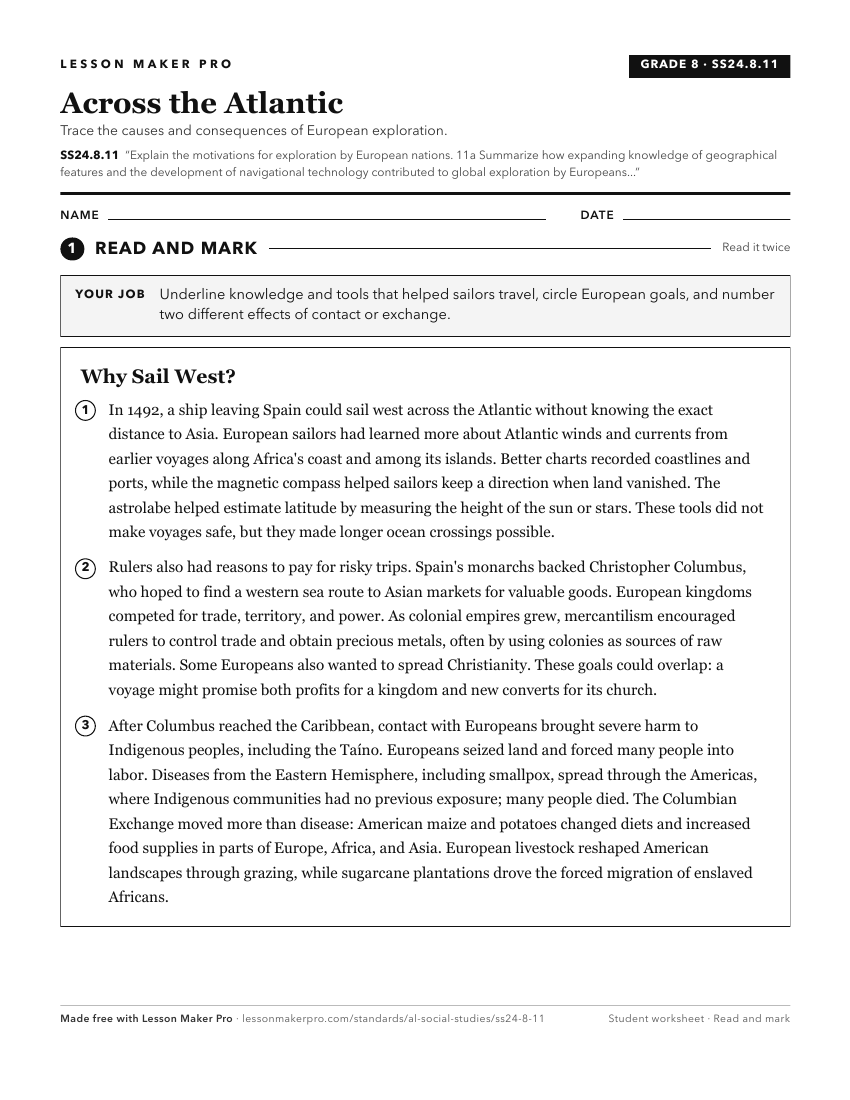
A ready-to-print activity worksheet aligned to SS24.8.11, with an answer key for the teacher on its own page. No account needed.
PDF, US Letter, prints cleanly in black and white.
Download the worksheetKeep exploring
Related Standards
- SS24.6.2b
Trace the routes of key European expeditions in North America and describe their effects on colonization in the New World.
- SS24.3.9
Explain reasons for European expeditions and the establishment of early settlements and colonies in North America during the sixteenth and seventeenth centuries...
Turn this cluster into a lesson
Grade, subject, topic, and the complete cluster are prefilled. Create one free, no account needed.
Also for this cluster:Make a WorksheetMake a QuizMake a Sub Lesson