Alabama Social Studies SS24.7.6
Standard Cluster
Explain how technological innovations and the geographic features of the Tigris and Euphrates Rivers contributed to the development of civilization in the Fertile Crescent. 6a Describe how agriculture, domestication of animals, inventions, irrigation, metalsmithing, and mining contributed to the settlement and growth of Mesopotamian civilizations. 6b Analyze how advancements in agriculture in Sumer led to economic growth, expansion of trade and transportation, and the emergence of independent city-states. 6c Summarize the cultural and political innovations of Mesopotamia, including The Epic of Gilgamesh and Hammurabi's Code.
2024 Alabama Course of Study: Social Studies
Cluster contents
Standards in This Cluster
SS24.7.6 is a cluster heading. These are the individual standards under it.
- SS24.7.6a
Describe how agriculture, domestication of animals, inventions, irrigation, metalsmithing, and mining contributed to the settlement and growth of Mesopotamian c...
- SS24.7.6b
Analyze how advancements in agriculture in Sumer led to economic growth, expansion of trade and transportation, and the emergence of independent city-states.
- SS24.7.6c
Summarize the cultural and political innovations of Mesopotamia, including The Epic of Gilgamesh and Hammurabi's Code.
Teacher's field guide
What This Cluster Means
What Students Need to Do
- Students use a map to explain why people settled near the Tigris and Euphrates and why they built canals. They trace how farming, domesticated animals, inventions, mining, and metalworking supported trade, transportation, and Sumerian city-states. They explain what Gilgamesh and Hammurabi's laws reveal about Mesopotamian beliefs and government.
What Mastery Looks Like
- Given a river map, a student identifies fertile land and explains how canals helped farmers manage dry periods. They connect extra crops and riverboats to trade, new jobs, and growing city-states. They distinguish Gilgamesh as a story about beliefs from Hammurabi's Code as laws showing a king's authority.
Common Misconceptions
- Students may think river floods always helped farmers, missing the damage that floods could cause. They may think canals created water rather than moved it to fields. Some confuse Gilgamesh, a story, with Hammurabi's Code, a collection of laws.
How to Assess It
- Give students a river map and ask: “Why did Sumerians build canals, how could extra grain lead to trade and city-states, and which tells us about laws, Gilgamesh or Hammurabi's Code?”
Lesson moves
Ways to Teach It
Build a sand-tray river with shallow canals; pour water slowly, then mark fields that get watered and fields a flood damages.
Read a short Gilgamesh excerpt and two laws from Hammurabi's Code; ask, “What does each source reveal about Mesopotamian life?”
Give pairs grain, sheep, plow, mine, copper tool, canal, and boat cards; have them build cause-and-effect chains ending in trade and city-states.
Show a photo of a modern irrigation canal; ask students to identify where the water comes from and which farms depend on it.
Free download
Printable SS24.7.6 Worksheet
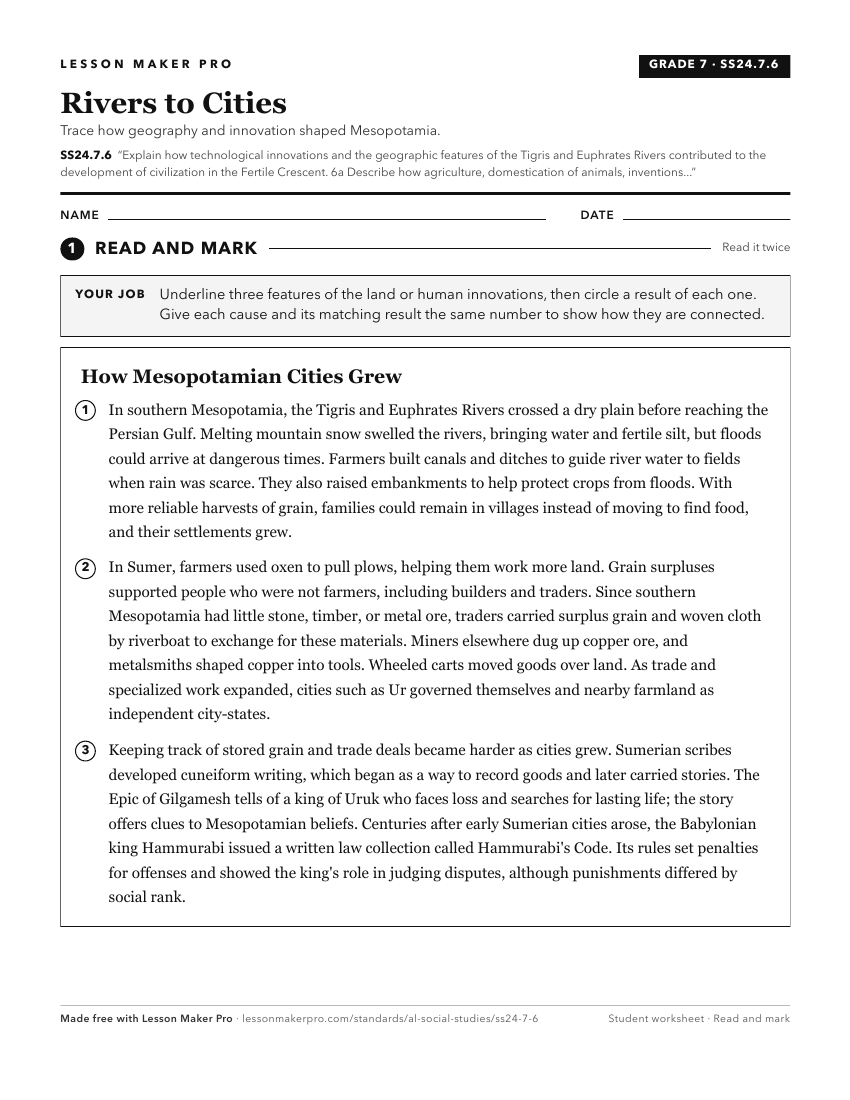
A ready-to-print activity worksheet aligned to SS24.7.6, with an answer key for the teacher on its own page. No account needed.
PDF, US Letter, prints cleanly in black and white.
Download the worksheetKeep exploring
Related Standards
Turn this cluster into a lesson
Grade, subject, topic, and the complete cluster are prefilled. Create one free, no account needed.
Also for this cluster:Make a WorksheetMake a QuizMake a Sub Lesson