Alabama Social Studies SS24.6.17
Standard Cluster
Explain key rights included in the Bill of Rights and provide examples of how citizens exercise these rights in today’s society. 17a Trace the origins of rights contained in the Bill of Rights to issues leading to the American Revolution and the concerns of colonists about unlimited government power. 17b Explain the significance of Marbury v. Madison (1803) in establishing judicial review by the Supreme Court. 17c Identify constitutional amendments that expanded political rights for citizens and describe the efforts of citizens to secure these rights.
2024 Alabama Course of Study: Social Studies
Cluster contents
Standards in This Cluster
SS24.6.17 is a cluster heading. These are the individual standards under it.
- SS24.6.17a
Trace the origins of rights contained in the Bill of Rights to issues leading to the American Revolution and the concerns of colonists about unlimited governmen...
- SS24.6.17b
Explain the significance of Marbury v. Madison (1803) in establishing judicial review by the Supreme Court.
- SS24.6.17c
Identify constitutional amendments that expanded political rights for citizens and describe the efforts of citizens to secure these rights.
Teacher's field guide
What This Cluster Means
What Students Need to Do
- Students explain rights such as free speech and protection from unreasonable searches using present-day examples. They connect colonial complaints about British searches and government power to the Bill of Rights. They explain judicial review and how citizens fought to expand voting rights.
What Mastery Looks Like
- A student can connect colonial searches to the Fourth Amendment and a peaceful rally to the First Amendment. They explain that Marbury v. Madison established the Supreme Court's power to strike down unconstitutional laws. They link later voting amendments to the groups and campaigns behind them.
Common Misconceptions
- Students may think free speech protects threats or that police need a warrant for every search. They may assume the Bill of Rights gave all adults the vote, or that the president decides whether laws are unconstitutional.
How to Assess It
- Exit ticket: Write four lines naming a colonial grievance and its matching right, a modern example of that right, what Marbury v. Madison established, and one voting amendment with an action citizens took to win it.
Lesson moves
Ways to Teach It
Give pairs cards for colonial general warrants, the Fourth Amendment, and modern search warrants; have them arrange and explain the connection.
Ask: If Congress passes a law that conflicts with the Constitution, what can the Supreme Court do after Marbury v. Madison?
Run a card match with the 15th, 19th, 24th, and 26th Amendments, affected voters, and citizen campaigns.
Show a city council public comment notice; have students draft a sentence asking for a safer crosswalk and name the right they used.
Free download
Printable SS24.6.17 Worksheet
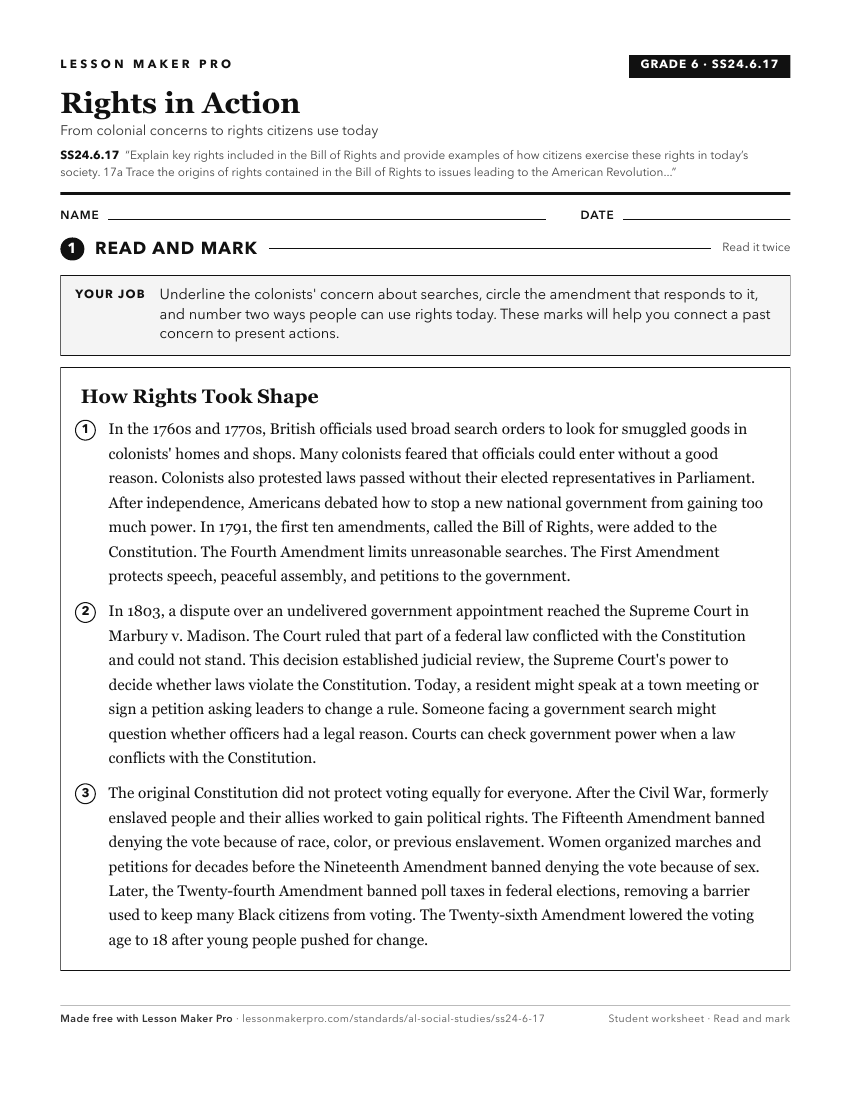
A ready-to-print activity worksheet aligned to SS24.6.17, with an answer key for the teacher on its own page. No account needed.
PDF, US Letter, prints cleanly in black and white.
Download the worksheetKeep exploring
Related Standards
- SS24.USG.12
Describe the rights and duties of citizens, including participation in the election process.
- SS24.4.7b
Explain why the Bill of Rights was added to the Constitution and how the amendment process allows changes to protect or expand rights.
- SS24.2.1
Explain how rights and responsibilities for citizens are part of the American system of government.
Turn this cluster into a lesson
Grade, subject, topic, and the complete cluster are prefilled. Create one free, no account needed.
Also for this cluster:Make a WorksheetMake a QuizMake a Sub Lesson