Alabama Social Studies SS24.4.17
Standard Cluster
Describe the social, political, and economic impacts of the conflicts, legislation, and treaties that led to the United States acquiring additional territory after the Civil War. 17a Explain how territorial expansion and the construction of the transcontinental railroad affected immigrants and Native Americans, including how it led to the loss of land in Indian Territory where Alabama tribes had been relocated. 17b Locate states admitted to and territories acquired by the United States between 1865 and 1900, and describe how these additional territories were acquired.
2024 Alabama Course of Study: Social Studies
Cluster contents
Standards in This Cluster
SS24.4.17 is a cluster heading. These are the individual standards under it.
- SS24.4.17a
Explain how territorial expansion and the construction of the transcontinental railroad affected immigrants and Native Americans, including how it led to the lo...
- SS24.4.17b
Locate states admitted to and territories acquired by the United States between 1865 and 1900, and describe how these additional territories were acquired.
Teacher's field guide
What This Cluster Means
What Students Need to Do
- Students locate new states and acquired territories on a map and explain how the United States gained each territory. They describe railroad jobs and discrimination faced by immigrants. They explain how settlement, treaties, and land laws reduced Native land and control, including in Indian Territory, where tribes from Alabama had been relocated.
What Mastery Looks Like
- Students identify Colorado as a new state, Alaska as a purchase, Hawaii as an annexation, and Puerto Rico as territory gained through a treaty after war. They explain that immigrants helped build railroads, while settlement and federal land laws reduced Muscogee (Creek) land and control in Indian Territory.
Common Misconceptions
- Students may think Oklahoma was a state by 1900 or that Alaska and Hawaii became states as soon as the United States acquired them. They may assume the railroad helped everyone equally or that Native nations freely gave up their land.
How to Assess It
- Give students a 1900 map with insets and ask them to label Colorado, Alaska, Puerto Rico, and Indian Territory. Then ask: “How was Alaska acquired, how was Puerto Rico acquired, and how did railroad expansion affect immigrant workers and Muscogee land?”
Lesson moves
Ways to Teach It
Give pairs a 1900 map and cards for Alaska's purchase, Colorado's statehood, Hawaii's annexation, and Muscogee land allotment; have them place each card.
Ask students to write: “Who gained land when rail lines reached Indian Territory, and what did Muscogee families lose?”
Play acquisition match: students pair Alaska with purchase, Hawaii with annexation, Puerto Rico with the 1898 treaty, and Colorado with statehood.
Use the Muscogee (Creek) Nation website to locate its capital, Okmulgee, then find the nation's ancestral homeland in Alabama on a map.
Free download
Printable SS24.4.17 Worksheet
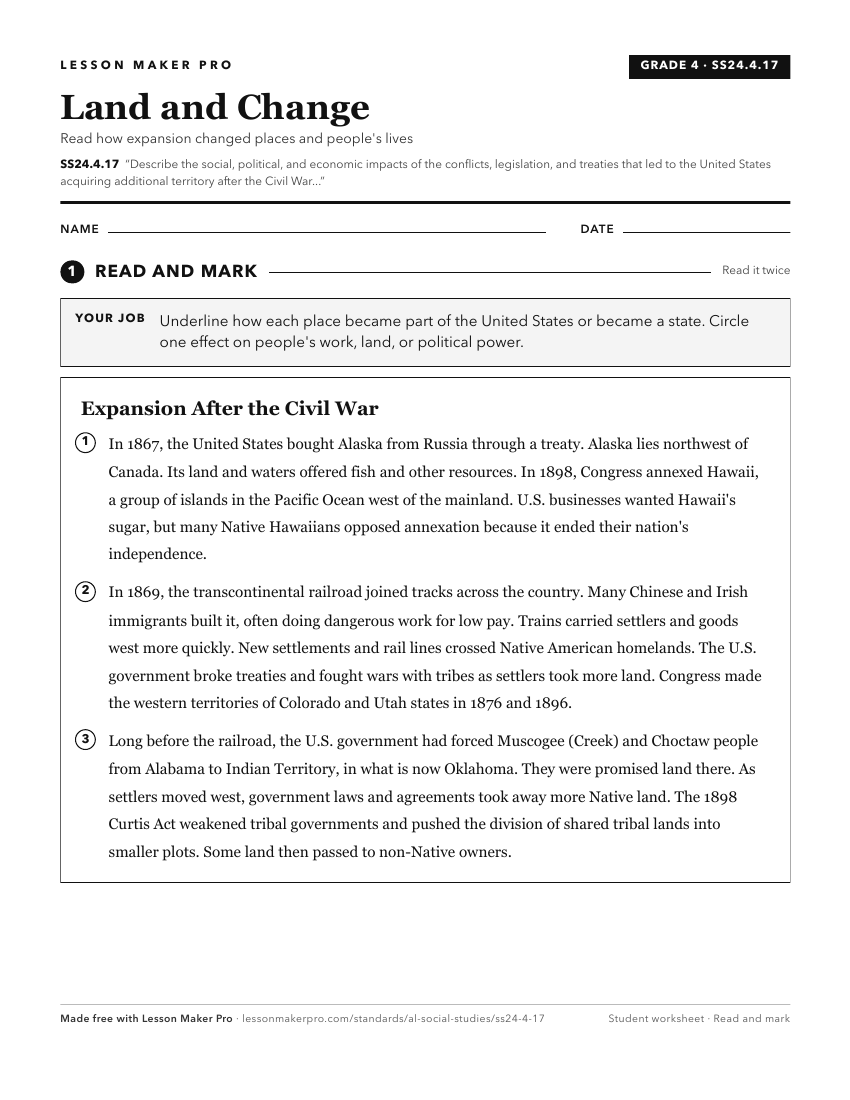
A ready-to-print activity worksheet aligned to SS24.4.17, with an answer key for the teacher on its own page. No account needed.
PDF, US Letter, prints cleanly in black and white.
Download the worksheetKeep exploring
Related Standards
- SS24.4.11
Describe events and factors that led to the United States' expansion prior to the Civil War, including conflicts, technological developments, trails, and the Go...
- SS24.US1.5a
Describe how the Treaty of Paris of 1783, Northwest Ordinance of 1785, Northwest Ordinance of 1787, and the Louisiana Purchase affected American territorial exp...
- SS24.US2.1b
Describe the consequences of the Spanish-American War, including the United States’ rise to global prominence, debate over territorial expansion, and military i...
Turn this cluster into a lesson
Grade, subject, topic, and the complete cluster are prefilled. Create one free, no account needed.
Also for this cluster:Make a WorksheetMake a QuizMake a Sub Lesson