Alabama Social Studies SS24.4.15
Standard Cluster
Identify major events of Reconstruction and evaluate the outcomes of Reconstruction policies. 15a Explain political changes in Alabama during Reconstruction, including new state constitutions, Black Codes, changes in political parties, voting rights, and citizenship rights for Black Americans. 15b Describe the effects of Reconstruction on education and social institutions in Alabama. 15c Explain how Africatown was established, describing the challenges its founders overcame and the ways they built community. 15d Recount the contributions of Alabamians who helped shape their state during Reconstruction.
2024 Alabama Course of Study: Social Studies
Cluster contents
Standards in This Cluster
SS24.4.15 is a cluster heading. These are the individual standards under it.
- SS24.4.15a
Explain political changes in Alabama during Reconstruction, including new state constitutions, Black Codes, changes in political parties, voting rights, and cit...
- SS24.4.15b
Describe the effects of Reconstruction on education and social institutions in Alabama.
- SS24.4.15c
Explain how Africatown was established, describing the challenges its founders overcame and the ways they built community.
- SS24.4.15d
Recount the contributions of Alabamians who helped shape their state during Reconstruction.
Teacher's field guide
What This Cluster Means
What Students Need to Do
- Students put major Reconstruction events in order and explain how Alabama's laws changed voting, citizenship, political parties, and schools. They describe how Africatown's founders bought land and built a community. They explain what Alabamians such as Benjamin Turner did during this period.
What Mastery Looks Like
- A student can explain that Black Codes restricted freedom, while federal amendments protected citizenship and Black men's voting rights. They can compare the 1868 constitution's school provisions with the 1875 constitution's requirement for separate schools. They can name Benjamin Turner as a congressman and Cudjo Lewis as an Africatown founder.
Common Misconceptions
- Students may think citizenship meant Black Alabamians were treated equally, or that the Fifteenth Amendment gave women voting rights. They may think Africatown's land was given to its founders rather than purchased by them.
How to Assess It
- Exit ticket: Name one policy that expanded Black men's voting rights, one law that restricted Black Alabamians' freedom, and one way Africatown's founders built community.
Lesson moves
Ways to Teach It
Give pairs dated cards for the Black Codes, 1868 constitution, Fifteenth Amendment, and 1875 constitution; have them build a timeline and label each effect.
Ask partners: What did Alabama's 1868 school rule offer, and what did its 1875 school rule require? Use two dated fact cards.
Play a matching round with cards for Benjamin Turner, Cudjo Lewis, and Alabama's 1868 and 1875 constitutions, pairing each with an action or effect.
Find Africatown and Mobile on a state map, then write why the founders stayed nearby when they could not afford to return to Africa.
Free download
Printable SS24.4.15 Worksheet
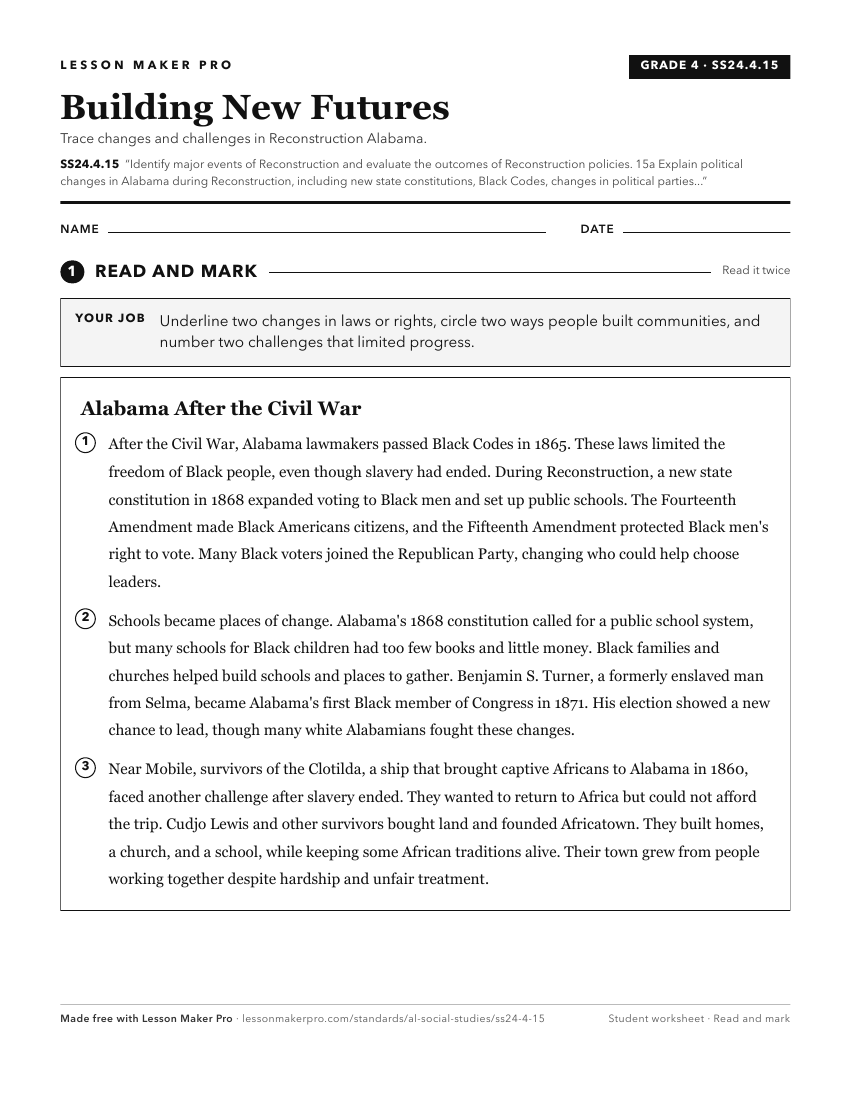
A ready-to-print activity worksheet aligned to SS24.4.15, with an answer key for the teacher on its own page. No account needed.
PDF, US Letter, prints cleanly in black and white.
Download the worksheetKeep exploring
Related Standards
- SS24.US1.13b
Compare congressional and presidential Reconstruction plans, including the legislation and constitutional amendments each plan proposed and passed.
- SS24.US1.13e
Develop an argument regarding how national and regional events and trends brought Reconstruction to an end.
- SS24.US1.13
Evaluate how Reconstruction affected the economic, political, and social landscape of the South.
Turn this cluster into a lesson
Grade, subject, topic, and the complete cluster are prefilled. Create one free, no account needed.
Also for this cluster:Make a WorksheetMake a QuizMake a Sub Lesson