Alabama Science P.6.a
The Standard
- P.6
- Obtain, evaluate, and communicate information concerning static and current electricity.
Develop and use a model to describe the mathematical relationship among charge, distance, and force as expressed by Coulomb’s law.
2023 Alabama Course of Study: Science · Energy
Teacher's field guide
What This Standard Means
What Students Need to Do
- Students draw a model of two charged objects and label the charges, distance, and force. They use Coulomb’s law to predict force size. They use the charge signs to predict attraction or repulsion.
What Mastery Looks Like
- Given two charges and a distance, students calculate the force or how it changes when a charge or the distance changes. Their model shows force acting along the line between the charges, with the correct direction for attraction or repulsion.
Common Misconceptions
- Students may think doubling the distance cuts the force in half, rather than to one-fourth. They may treat a negative charge as a weaker charge instead of using its sign to determine direction.
How to Assess It
- Exit ticket: Two +1 charge cards start 2 cm apart; one charge doubles and the gap doubles. Find the new force as a fraction of the old, state whether the cards attract or repel, and show your work.
Lesson moves
Ways to Teach It
Move +1, +2, and −1 charge cards on a grid, then calculate relative force for gaps of 1 and 2 squares.
Write a note explaining why doubling the distance cuts the force to one-fourth, using a sketch and the equation.
Play a matching game with charge pairs, distances, and force ratios; calculate each ratio before claiming a match.
Sketch charged toner near an oppositely charged printer drum, then calculate how doubling the gap changes their attraction.
Free download
Printable P.6.a Worksheet
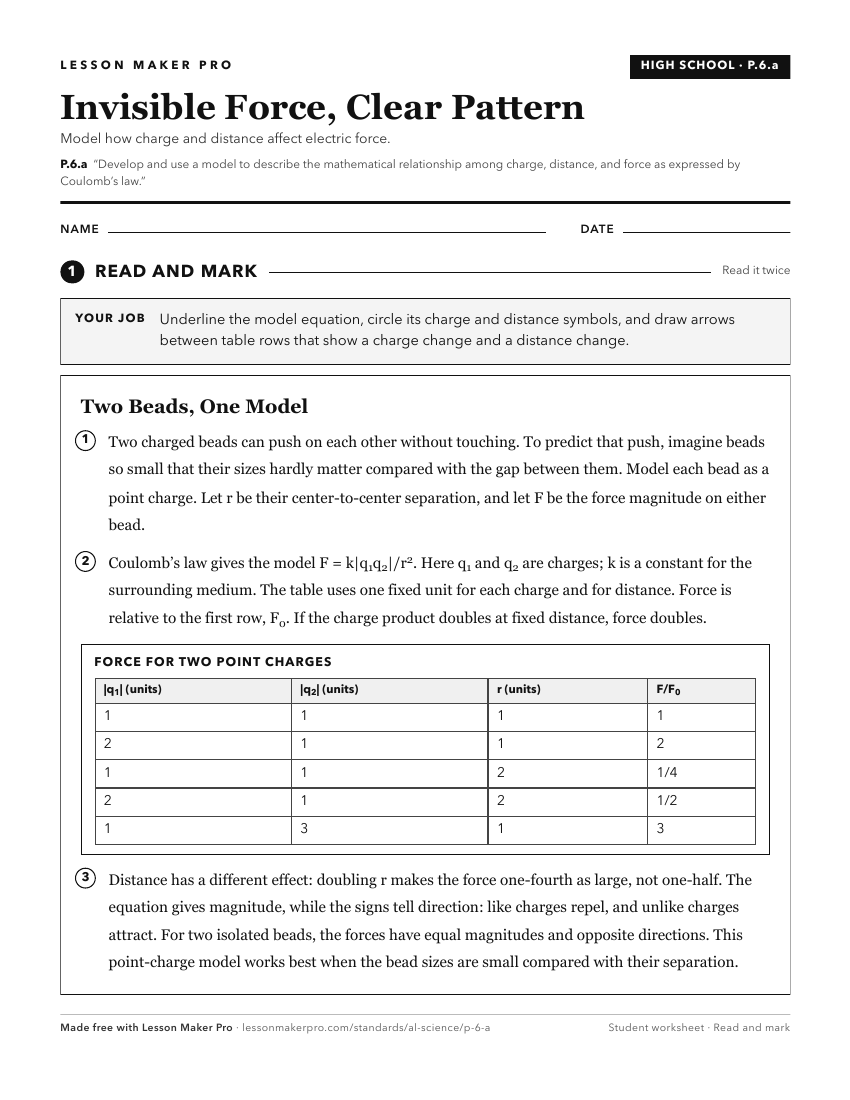
A ready-to-print activity worksheet aligned to P.6.a, with an answer key for the teacher on its own page. No account needed.
PDF, US Letter, prints cleanly in black and white.
Download the worksheetKeep exploring
Related Standards
- P.5.b
Develop and use a model to describe the mathematical relationship between mass, distance, and force as expressed by Newton’s law of universal gravitation.
- 8.12
Use a model to identify factors affecting the strength of noncontact forces, including magnetic, gravitational, and electrical forces, and demonstrate that fiel...
- PS.3.d
Develop and use models to determine the relationships among voltage, current, and resistance at specific loads in series and parallel circuits.
- 8.16
Develop and use a model to construct an explanation of how electrical energy is transferred and transformed.
Turn this exact standard into a lesson
Grade, subject, topic, and the complete standard are prefilled. Create one free, no account needed.
Also for this standard:Make a WorksheetMake a QuizMake a Sub Lesson