Alabama Science ESS.4.a
The Standard
- ESS.4
- Obtain, evaluate, and communicate information about the geologic conditions and processes that form different Earth materials.
Plan and carry out investigations to explore the processes that form plutonic (intrusive) and volcanic (extrusive) igneous rocks of differing compositions and textures.
2023 Alabama Course of Study: Science
Teacher's field guide
What This Standard Means
What Students Need to Do
- Students plan and run a cooling test, then compare its crystals with igneous rock samples. They use crystal size, gas holes, and mineral makeup to explain where and how the rocks formed.
What Mastery Looks Like
- A student can explain why slow cooling underground makes large crystals, while rapid cooling at the surface makes tiny crystals or glass. They can group granite with rhyolite and gabbro with basalt by composition, even though each pair has different crystal sizes.
Common Misconceptions
- Students may think large crystals mean a rock has more silica, rather than that it cooled slowly. They may assume every volcanic rock is glassy or mistake gas holes for crystals.
How to Assess It
- Exit ticket: Granite and rhyolite are both silica-rich. Granite has large crystals, while rhyolite has tiny crystals. Which formed underground, and what explains the difference?
Lesson moves
Ways to Teach It
Give pairs two equal cups of warm, saturated alum solution; have them cool one in ice and one at room temperature, then measure crystals tomorrow.
Show photos of granite, rhyolite, gabbro, and basalt; ask which pairs share a composition but differ in crystal size, and why.
Give teams unlabeled granite, gabbro, basalt, and rhyolite samples plus a mineral key; have them sort by composition and crystal size.
Show photos of a granite quarry and a basalt lava flow; have students predict which rock has larger crystals and explain why.
Free download
Printable ESS.4.a Worksheet
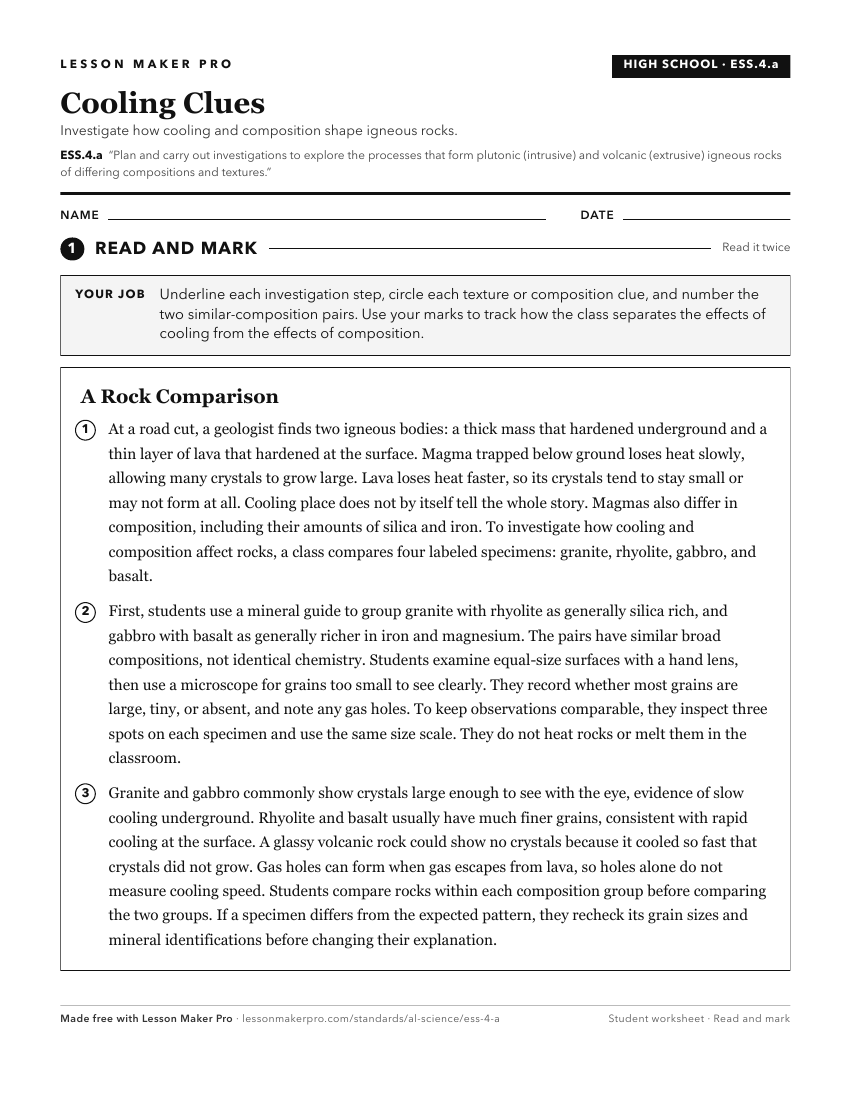
A ready-to-print activity worksheet aligned to ESS.4.a, with an answer key for the teacher on its own page. No account needed.
PDF, US Letter, prints cleanly in black and white.
Download the worksheetKeep exploring
Related Standards
- ESS.4.c
Construct an explanation using evidence from experiments, models, or data of the processes that create and transform igneous, sedimentary, and metamorphic rocks...
- 2.1
Plan and carry out investigations to compare, contrast, and classify various solid and liquid materials according to physical properties, including color and te...
- ESS.4
Obtain, evaluate, and communicate information about the geologic conditions and processes that form different Earth materials.
- PS.5.a
Carry out investigations and use results to compare and contrast the physical and chemical properties of matter.
Turn this exact standard into a lesson
Grade, subject, topic, and the complete standard are prefilled. Create one free, no account needed.
Also for this standard:Make a WorksheetMake a QuizMake a Sub Lesson