Alabama Science ES.5
The Standard
Obtain, evaluate, and communicate information regarding how short-term and long-term natural cyclic fluctuations cause ecosystem change.
2023 Alabama Course of Study: Science · Earth’s Systems
Teacher's field guide
What This Standard Means
What Students Need to Do
- Students use records to spot repeating changes, from seasonal rainfall to ice age cycles. They check where the data came from and explain how those changes affect habitats and species numbers.
What Mastery Looks Like
- Given dated rainfall and ice-cover graphs, students identify each cycle's time scale and describe a likely habitat change. They cite graph evidence and check whether the source explains how it collected the data.
Common Misconceptions
- Students may treat one unusual year as proof of a cycle. They may also assume cycles repeat on an exact schedule or that the same species return after every change.
How to Assess It
- Exit ticket: A pond's spring and fall depths over three years are 30/10, 28/9, and 31/11 cm. Describe the pattern, predict one effect on frogs, and name one source detail you would check before trusting the numbers.
Lesson moves
Ways to Teach It
Give pairs four season cards with rainfall of 4, 8, 2, 5 cm and frog counts of 3, 12, 4, 6; graph both.
Compare the pond graph with a glacial-period ice map and a present-day map; write how the time scales and habitat changes differ.
Play Cycle or Not with rainfall cards showing 8, 2, 9, 3, 8, 2 and 8, 2, 5, 1, 7, 4; defend each choice.
Check dated spring and fall bird sightings for a nearby park on eBird; discuss how seasonal habitat changes might explain the pattern.
Free download
Printable ES.5 Worksheet
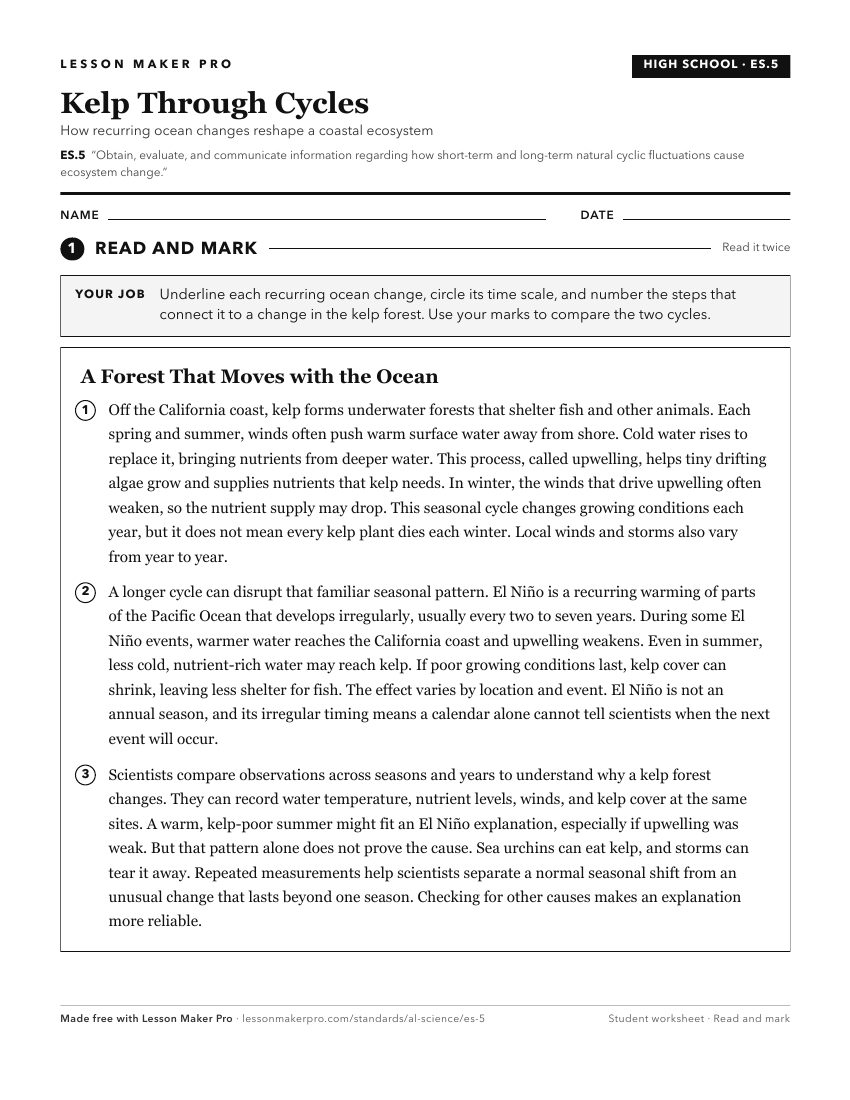
A ready-to-print activity worksheet aligned to ES.5, with an answer key for the teacher on its own page. No account needed.
PDF, US Letter, prints cleanly in black and white.
Download the worksheetKeep exploring
Related Standards
- ES.9
Obtain, evaluate, and communicate information based on evidence to explain how key natural resources, natural hazards, and climate variability influence human a...
- ES.2
Obtain, evaluate, and communicate information to model the cycling of matter through the biosphere, atmosphere, hydrosphere, and geosphere, including the flow o...
- ES.12
Obtain, evaluate, and communicate information to describe the effects of human population growth on global ecosystems.
- 6.11
Obtain, evaluate, and communicate information concerning the relationships between human activities and natural processes and how those relationships affect Ear...
Turn this exact standard into a lesson
Grade, subject, topic, and the complete standard are prefilled. Create one free, no account needed.
Also for this standard:Make a WorksheetMake a QuizMake a Sub Lesson