Alabama Science ES.2
The Standard
Obtain, evaluate, and communicate information to model the cycling of matter through the biosphere, atmosphere, hydrosphere, and geosphere, including the flow of carbon, water, nitrogen, phosphorus, and sulfur.
2023 Alabama Course of Study: Science · Ecosystems: Interactions, Energy, and Dynamics
Teacher's field guide
What This Standard Means
What Students Need to Do
- Students use diagrams and short readings to track carbon, water, nitrogen, phosphorus, and sulfur through living things, air, water, and rock or soil. They check claims against sources and draw models with arrows labeled by processes such as evaporation, nitrogen fixation, and weathering.
What Mastery Looks Like
- A student can show where each substance is stored and label how it moves between reservoirs. They can explain why phosphorus has no major gas phase and correct an inaccurate cycle diagram using evidence.
Common Misconceptions
- Students may draw every cycle as the same loop, with each substance passing through every sphere in the same order. Some show phosphorus moving through the air as a gas or assume plants can use nitrogen gas directly.
How to Assess It
- Give students a four-sphere diagram. Ask them to draw one labeled transfer for each of the five substances and explain why phosphorus does not have a major gas phase.
Lesson moves
Ways to Teach It
Set out four sphere mats and have students move carbon, water, nitrogen, phosphorus, and sulfur cards between them using labeled process arrows.
Give students a diagram that wrongly shows phosphorus gas, then have them use a textbook diagram to write a correction.
Play a card match pairing reservoirs with processes such as photosynthesis, evaporation, nitrogen fixation, and rock weathering; require an explanation for each pair.
Use a local watershed map and a fertilizer label to trace nitrogen and phosphorus from lawns through runoff into streams.
Free download
Printable ES.2 Worksheet
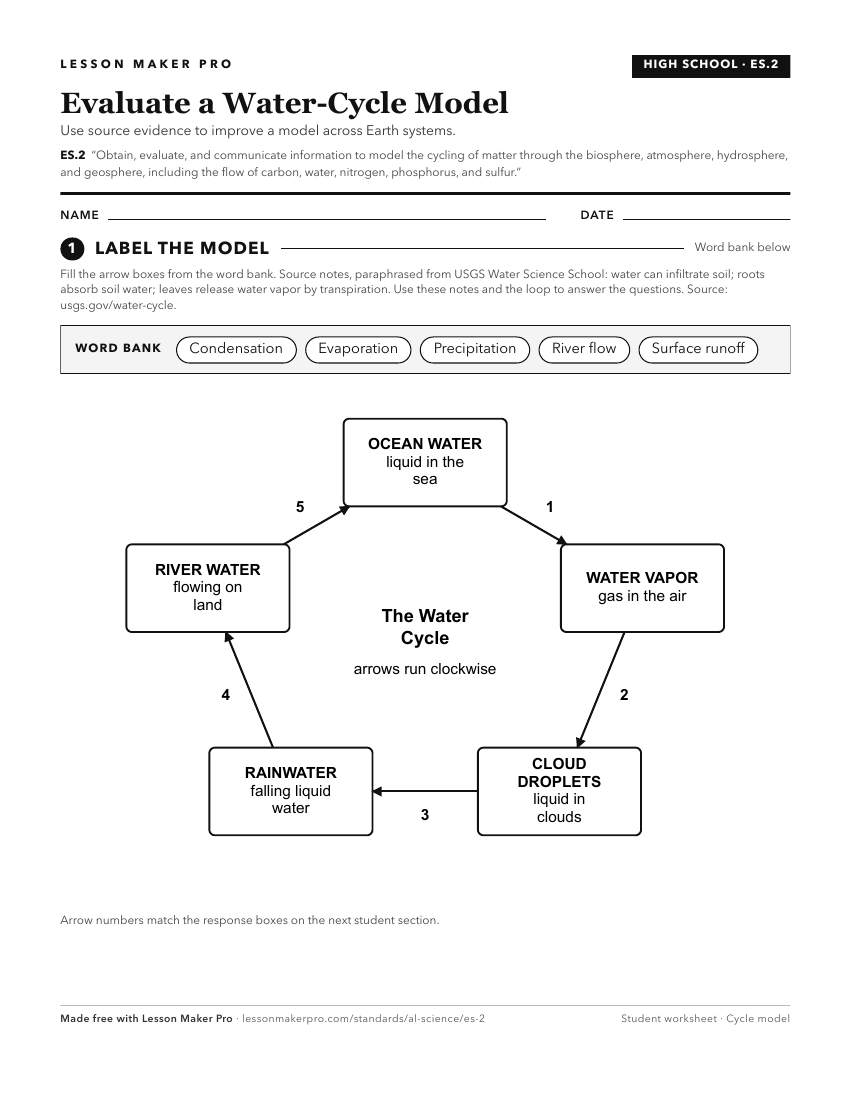
A ready-to-print activity worksheet aligned to ES.2, with an answer key for the teacher on its own page. No account needed.
PDF, US Letter, prints cleanly in black and white.
Download the worksheetKeep exploring
Related Standards
- 7.5
Construct an explanation of how the cycling of matter between abiotic and biotic parts of ecosystems demonstrates the flow of energy and the conservation of mat...
- 6.11
Obtain, evaluate, and communicate information concerning the relationships between human activities and natural processes and how those relationships affect Ear...
- 5.12
Use a model to represent how any two of Earth's systems (atmosphere, biosphere, geosphere, and hydrosphere) interact and support life.
- ES.5
Obtain, evaluate, and communicate information regarding how short-term and long-term natural cyclic fluctuations cause ecosystem change.
Turn this exact standard into a lesson
Grade, subject, topic, and the complete standard are prefilled. Create one free, no account needed.
Also for this standard:Make a WorksheetMake a QuizMake a Sub Lesson