Alabama Science ES.11.b
The Standard
- ES.11
- Construct an explanation of how human populations undergo growth and decline.
Construct explanations of the types of environmental impacts produced by human populations in each stage of the demographic transition model.
2023 Alabama Course of Study: Science · Earth and Human Activity
Teacher's field guide
What This Standard Means
What Students Need to Do
- Students use birth rates, death rates, and population growth to identify stages of demographic change. They explain how land use, water demand, pollution, and resource use may change at each stage.
What Mastery Looks Like
- Students can link rapid population growth to pressure on farmland and water, and high consumption per person to greater waste and emissions. They can explain why a shrinking population does not guarantee less pollution.
Common Misconceptions
- Students may assume the fastest-growing population always produces the most emissions. They may also think falling birth rates quickly reduce resource use, or that every country follows the same pattern.
How to Assess It
- Give students this exit ticket: Place A has high birth rates, falling death rates, and low energy use per person. Place B has low birth and death rates and high energy use per person. Identify each place’s stage, predict one environmental impact for each, and explain which may have higher emissions per person.
Lesson moves
Ways to Teach It
Give groups people counters and resource tokens; change either population or tokens per person, then compare total resource demand.
Ask, “Could a country with slower population growth still produce more pollution?” Have students support their answer with population and consumption data.
Hand out stage cards with birth and death trends and impact cards; students match pairs and explain one link aloud.
Open World Bank birth rate, death rate, and carbon emissions per person charts for two countries; students compare demographic patterns with emissions.
Free download
Printable ES.11.b Worksheet
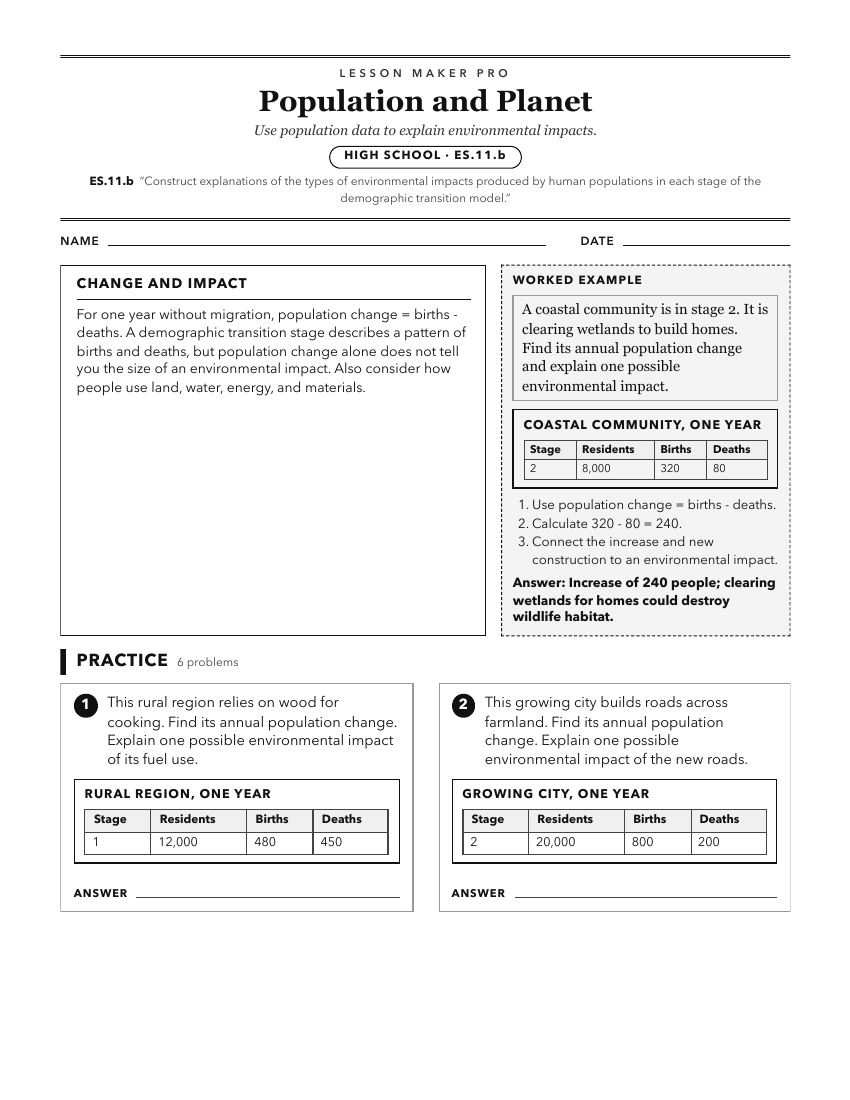
A ready-to-print activity worksheet aligned to ES.11.b, with an answer key for the teacher on its own page. No account needed.
PDF, US Letter, prints cleanly in black and white.
Download the worksheetKeep exploring
Related Standards
- ES.11
Construct an explanation of how human populations undergo growth and decline.
- ES.12.b
Evaluate and communicate information describing the effects of urbanization on the environment.
- ES.12
Obtain, evaluate, and communicate information to describe the effects of human population growth on global ecosystems.
- ES.11.a
Analyze and interpret data on human population trends in developing and developed countries and in the global population as a whole.
Turn this exact standard into a lesson
Grade, subject, topic, and the complete standard are prefilled. Create one free, no account needed.
Also for this standard:Make a WorksheetMake a QuizMake a Sub Lesson