Alabama Science CHE.6.c
The Standard
- CHE.6
- Make qualitative and quantitative claims, based on ion concentration, about the acidic, basic, or neutral characteristics of a solution.
Use multiple models to predict the relative properties of strong, weak, concentrated, and dilute acids and bases.
2023 Alabama Course of Study: Science · Matter and Its Interactions
Teacher's field guide
What This Standard Means
What Students Need to Do
- Students use particle diagrams and pH or conductivity data to predict how acids and bases behave. They separate strength, which describes how much dissociates, from concentration, which describes how much is dissolved.
What Mastery Looks Like
- At equal concentrations, a student predicts that hydrochloric acid has a lower pH and higher conductivity than acetic acid. They draw more ions in the hydrochloric acid sample to explain why. They know strength alone cannot settle every comparison when concentrations differ.
Common Misconceptions
- Students often treat strong as concentrated and weak as dilute. They may assume a strong acid always has a lower pH than a weak acid, regardless of concentration. They may draw a weak acid with no ions at all.
How to Assess It
- Exit ticket: Draw particle diagrams for 0.10 M hydrochloric acid and 0.10 M acetic acid. Predict which has lower pH and higher conductivity, then explain why.
Lesson moves
Ways to Teach It
Test vinegar, diluted vinegar, baking soda solution, and diluted baking soda solution with pH paper, then record the readings.
Show two equal-concentration acid particle diagrams and ask, "Which acid is stronger, and which particles support your answer?"
Give teams acid and base cards with strength and concentration values; have them match particle diagrams and flag pH comparisons needing more data.
Compare a vinegar label marked 5% acidity with a diluted vinegar recipe; explain what changes and what stays the same.
Free download
Printable CHE.6.c Worksheet
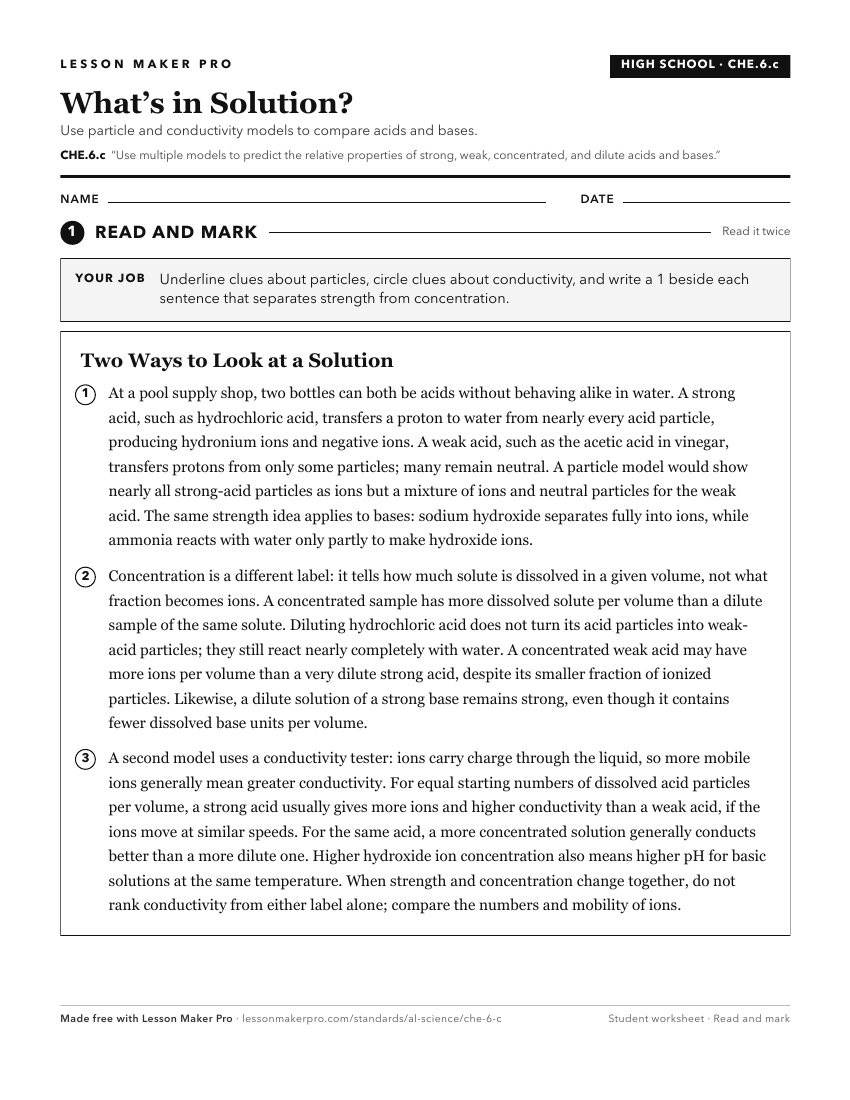
A ready-to-print activity worksheet aligned to CHE.6.c, with an answer key for the teacher on its own page. No account needed.
PDF, US Letter, prints cleanly in black and white.
Download the worksheetKeep exploring
Related Standards
- PS.6.c
Analyze and interpret data from experiments to determine whether solutions are acidic, basic, or neutral to predict properties of the solutions.
- CHE.6.a
Obtain, evaluate, and communicate information concerning the properties of acids and bases.
- CHE.6.e
Plan and carry out a strong acid-strong base titration to determine the concentration of an unknown acidic or basic solution.
- CHE.3
Develop and use multiple types of models to represent chemical reactions.
Turn this exact standard into a lesson
Grade, subject, topic, and the complete standard are prefilled. Create one free, no account needed.
Also for this standard:Make a WorksheetMake a QuizMake a Sub Lesson