Alabama Science BIO.5.c
The Standard
- BIO.5
- Plan and carry out investigations and utilize results to explain the role and cycling of products and reactants involved in the cellular conversion of energy.
Use models of the reactants and products of cellular respiration (both aerobic and anaerobic) to illustrate how chemical energy is stored in the bonds of carbohydrates and lipids and converted to ATP and heat when the bonds are broken.
2023 Alabama Course of Study: Science
Teacher's field guide
What This Standard Means
What Students Need to Do
- Students model glucose becoming carbon dioxide and water with oxygen, or lactate without oxygen. They show how cells use the net energy change to make ATP, with some energy leaving as heat. They also show how fatty acids fuel ATP production when oxygen is available.
What Mastery Looks Like
- A student labels the reactants, products, ATP, and heat on an aerobic respiration model. They show that muscle cells make less ATP from glucose when oxygen is scarce and lactate forms. They place fatty acids in an oxygen-using pathway, not the lactate pathway.
Common Misconceptions
- Some students put oxygen into lactate fermentation or give it the same ATP yield as aerobic respiration. Others think breaking bonds alone releases energy, but breaking bonds takes energy. Forming new bonds in the products gives a net release.
How to Assess It
- Exit ticket: Complete three arrow models, glucose with oxygen, glucose without oxygen in a muscle cell, and fatty acids with oxygen. Label the products, relative ATP yield, and heat.
Lesson moves
Ways to Teach It
Give groups molecule cards for glucose, oxygen, carbon dioxide, and water; have them balance the reaction and add ATP and heat arrows.
Ask, “Why does a muscle cell make less ATP from glucose when oxygen runs low?” Have students defend answers with two reaction sketches.
Give pairs duplicate molecule cards to sort into glucose oxidation, lactate fermentation, and fatty acid oxidation; have them explain each match.
Compare a 30-second sprint with a 30-minute jog; students annotate oxygen use and likely fuel sources on two muscle diagrams.
Free download
Printable BIO.5.c Worksheet
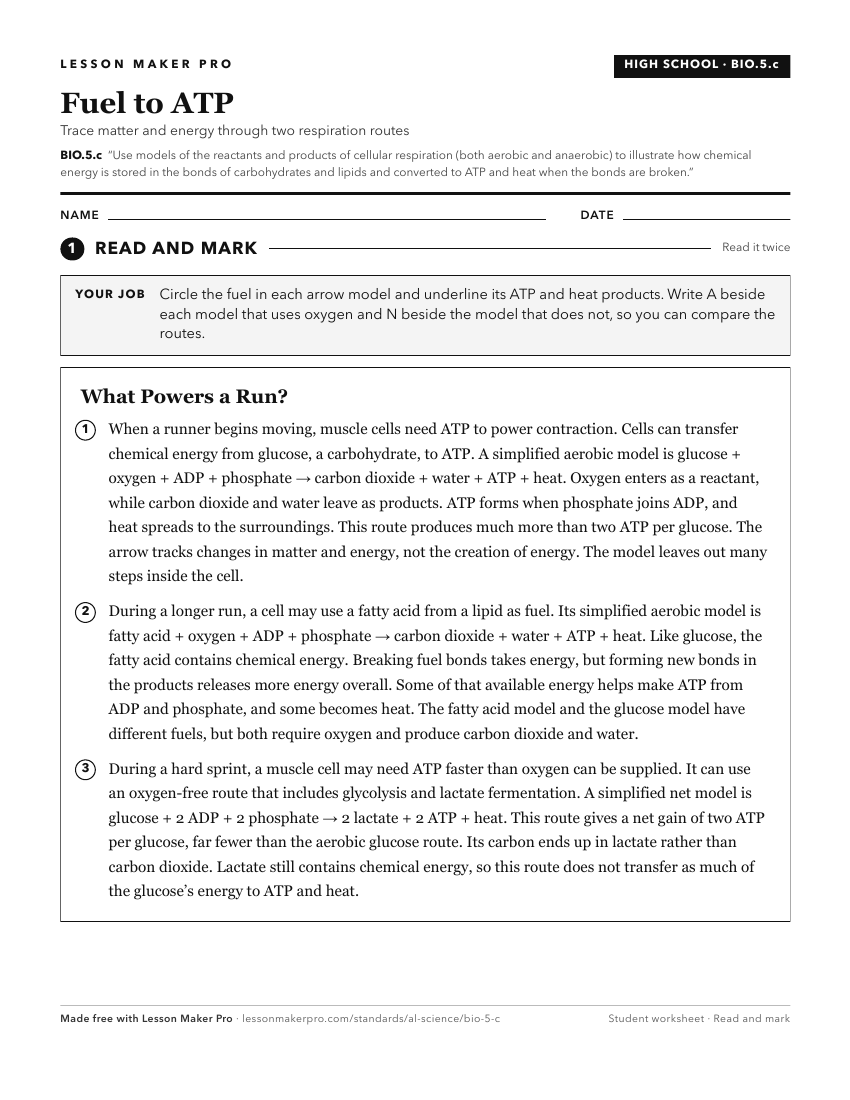
A ready-to-print activity worksheet aligned to BIO.5.c, with an answer key for the teacher on its own page. No account needed.
PDF, US Letter, prints cleanly in black and white.
Download the worksheetKeep exploring
Related Standards
- BIO.5.b
Use models of the reactants and products of photosynthesis to illustrate the conversion of light energy into stored chemical energy within cells.
- 7.2
Construct an explanation of how photosynthesis and cellular respiration cycle matter and establish the flow of energy into and out of an organism.
- BIO.5
Plan and carry out investigations and utilize results to explain the role and cycling of products and reactants involved in the cellular conversion of energy.
- BIO.5.a
Construct an explanation of how the structural characteristics of carbohydrates and lipids store energy.
Turn this exact standard into a lesson
Grade, subject, topic, and the complete standard are prefilled. Create one free, no account needed.
Also for this standard:Make a WorksheetMake a QuizMake a Sub Lesson