Alabama Science BIO.5.a
The Standard
- BIO.5
- Plan and carry out investigations and utilize results to explain the role and cycling of products and reactants involved in the cellular conversion of energy.
Construct an explanation of how the structural characteristics of carbohydrates and lipids store energy.
2023 Alabama Course of Study: Science
Teacher's field guide
What This Standard Means
What Students Need to Do
- Students use molecular diagrams to explain how carbohydrates and lipids can supply energy to cells. They compare sugar units with the long carbon and hydrogen chains found in many lipids.
What Mastery Looks Like
- A student can point out sugar units in a carbohydrate and fatty acid chains in a lipid. They can explain that both release usable energy when oxidized, while lipids yield more energy per gram because they contain more carbon and hydrogen relative to oxygen.
Common Misconceptions
- Students may say that breaking bonds alone releases energy. Breaking bonds takes energy; the overall reaction releases energy when new bonds form. Students may also think carbohydrates and lipids yield the same energy per gram.
How to Assess It
- Show a glucose diagram and a triglyceride diagram. Ask students to label the sugar unit and fatty acid chains, then explain which molecule yields more energy per gram when oxidized and why.
Lesson moves
Ways to Teach It
Use colored paper atoms to build glucose and a fatty acid chain, then mark carbon-hydrogen bonds and oxygen atoms.
Display glucose and triglyceride diagrams; ask, 'What features help explain why the triglyceride yields more energy per gram?'
Give pairs diagram cards of glucose, starch, triglyceride, and phospholipid; have them sort by sugar units or fatty acid chains and justify.
Hand out a chart showing 4 Calories per gram for carbohydrates and 9 for fats; have students explain the difference with molecular sketches.
Free download
Printable BIO.5.a Worksheet
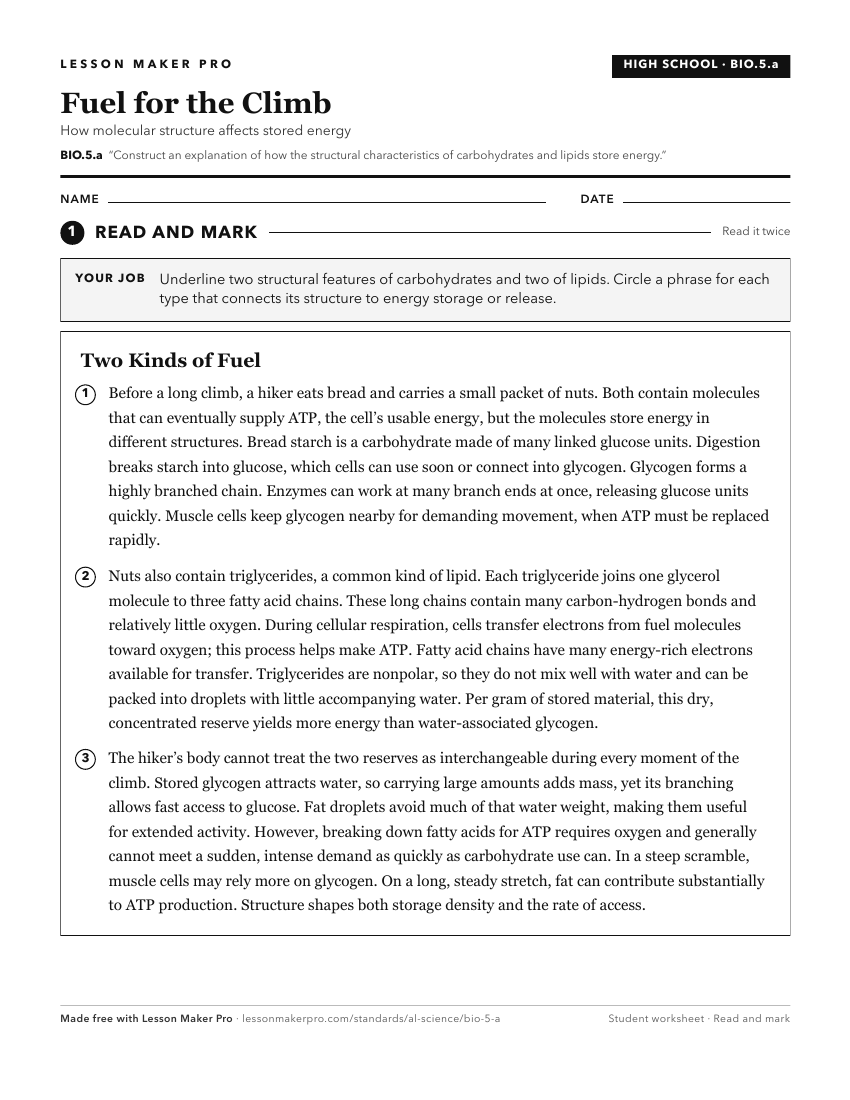
A ready-to-print activity worksheet aligned to BIO.5.a, with an answer key for the teacher on its own page. No account needed.
PDF, US Letter, prints cleanly in black and white.
Download the worksheetKeep exploring
Related Standards
- BIO.4.a
Use models to illustrate how the structural characteristics of lipids and proteins in the cell membrane regulate cellular processes.
- BIO.5.c
Use models of the reactants and products of cellular respiration (both aerobic and anaerobic) to illustrate how chemical energy is stored in the bonds of carboh...
- 7.2
Construct an explanation of how photosynthesis and cellular respiration cycle matter and establish the flow of energy into and out of an organism.
- BIO.5.b
Use models of the reactants and products of photosynthesis to illustrate the conversion of light energy into stored chemical energy within cells.
Turn this exact standard into a lesson
Grade, subject, topic, and the complete standard are prefilled. Create one free, no account needed.
Also for this standard:Make a WorksheetMake a QuizMake a Sub Lesson