Alabama Science 1.3
The Standard
Plan and carry out investigations to determine how light is affected when it interacts with various types of materials.
2023 Alabama Course of Study: Science · Waves and Their Applications in Technologies for Information Transfer
Teacher's field guide
What This Standard Means
What Students Need to Do
- Students plan a flashlight test and keep the light the same distance from each material. They observe whether light passes through, partly passes through, bounces off, or is blocked.
What Mastery Looks Like
- A student tests clear plastic, wax paper, cardboard, and a mirror using the same setup. They draw where the light goes and use their drawings to explain how the materials differ.
Common Misconceptions
- Students may think a mirror lets light through because it looks bright. They may think wax paper blocks all light because they cannot see clearly through it.
How to Assess It
- Give pairs a flashlight, wax paper, cardboard, and white paper. Ask them to choose one flashlight distance, test both materials, and draw the light they see on the white paper.
Lesson moves
Ways to Teach It
Have pairs test clear plastic, wax paper, cardboard, and a mirror with one flashlight, then draw where light appears.
Ask, "Why can you see light through wax paper but not cardboard?" Have students use their test drawings to explain.
Play a sorting game with picture cards showing light hitting a window, wax paper, cardboard, or mirror; sort by what light does.
Show photos of a clear classroom window and a frosted bathroom window; ask which gives privacy while still letting light in.
Free download
Printable 1.3 Worksheet
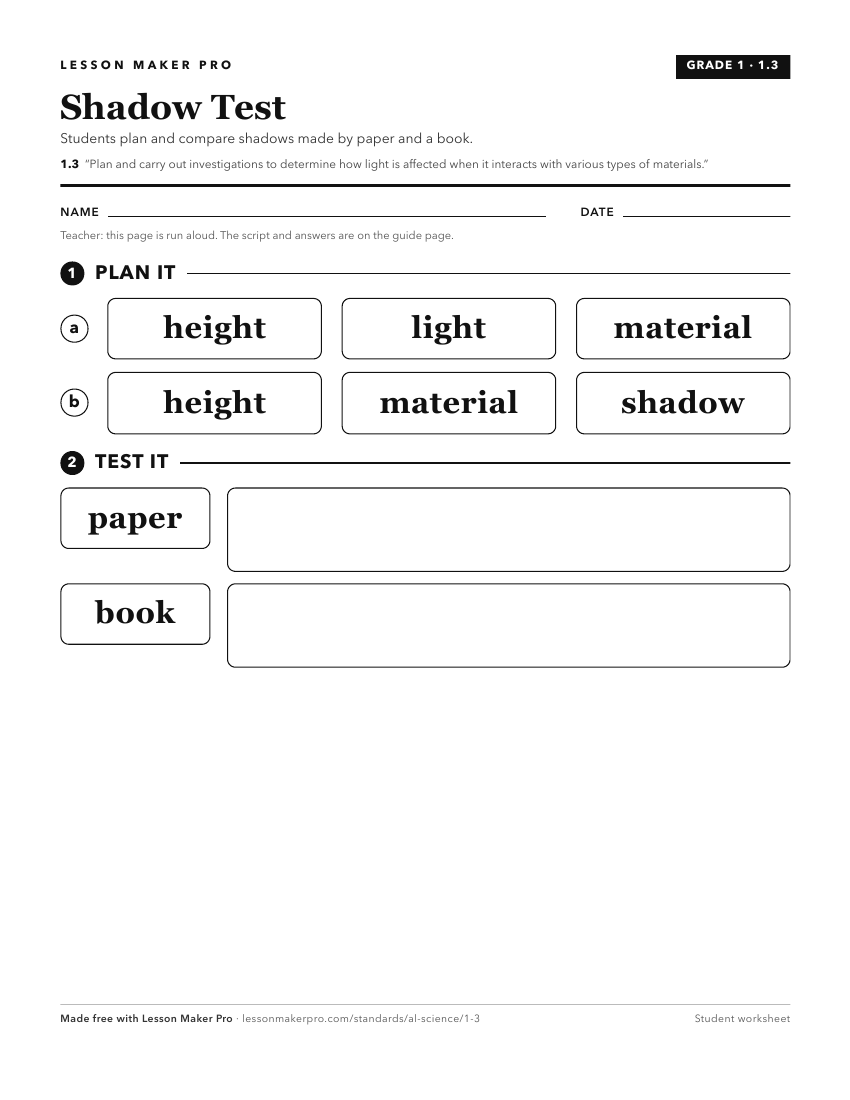
A ready-to-print activity worksheet aligned to 1.3, with an answer key for the teacher on its own page. No account needed.
PDF, US Letter, prints cleanly in black and white.
Download the worksheetKeep exploring
Related Standards
- 2.1
Plan and carry out investigations to compare, contrast, and classify various solid and liquid materials according to physical properties, including color and te...
- 5.2
Analyze data collected through observations and measurements to identify materials based on their properties, including color, hardness, and reflectivity.
- 4.3
Plan and carry out investigations to provide evidence that energy is transferred by sound, light, heat, and electric currents.
- 4.2
Plan and carry out investigations to answer questions regarding changes in energy when objects collide, and predict reasonable outcomes based on observed patter...
Turn this exact standard into a lesson
Grade, subject, topic, and the complete standard are prefilled. Create one free, no account needed.
Also for this standard:Make a WorksheetMake a QuizMake a Sub Lesson