Alabama Math PC.NQ.D
Standard Cluster
Understand limits of functions.
2019 Alabama Course of Study: Mathematics · Precalculus
Cluster contents
Standards in This Cluster
PC.NQ.D is a cluster heading. These are the individual standards under it.
Teacher's field guide
What This Cluster Means
What Students Need to Do
- Students find the value a function approaches as the input gets close to a point. They use graphs, tables, or expressions to check what happens from both sides.
What Mastery Looks Like
- A student can estimate a limit and explain the evidence they used. They can tell when the two sides disagree and separate the limit from the function's value at that point.
Common Misconceptions
- Students often assume the limit must equal the function's value at the point. They may also report a limit when the graph approaches different values from the left and right.
How to Assess It
- Exit ticket: For f(x) = (x² − 9)/(x − 3), find the limit as x approaches 3. Is f(3) defined? Explain the difference.
Lesson moves
Ways to Teach It
Give pairs a printed graph with a hole; have them slide two sticky notes toward the hole and record the y-value each approaches.
Ask: A graph has a hole at (2, 5) and a solid dot at (2, 1). What is the limit? Explain.
Give groups four small graphs and limit cards; have them match each graph with its left-hand, right-hand, and overall limit.
Plot a parking fee that jumps from $4 to $8 after two hours; ask what fee it approaches from each side.
Free download
Printable PC.NQ.D Worksheet
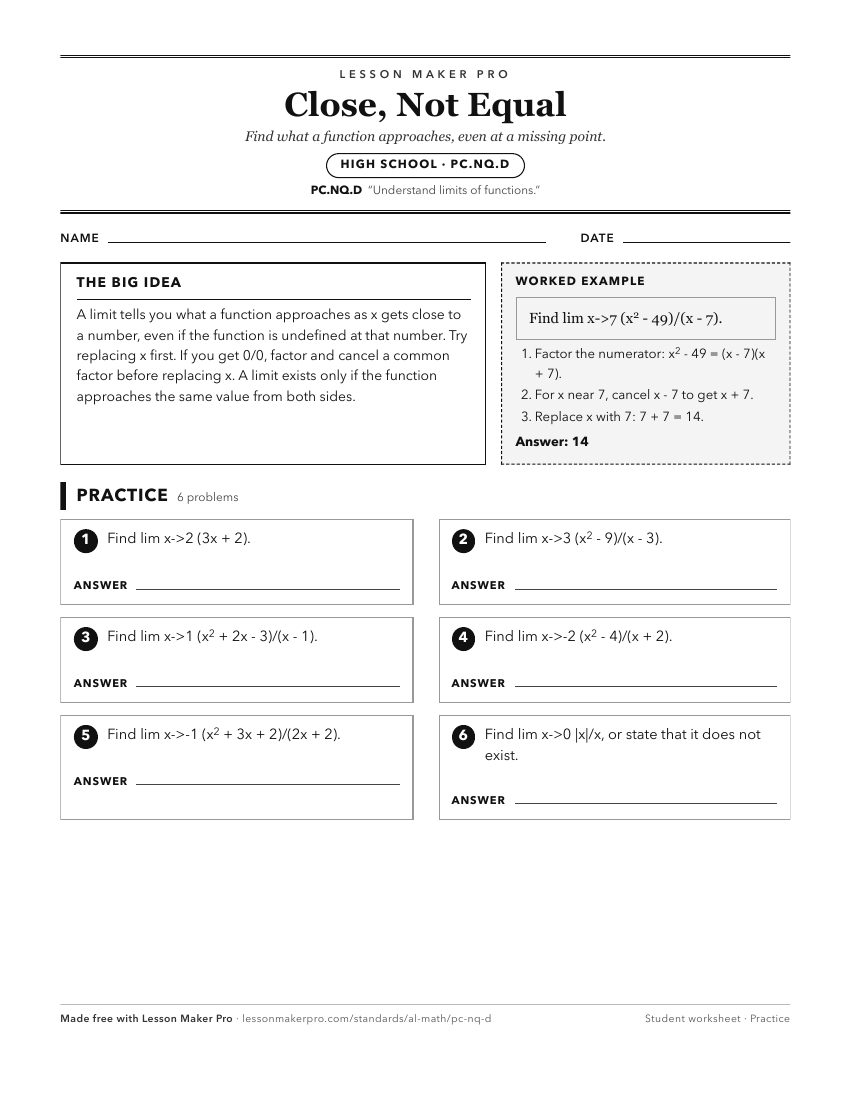
A ready-to-print activity worksheet aligned to PC.NQ.D, with an answer key for the teacher on its own page. No account needed.
PDF, US Letter, prints cleanly in black and white.
Download the worksheetKeep exploring
Related Standards
- 8A.AF.F.16.b
Relate the domain of a function to its graph and, where applicable, to the quantitative relationship it describes. Limit to linear, quadratic, exponential, and ...
- A1P.AF.E.15.b
Relate the domain of a function to its graph and, where applicable, to the quantitative relationship it describes. Limit to linear, quadratic, exponential, and ...
Turn this cluster into a lesson
Grade, subject, topic, and the complete cluster are prefilled. Create one free, no account needed.
Also for this cluster:Make a WorksheetMake a QuizMake a Sub Lesson