Alabama Math PC.A.B.16
The Standard
- PC.A.B
- Understand the relationship between zeros and factors of polynomials.
Derive and apply the Remainder Theorem: For a polynomial p(x) and a number a, the remainder on division by x – a is p(a), so p(a) = 0 if and only if (x – a) is a factor of p(x).
2019 Alabama Course of Study: Mathematics · Algebra
Teacher's field guide
What This Standard Means
What Students Need to Do
- Students use division to write a polynomial as a multiple of x−a plus a remainder. They substitute a to show why the multiple disappears, then use the result to test possible factors.
What Mastery Looks Like
- Given p(x)=x²−5x+6, a student finds p(2)=0 and p(4)=2 without dividing. They conclude x−2 is a factor, while division by x−4 leaves remainder 2.
Common Misconceptions
- Students may substitute −a when the divisor is x−a. They may mistake p(a) for the quotient, or think x−a is a factor when the remainder is not zero.
How to Assess It
- Exit ticket: For p(x)=x²−5x+6, find the remainders when dividing by x−2 and x−4. Name the factor and explain your answer using p(x)=(x−a)q(x)+r.
Lesson moves
Ways to Teach It
Give pairs paper cards marked x−3, x+2, and 4; have them assemble p(x)=(x−3)(x+2)+4 and evaluate p(3).
Ask students to explain why p(2)=0 makes x−2 a factor by substituting 2 into p(x)=(x−2)q(x)+r.
Play a matching game with cards p(x)=x²−5x+6, x−2, x−4, 0, and 2; students match divisors to remainders.
Give h(t)=−t²+6t for a ball’s height; students test whether t−6 is a factor and explain what t=6 means.
Free download
Printable PC.A.B.16 Worksheet
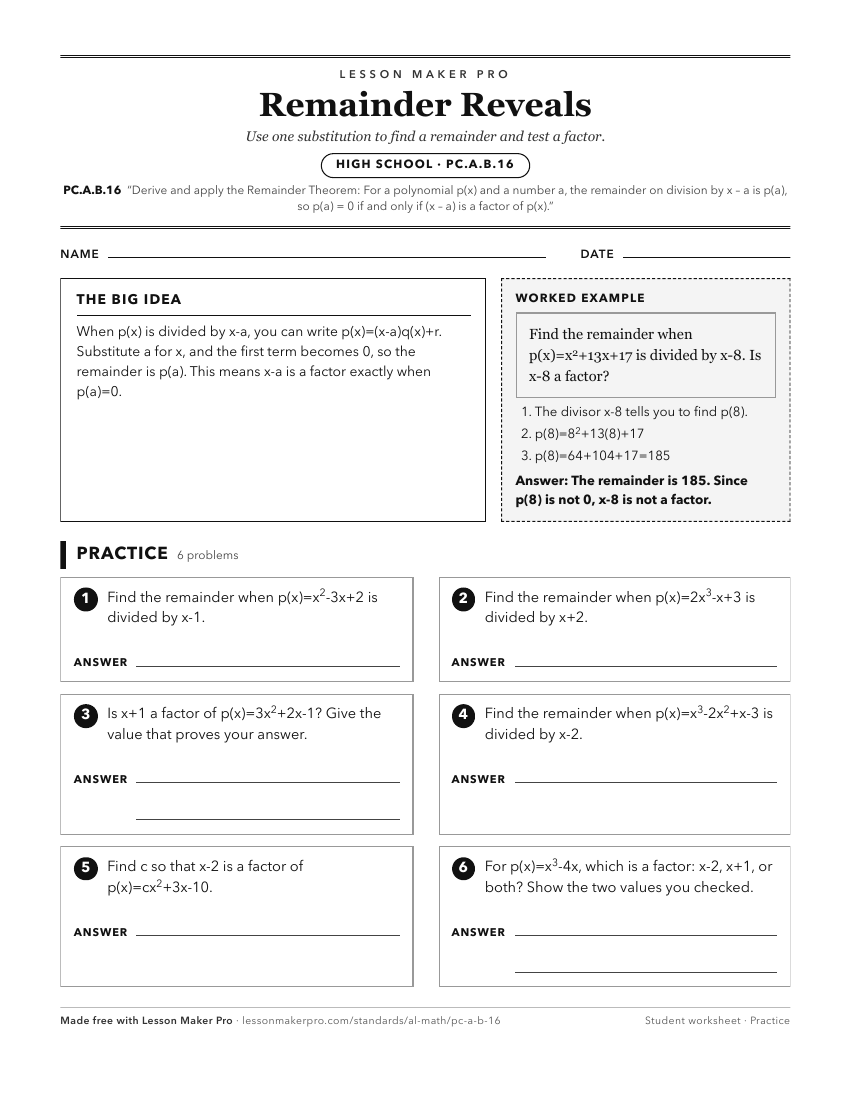
A ready-to-print activity worksheet aligned to PC.A.B.16, with an answer key for the teacher on its own page. No account needed.
PDF, US Letter, prints cleanly in black and white.
Download the worksheetKeep exploring
Related Standards
- A1P.AF.C.9.a
Use the method of completing the square to transform any quadratic equation in x into an equation of the form (x – p)² = q that has the same solutions. Explain ...
- 8A.AF.D.11.a
Use the method of completing the square to transform any quadratic equation in x into an equation of the form (x – p)² = q that has the same solutions. Explain ...
Turn this exact standard into a lesson
Grade, subject, topic, and the complete standard are prefilled. Create one free, no account needed.
Also for this standard:Make a WorksheetMake a QuizMake a Sub Lesson