Alabama Math 8A.AF.D.11.a
The Standard
- 8A.AF.D
- The structure of an equation or inequality (including, but not limited to, one-variable linear and quadratic equations, inequalities, and systems of linear equations in two variables) can be purposefully analyzed (with and without technology) to determine an efficient strategy to find a solution, if one exists, and then to justify the solution.
- 8A.AF.D.11
- Select an appropriate method to solve a quadratic equation in one variable.
Use the method of completing the square to transform any quadratic equation in x into an equation of the form (x – p)² = q that has the same solutions. Explain how the quadratic formula is derived from this form.
2019 Alabama Course of Study: Mathematics · The structure of an equation or inequality (including, but not limited to, one-variable linear and quadratic equations, inequalities, and systems of linear equations in two variables) can be purposefully analyzed (with and without technology) to determine an efficient strategy to find a solution, if one exists, and then to justify the solution.
Teacher's field guide
What This Standard Means
What Students Need to Do
- Students divide a quadratic equation by its leading coefficient, then add the square of half the x coefficient to both sides. They rewrite it as a squared binomial equal to a number and use square roots to derive the quadratic formula.
What Mastery Looks Like
- Given 2x²+8x−10=0, a student gets (x+2)²=9 and finds x=1 and x=−5. They can repeat the steps with ax²+bx+c=0 and show where both signs in the formula come from.
Common Misconceptions
- Students may add half the x coefficient instead of its square, or add it to only one side. They may forget to divide every term by the leading coefficient. They may drop the negative square root or claim a real solution when the squared expression equals a negative number.
How to Assess It
- Exit ticket: Starting with ax²+bx+c=0, where a≠0, write the completed-square form and show how taking both square roots gives the quadratic formula.
Lesson moves
Ways to Teach It
Give pairs algebra tiles for x²+6x=7; have them build the square, add nine unit tiles to both sides, and write (x+3)²=16.
Ask students to explain on mini whiteboards why adding (b/2a)² to both sides completes the square after dividing ax²+bx+c=0 by a.
Sort cards for x²+4x−5=0, (x+2)²=9, and {1, −5}; add x²+2x+5=0, (x+1)²=−4, and no real roots.
Give h(t)=−t²+6t+7 for a ball's height; have students complete the square, solve h(t)=0, and reject the negative time.
Free download
Printable 8A.AF.D.11.a Worksheet
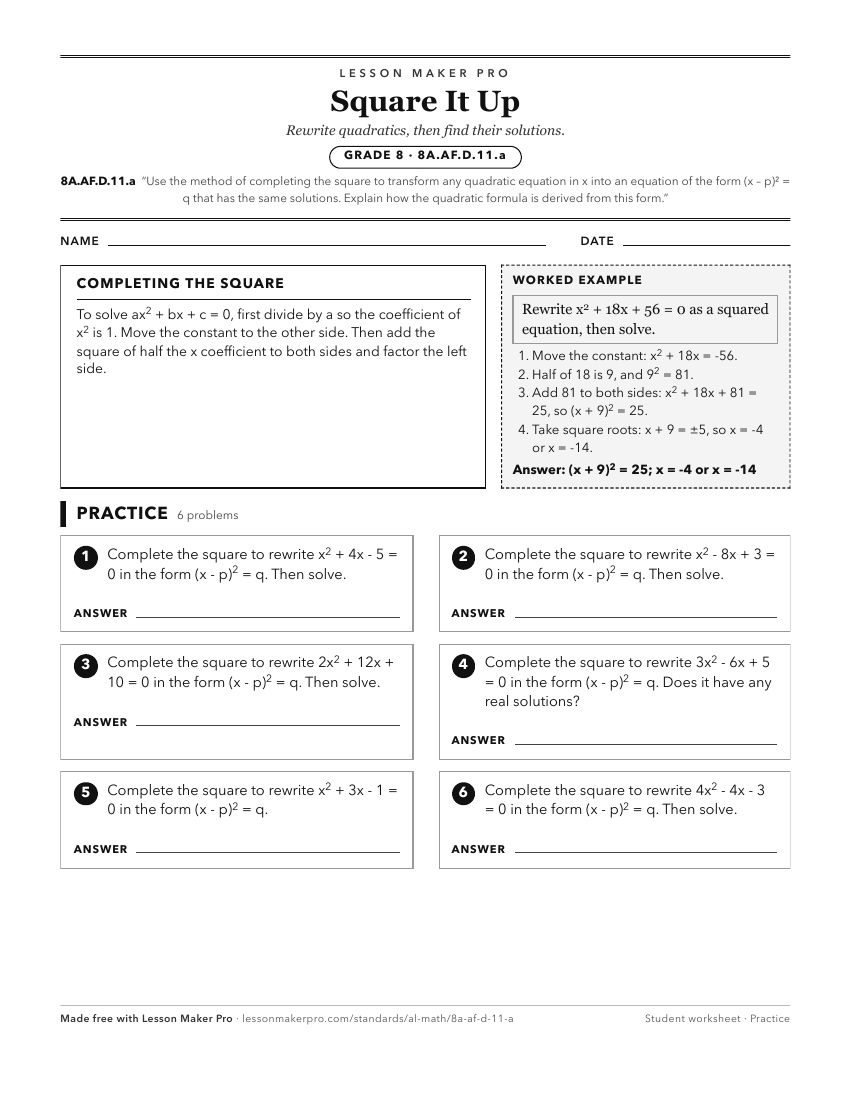
A ready-to-print activity worksheet aligned to 8A.AF.D.11.a, with an answer key for the teacher on its own page. No account needed.
PDF, US Letter, prints cleanly in black and white.
Download the worksheetKeep exploring
Related Standards
- A1P.AF.C.9.a
Use the method of completing the square to transform any quadratic equation in x into an equation of the form (x – p)² = q that has the same solutions. Explain ...
- A1P.AF.C.9.b
Solve quadratic equations by inspection (such as x² = 49), taking square roots, completing the square, the quadratic formula, and factoring, as appropriate to t...
- 8A.AF.D.11.b
Solve quadratic equations by inspection (such as x² = 49), taking square roots, completing the square, the quadratic formula, and factoring, as appropriate to t...
Turn this exact standard into a lesson
Grade, subject, topic, and the complete standard are prefilled. Create one free, no account needed.
Also for this standard:Make a WorksheetMake a QuizMake a Sub Lesson