Alabama Math GDA.GM.J.37
The Standard
- GDA.GM.J
- Recognizing congruence, similarity, symmetry, measurement opportunities, and other geometric ideas, including right triangle trigonometry, in real-world contexts provides a means of building understanding of these concepts and is a powerful tool for solving problems related to the physical world in which we live.
Investigate and apply relationships among inscribed angles, radii, and chords, including but not limited to: the relationship between central, inscribed, and circumscribed angles; inscribed angles on a diameter are right angles; the radius of a circle is perpendicular to the tangent where the radius intersects the circle.
2019 Alabama Course of Study: Mathematics
Teacher's field guide
What This Standard Means
What Students Need to Do
- Students find missing angles using central angles, inscribed angles, and angles formed by two tangents. They connect equal chords to equal arcs. They spot right angles across a diameter and where a radius meets a tangent.
What Mastery Looks Like
- Given a circle diagram, a student halves a central angle to find an inscribed angle over the same arc. They subtract the central angle from 180° to find the angle between two tangents. They match equal chords to equal arcs and mark both kinds of right angles.
Common Misconceptions
- Students may think central and inscribed angles over the same arc are equal. Some use the wrong arc when finding an inscribed angle. Others assume a radius is perpendicular to every chord, rather than to a tangent at the point of contact.
How to Assess It
- Draw a circle with center O, points A and B on the circle, and tangents at A and B meeting at P. Mark angle AOB as 100°, place C on the longer arc AB, and ask students to find angles ACB, APB, and OAP.
Lesson moves
Ways to Teach It
Cut a paper circle, fold a diameter, place a third point on the edge, and measure the angle formed with the diameter's endpoints.
Show two inscribed angles facing the same arc and ask, "Why are they equal, and how do they compare with the central angle?"
Give pairs cards showing central angles, inscribed angles, and two-tangent angles; have them find each missing angle and explain their answer.
Draw a bicycle wheel resting on a straight road; connect its center to the contact point and mark the 90° angle.
Free download
Printable GDA.GM.J.37 Worksheet
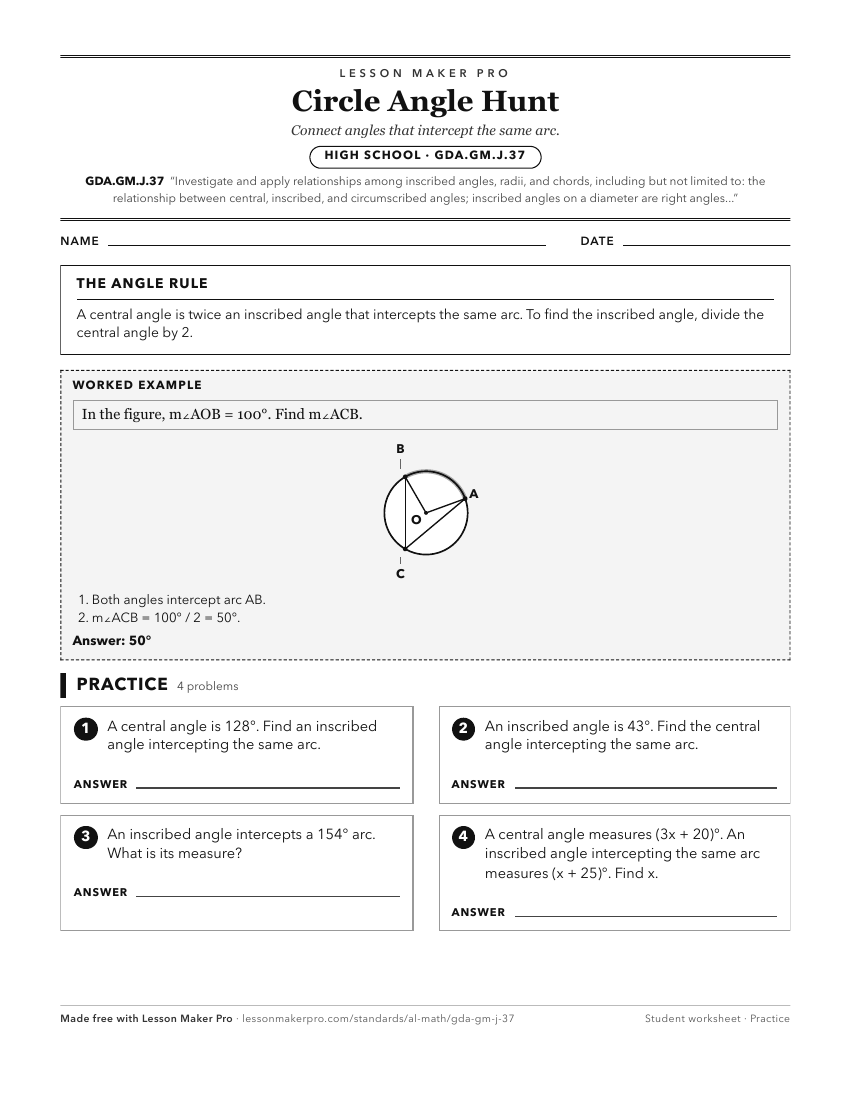
A ready-to-print activity worksheet aligned to GDA.GM.J.37, with an answer key for the teacher on its own page. No account needed.
PDF, US Letter, prints cleanly in black and white.
Download the worksheetKeep exploring
Related Standards
- GDA.GM.H.31.a
Investigate, prove, and apply theorems about lines and angles, including but not limited to: vertical angles are congruent; when a transversal crosses parallel ...
- 7.GM.B.20
Explain the relationships among circumference, diameter, area, and radius of a circle to demonstrate understanding of formulas for the area and circumference of...
- 7A.GM.B.36
Explain the relationships among circumference, diameter, area, and radius of a circle to demonstrate understanding of formulas for the area and circumference of...
- GDA.GM.H.31.b
Investigate, prove, and apply theorems about triangles, including but not limited to: the sum of the measures of the interior angles of a triangle is 180˚; the ...
Turn this exact standard into a lesson
Grade, subject, topic, and the complete standard are prefilled. Create one free, no account needed.
Also for this standard:Make a WorksheetMake a QuizMake a Sub Lesson