Alabama Math 7.GM.B.20
Standard Cluster
- 7.GM.B
- Solve real-world and mathematical problems involving angle measure, circumference, area, surface area, and volume.
Explain the relationships among circumference, diameter, area, and radius of a circle to demonstrate understanding of formulas for the area and circumference of a circle. a. Informally derive the formula for area of a circle. b. Solve area and circumference problems in real-world and mathematical situations involving circles.
2019 Alabama Course of Study: Mathematics · Geometry and Measurement
Cluster contents
Standards in This Cluster
7.GM.B.20 is a cluster heading. These are the individual standards under it.
Teacher's field guide
What This Cluster Means
What Students Need to Do
- Students connect the radius, diameter, and circumference of a circle. They rearrange paper wedges to see why a circle’s area is π times the radius squared. They use these relationships to solve problems.
What Mastery Looks Like
- Given a diameter, a student finds the radius before calculating area. They explain that rearranged wedges make a near rectangle with height equal to the radius and width equal to half the circumference. They use linear units for circumference and square units for area.
Common Misconceptions
- Students may use the diameter instead of the radius when finding area. They may confuse circumference with area or label both answers with square units. Some think doubling the radius doubles the area.
How to Assess It
- Exit ticket: A circle has a diameter of 10 cm. Sketch rearranged wedges to explain the area formula, then find the circle’s area and circumference.
Lesson moves
Ways to Teach It
Cut a paper circle into 12 equal wedges and alternate them to form a near rectangle; label its height and base.
Ask, “If a circle’s radius doubles, what happens to its circumference and area?” Have partners justify their answers with numbers.
Play a card match using circle diagrams marked with radii or diameters and cards showing matching circumference and area calculations.
Use string and chalk to mark a 3 m radius garden on pavement, then calculate its edging length and mulch area.
Free download
Printable 7.GM.B.20 Worksheet
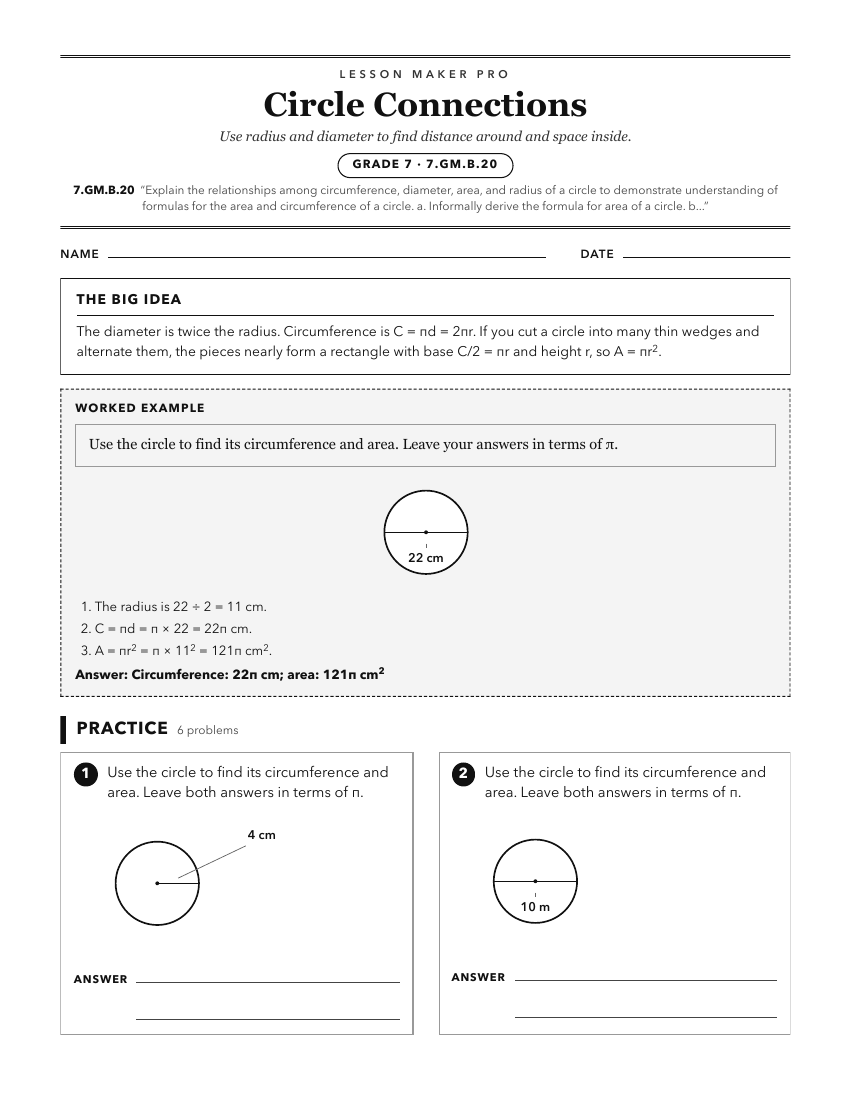
A ready-to-print activity worksheet aligned to 7.GM.B.20, with an answer key for the teacher on its own page. No account needed.
PDF, US Letter, prints cleanly in black and white.
Download the worksheetKeep exploring
Related Standards
Turn this cluster into a lesson
Grade, subject, topic, and the complete cluster are prefilled. Create one free, no account needed.
Also for this cluster:Make a WorksheetMake a QuizMake a Sub Lesson