Alabama Math FM.LR.A
Standard Cluster
The validity of a statement or argument can be determined using the models and language of first order logic.
2019 Alabama Course of Study: Mathematics · Applications of Finite Mathematics
Cluster contents
Standards in This Cluster
FM.LR.A is a cluster heading. These are the individual standards under it.
- FM.LR.A.1
Represent logic statements in words, with symbols, and in truth tables, including conditional, biconditional, converse, inverse, contrapositive, and quantified ...
- FM.LR.A.2
Represent logic operations such as and, or, not, nor, and x or (exclusive or) in words, with symbols, and in truth tables.
- FM.LR.A.3
Use truth tables to solve application-based logic problems and determine the truth value of simple and compound statements including negations and implications.
- FM.LR.A.3.a
Determine whether statements are equivalent and construct equivalent statements.
- FM.LR.A.4
Determine whether a logical argument is valid or invalid, using laws of logic such as the law of syllogism and the law of detachment.
- FM.LR.A.4.a
Determine whether a logical argument is a tautology or a contradiction.
- FM.LR.A.5
Prove a statement indirectly by proving the contrapositive of the statement.
Teacher's field guide
What This Cluster Means
What Students Need to Do
- Students identify who a claim is about and what words like “all,” “some,” and “if” mean. They decide whether a conclusion must follow from the starting claims.
What Mastery Looks Like
- Students check every member of a small group for an “all” claim and find one example for a “some” claim. They can follow a valid chain of claims. When an argument fails, they give a case where the starting claims are true but the conclusion is false.
Common Misconceptions
- Students may treat “some” as “most,” or accept an “all” claim after checking only a few cases. They may reverse “if A, then B” to mean “if B, then A.” A true conclusion does not make the argument leading to it valid.
How to Assess It
- Exit ticket: “Every chess player likes puzzles. Sam likes puzzles. Must Sam play chess?” Ask students to explain their answer with a diagram or a possible case.
Lesson moves
Ways to Teach It
Give pairs six colored shape cards and ask them to test “Every triangle is red” and “Some red shapes are triangles.”
Ask, “Can ‘Some students take art’ and ‘Every student takes art’ both be true?” Have students write a class list to show why.
Play counterexample hunt: students earn a point by describing a reader who is not a poet when told, “All poets are readers.”
Read the rule “All students with permits may park in Lot A,” then ask whether parking there proves a student has a permit.
Free download
Printable FM.LR.A Worksheet
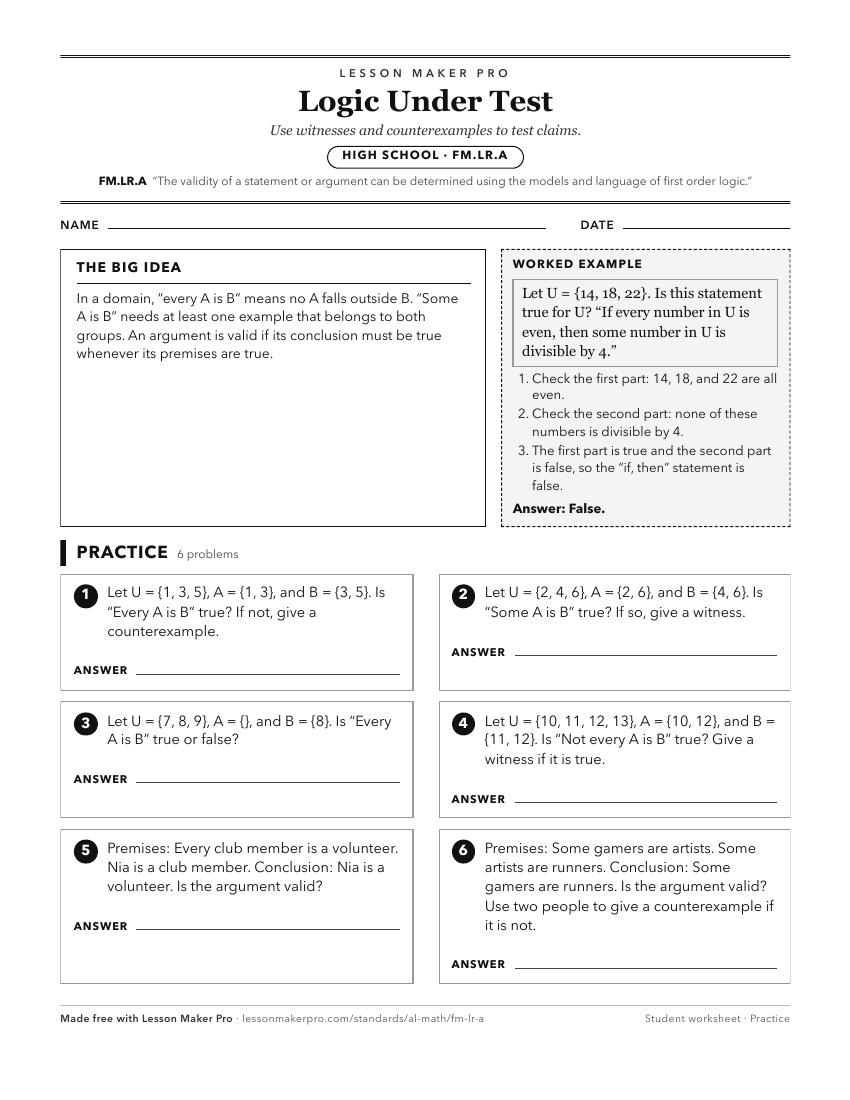
A ready-to-print activity worksheet aligned to FM.LR.A, with an answer key for the teacher on its own page. No account needed.
PDF, US Letter, prints cleanly in black and white.
Download the worksheetTurn this cluster into a lesson
Grade, subject, topic, and the complete cluster are prefilled. Create one free, no account needed.
Also for this cluster:Make a WorksheetMake a QuizMake a Sub Lesson