Alabama Math FM.LR.A.2
The Standard
- FM.LR.A
- The validity of a statement or argument can be determined using the models and language of first order logic.
Represent logic operations such as and, or, not, nor, and x or (exclusive or) in words, with symbols, and in truth tables.
2019 Alabama Course of Study: Mathematics
Teacher's field guide
What This Standard Means
What Students Need to Do
- Students use P and Q to stand for two conditions. They write the conditions in words and symbols, then show which combinations make each statement true or false.
What Mastery Looks Like
- Given P and Q, students can write P ∧ Q, P ∨ Q, ¬P, ¬(P ∨ Q), and P ⊕ Q in words. They fill all four rows of a truth table and explain why OR is true when both conditions are true, but XOR is not.
Common Misconceptions
- Students often think OR means exactly one condition is true. They may mark NOR true when only one condition is false, or read ¬(P ∨ Q) as ¬P ∨ Q.
How to Assess It
- Exit ticket: Let P mean “It rains” and Q mean “The bus is late.” Write P ∧ Q, P ∨ Q, ¬P, ¬(P ∨ Q), and P ⊕ Q in words, then complete a four-row truth table.
Lesson moves
Ways to Teach It
Use four P/Q card pairs and colored tokens to mark where AND, OR, NOT P, NOR, and XOR are true.
Ask, “If a cafeteria offers soup OR salad, can you take both?” Have students explain how the answer changes with XOR.
Run a truth-table relay: teams fill one missing cell per turn on tables for AND, OR, NOT P, NOR, and XOR.
Show a lunch form that says “milk or juice, but not both”; students write its symbol and list the valid choices.
Free download
Printable FM.LR.A.2 Worksheet
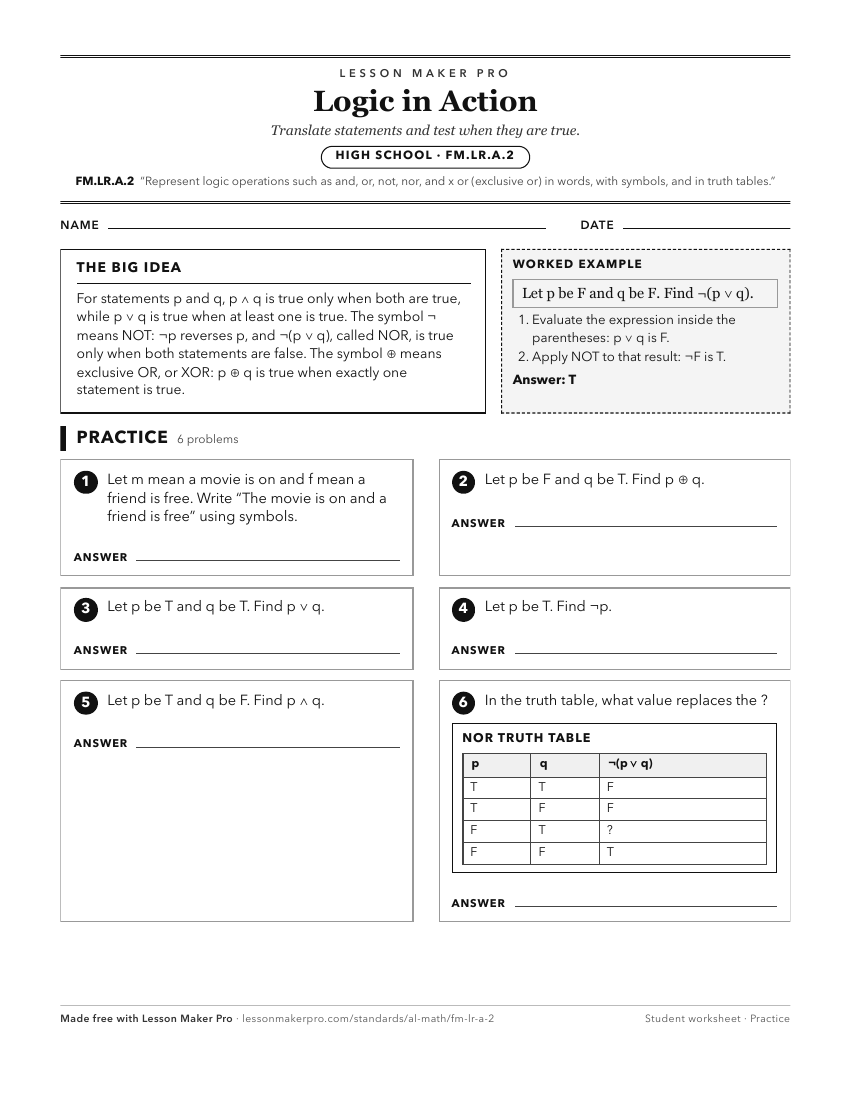
A ready-to-print activity worksheet aligned to FM.LR.A.2, with an answer key for the teacher on its own page. No account needed.
PDF, US Letter, prints cleanly in black and white.
Download the worksheetKeep exploring
Related Standards
- FM.LR.A.1
Represent logic statements in words, with symbols, and in truth tables, including conditional, biconditional, converse, inverse, contrapositive, and quantified ...
- FM.LR.A.3
Use truth tables to solve application-based logic problems and determine the truth value of simple and compound statements including negations and implications.
Turn this exact standard into a lesson
Grade, subject, topic, and the complete standard are prefilled. Create one free, no account needed.
Also for this standard:Make a WorksheetMake a QuizMake a Sub Lesson