Alabama Math FM.FD.A
Standard Cluster
Various methods for determining a winner in a voting system can result in paradoxes or other issues of fairness.
2019 Alabama Course of Study: Mathematics · Applications of Finite Mathematics
Cluster contents
Standards in This Cluster
FM.FD.A is a cluster heading. These are the individual standards under it.
- FM.FD.A.22
Analyze advantages and disadvantages of different types of ballot voting systems.
- FM.FD.A.22.a
Identify impacts of using a preferential ballot voting system and compare it to single candidate voting and other voting systems.
- FM.FD.A.22.b
Analyze the impact of legal and cultural features of political systems on the mathematical aspects of elections.
- FM.FD.A.23
Apply a variety of methods for determining a winner using a preferential ballot voting system, including plurality, majority, run-off with majority, sequential ...
- FM.FD.A.24
Identify issues of fairness for different methods of determining a winner using a preferential voting ballot and other voting systems and identify paradoxes tha...
- FM.FD.A.25
Use methods of weighted voting and identify issues of fairness related to weighted voting.
- FM.FD.A.25.a
Distinguish between weight and power in voting.
Teacher's field guide
What This Cluster Means
What Students Need to Do
- Students count ranked ballots using first-place votes, point scores, and head-to-head comparisons. They compare the winners and explain why a counting method can change the result.
What Mastery Looks Like
- Given one set of ballots, a student finds the winner under each method and shows the counts. They can explain why the candidate with the most first-place votes may not be the choice most voters prefer.
Common Misconceptions
- Students may call the most first-place votes a majority, even when that candidate has less than half. They may count only the top choice on a ranked ballot or assume different results mean someone miscounted.
How to Assess It
- Give students seven ballots: three A>B>C, two B>C>A, and two C>B>A, listed from favorite to least favorite. Ask them to find the winners by first-place votes and by 2, 1, 0 points, then explain why the winners differ.
Lesson moves
Ways to Teach It
Give pairs seven ranked ballot slips and counters; have them sort first choices, then score every ranking with 2, 1, and 0 points.
Ask, 'Should A win with three first-place votes when four voters rank B above A?' Have students cite the ballots.
Give teams three printed ballot sets; have them race to find winners by first-place votes, point scores, and head-to-head counts.
Poll the class on three school lunch choices with ranked paper ballots; compare what the cafeteria would serve under two counting methods.
Free download
Printable FM.FD.A Worksheet
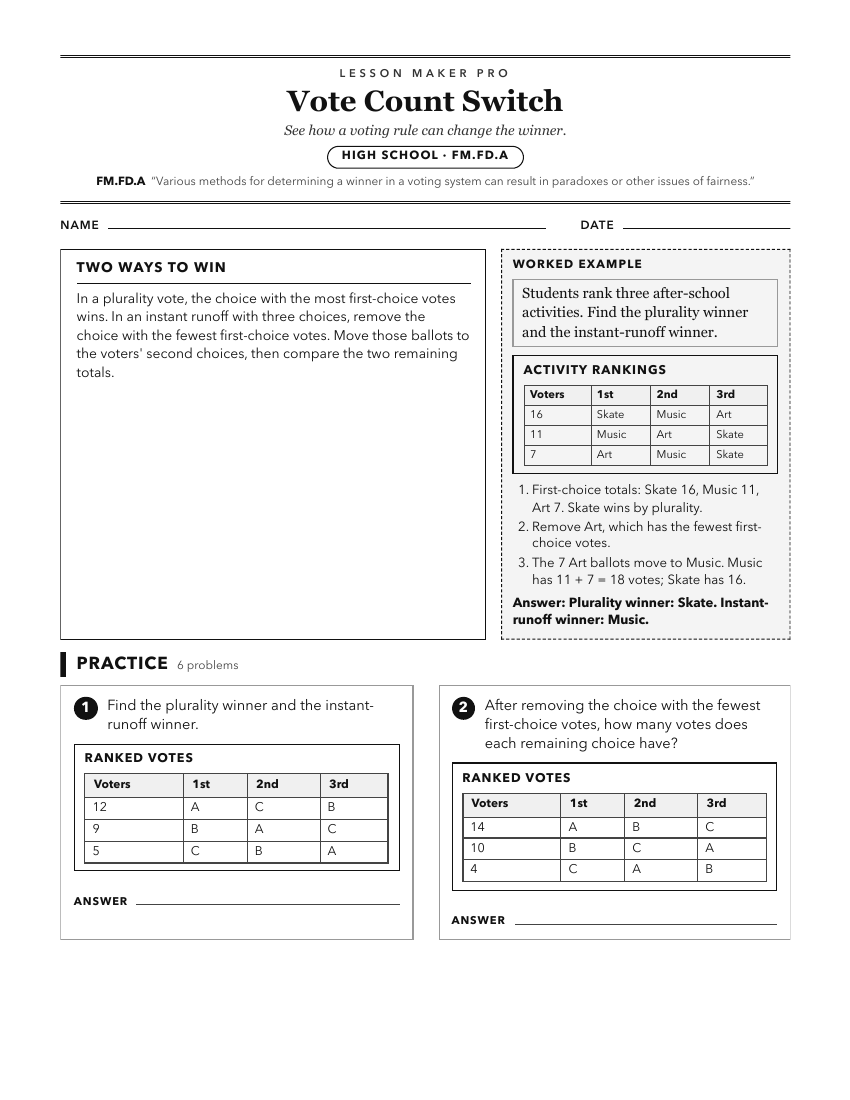
A ready-to-print activity worksheet aligned to FM.FD.A, with an answer key for the teacher on its own page. No account needed.
PDF, US Letter, prints cleanly in black and white.
Download the worksheetTurn this cluster into a lesson
Grade, subject, topic, and the complete cluster are prefilled. Create one free, no account needed.
Also for this cluster:Make a WorksheetMake a QuizMake a Sub Lesson