Alabama Math A2S.GM.B
Standard Cluster
Recognizing congruence, similarity, symmetry, measurement opportunities, and other geometric ideas, including right triangle trigonometry in real-world contexts, provides a means of building understanding of these concepts and is a powerful tool for solving problems related to the physical world in which we live.
2019 Alabama Course of Study: Mathematics · Algebra II With Statistics
Cluster contents
Standards in This Cluster
A2S.GM.B is a cluster heading. These are the individual standards under it.
- A2S.GM.B.35
Choose trigonometric functions (sine and cosine) to model periodic phenomena with specified amplitude, frequency, and midline.
- A2S.GM.B.36
Prove the Pythagorean identity sin²(θ) + cos²(θ) = 1 and use it to calculate trigonometric ratios.
- A2S.GM.B.37
Derive and apply the formula A = ½·ab·sin(C) for the area of a triangle by drawing an auxiliary line from a vertex perpendicular to the opposite side, extending...
- A2S.GM.B.38
Derive and apply the Law of Sines and the Law of Cosines to find unknown measurements in right and non-right triangles. Extend the domain of sine and cosine to ...
Teacher's field guide
What This Cluster Means
What Students Need to Do
- Students identify congruent and similar shapes and lines of symmetry in drawings or objects. They measure lengths and angles, then use scale factors or right triangle trigonometry to find missing distances. They explain why their method fits the situation.
What Mastery Looks Like
- A student matches corresponding sides and explains whether two figures are similar or congruent. They choose a trig ratio to find a height or distance, show their work, and label the answer with units.
Common Misconceptions
- Students may call figures congruent when they have the same shape but different sizes. They may pair the wrong sides when setting up a scale factor. They may choose a trig ratio without checking which side is opposite or adjacent to the given angle.
How to Assess It
- Exit ticket: A 10 m ladder rests against a wall at a 65° angle to the ground. Sketch the triangle, find the height reached, and name the trig ratio you used.
Lesson moves
Ways to Teach It
Cut out paper triangles, measure their sides, sort congruent and similar pairs, and fold each triangle to test for symmetry.
Show two scaled drawings of a room and ask, “Why are they similar but not congruent? Which lengths show this?”
Give pairs cards showing right triangles with one angle and one side; have them choose a trig ratio and solve.
Measure a building’s distance and angle of elevation with a phone clinometer, then use tangent and eye height to estimate its height.
Free download
Printable A2S.GM.B Worksheet
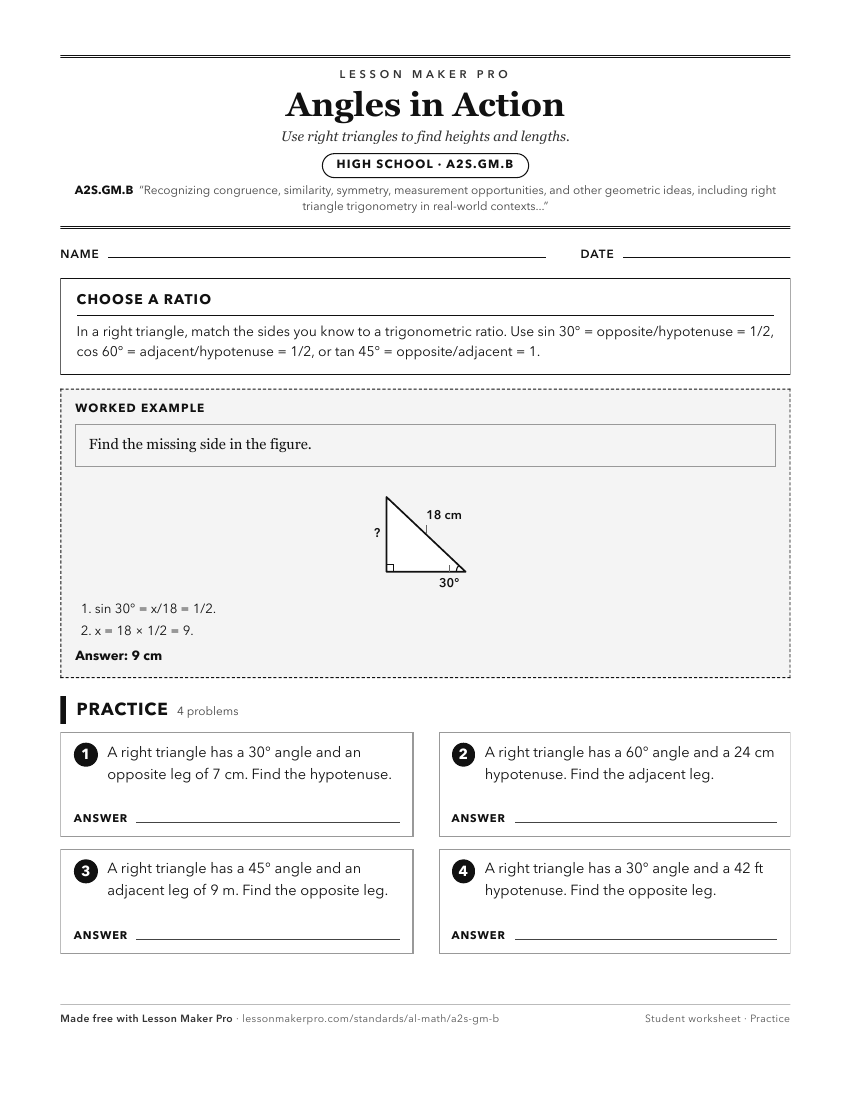
A ready-to-print activity worksheet aligned to A2S.GM.B, with an answer key for the teacher on its own page. No account needed.
PDF, US Letter, prints cleanly in black and white.
Download the worksheetKeep exploring
Related Standards
- GDA.GM.J
Recognizing congruence, similarity, symmetry, measurement opportunities, and other geometric ideas, including right triangle trigonometry, in real-world context...
- GDA.GM.J.34
Use congruence and similarity criteria for triangles to solve problems in real-world contexts.
- 7A.GM.A.34
Construct geometric shapes (freehand, using a ruler and a protractor, and using technology) given measurement constraints with an emphasis on constructing trian...
Turn this cluster into a lesson
Grade, subject, topic, and the complete cluster are prefilled. Create one free, no account needed.
Also for this cluster:Make a WorksheetMake a QuizMake a Sub Lesson