Alabama Math 7A.GM.A.34
The Standard
- 7A.GM.A
- Construct and describe geometrical figures, analyzing relationships among them.
Construct geometric shapes (freehand, using a ruler and a protractor, and using technology) given measurement constraints with an emphasis on constructing triangles from three measures of angles or sides, noticing when the conditions determine a unique triangle, more than one triangle, or no triangle.
2019 Alabama Course of Study: Mathematics
Teacher's field guide
What This Standard Means
What Students Need to Do
- Students draw triangles from given lengths and angles, freehand, with a ruler and protractor, and with a geometry app. They decide whether the measurements allow one triangle, more than one, or none. They explain their decision using side lengths or angles.
What Mastery Looks Like
- A student can draw a triangle with sides of 3 cm, 4 cm, and 5 cm and explain why every valid drawing has the same size and shape. They can show why sides of 2 cm, 3 cm, and 6 cm will not meet. They can draw different-sized triangles that all have angles of 50°, 60°, and 70°.
Common Misconceptions
- Students may count a rotated or flipped drawing as a different triangle. They may think three angles fix a triangle's size. They may also assume any three side lengths will close, or that two sides and a nonincluded angle always make just one triangle.
How to Assess It
- Ask students to draw a triangle with sides of 3 cm, 4 cm, and 5 cm. Then have them label that set, sides of 2 cm, 3 cm, and 6 cm, and angles of 50°, 60°, and 70° as one, none, or many triangles, with a reason for each.
Lesson moves
Ways to Teach It
Give pairs a 5 cm base and angles of 50° and 60°; have them draw the rays with protractors and compare their triangles.
Ask, 'Why can't sides of 2 cm, 3 cm, and 6 cm close into a triangle?' Have students explain with a sketch.
Play a card sort with 3-4-5 sides, 2-3-6 sides, and 50°-60°-70° angles; teams sort them into one, none, or many.
Show a triangular shelf bracket with 4 cm, 5 cm, and 6 cm edges; use GeoGebra to test whether its shape can change.
Free download
Printable 7A.GM.A.34 Worksheet
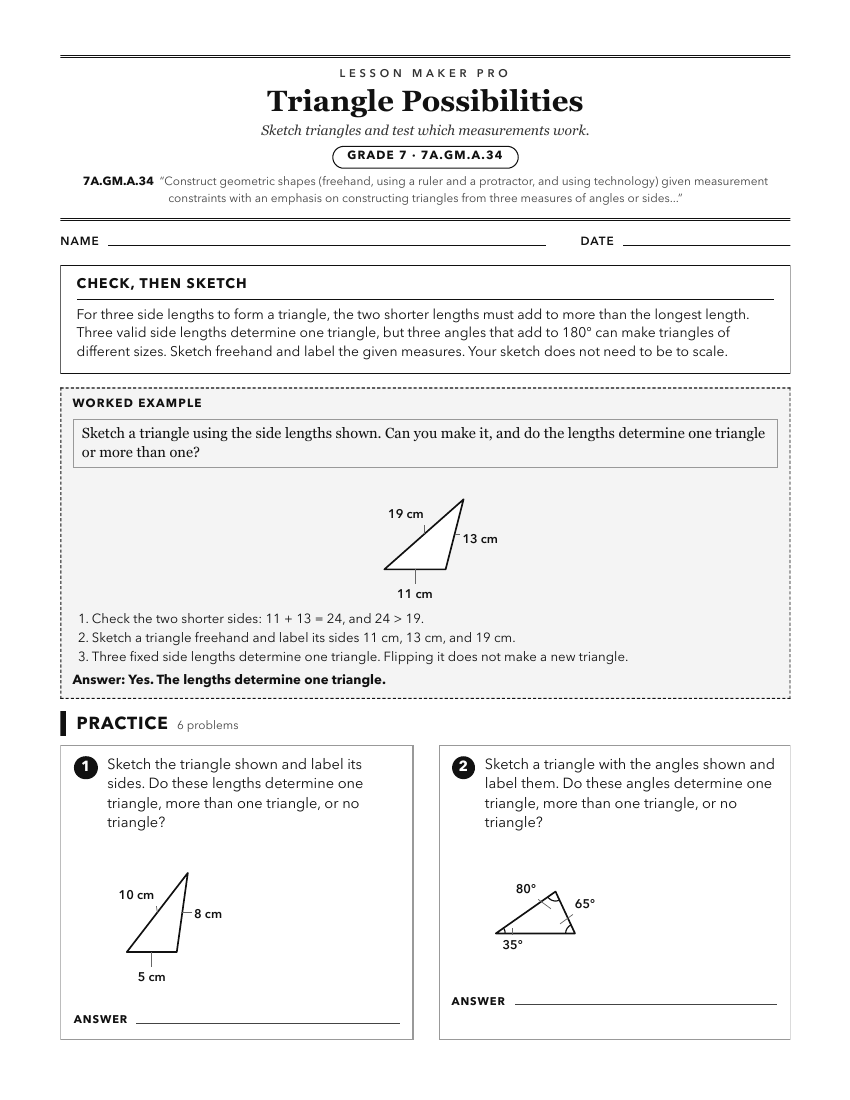
A ready-to-print activity worksheet aligned to 7A.GM.A.34, with an answer key for the teacher on its own page. No account needed.
PDF, US Letter, prints cleanly in black and white.
Download the worksheetKeep exploring
Related Standards
- GDA.GM.J.36
Use geometric shapes, their measures, and their properties to model objects and use those models to solve problems.
- A2S.GM.B
Recognizing congruence, similarity, symmetry, measurement opportunities, and other geometric ideas, including right triangle trigonometry in real-world contexts...
- GDA.GM.J
Recognizing congruence, similarity, symmetry, measurement opportunities, and other geometric ideas, including right triangle trigonometry, in real-world context...
Turn this exact standard into a lesson
Grade, subject, topic, and the complete standard are prefilled. Create one free, no account needed.
Also for this standard:Make a WorksheetMake a QuizMake a Sub Lesson