Alabama Math A2S.GM.A
Standard Cluster
When an object is the image of a known object under a similarity transformation, a length, area, or volume on the image can be computed by using proportional relationships.
2019 Alabama Course of Study: Mathematics · Algebra II With Statistics
Cluster contents
Standards in This Cluster
A2S.GM.A is a cluster heading. These are the individual standards under it.
Teacher's field guide
What This Cluster Means
What Students Need to Do
- Students find lengths, areas, and volumes on scaled copies of shapes. They multiply by the scale factor for length, its square for area, and its cube for volume.
What Mastery Looks Like
- Given a scale factor of 3, a student turns an area of 12 cm² into 108 cm² and a volume of 8 cm³ into 216 cm³. They can explain why the multipliers differ.
Common Misconceptions
- Students may use the length scale factor for area and volume too. Some square the factor for volume instead of cubing it.
How to Assess It
- A 2 cm by 3 cm by 4 cm box is scaled by 2. Find its new longest edge, surface area, and volume, and show the multiplier used for each.
Lesson moves
Ways to Teach It
Build 2 by 2 by 2 and 4 by 4 by 4 cubes with unit blocks, then compare edge lengths and block counts.
Ask, 'If every edge of a cube doubles, why doesn't its surface area just double?' Have students sketch its faces and explain.
Give pairs cards with a scale factor and one known measurement; they race to find the matching length, area, or volume.
Hand out a 1:50 floor plan with a 4 cm by 6 cm room; students calculate its actual floor area.
Free download
Printable A2S.GM.A Worksheet
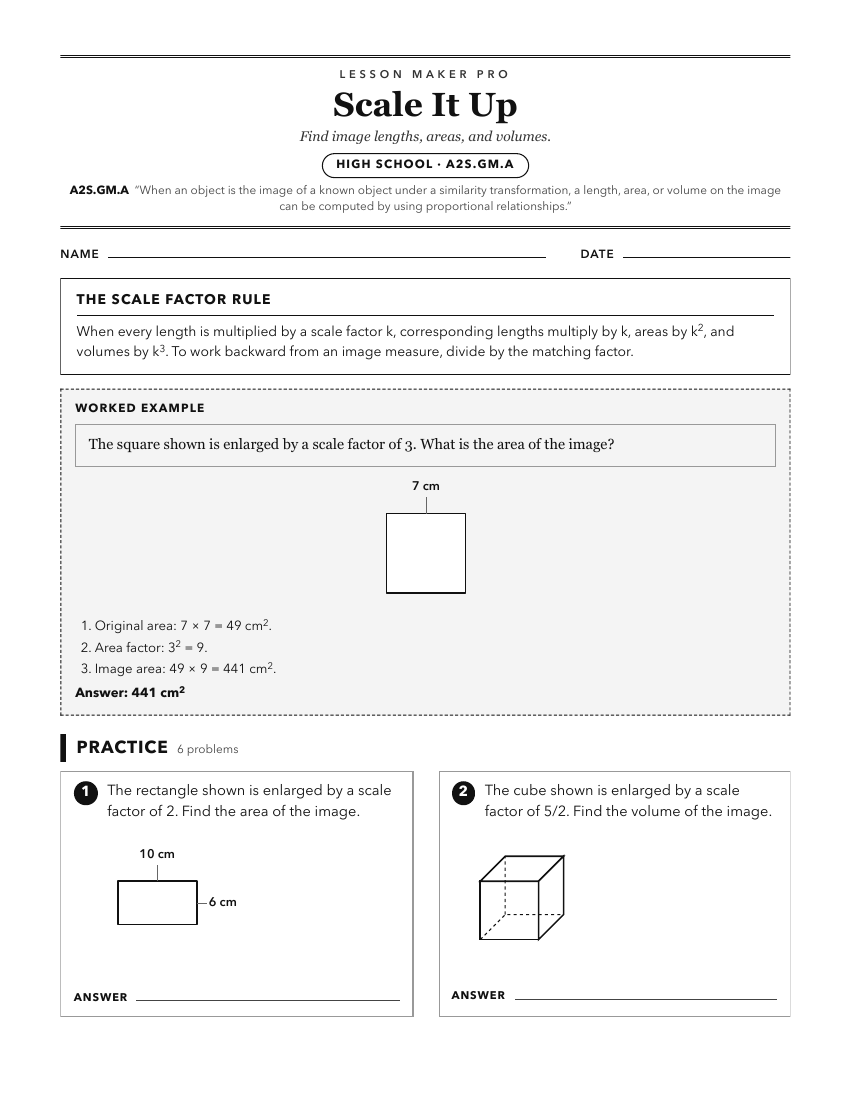
A ready-to-print activity worksheet aligned to A2S.GM.A, with an answer key for the teacher on its own page. No account needed.
PDF, US Letter, prints cleanly in black and white.
Download the worksheetKeep exploring
Related Standards
- GDA.GM.C
When an object is the image of a known object under a similarity transformation, a length, area, or volume on the image can be computed by using proportional re...
- GDA.GM.F
Showing that two figures are similar involves finding a similarity transformation (dilation or composite of a dilation with a rigid motion) or, equivalently, a ...
- GDA.GM.C.19
Derive and apply the relationships between the lengths, perimeters, areas, and volumes of similar figures in relation to their scale factor.
- GDA.GM.F.27
Given two figures, determine whether they are similar by identifying a similarity transformation (sequence of rigid motions and dilations) that maps one figure ...
Turn this cluster into a lesson
Grade, subject, topic, and the complete cluster are prefilled. Create one free, no account needed.
Also for this cluster:Make a WorksheetMake a QuizMake a Sub Lesson