Alabama Math A2S.AF.D
Standard Cluster
Expressions, equations, and inequalities can be used to analyze and make predictions, both within mathematics and as mathematics is applied in different contexts—in particular, contexts that arise in relation to linear, quadratic, and exponential situations.
2019 Alabama Course of Study: Mathematics · Algebra II With Statistics
Cluster contents
Standards in This Cluster
A2S.AF.D is a cluster heading. These are the individual standards under it.
- A2S.AF.D.10
Create equations and inequalities in one variable and use them to solve problems. Extend to equations arising from polynomial, trigonometric (sine and cosine), ...
- A2S.AF.D.12
Solve simple equations involving exponential, radical, logarithmic, and trigonometric functions using inverse functions.
- A2S.AF.D.13
Create equations in two or more variables to represent relationships between quantities; graph equations on coordinate axes with labels and scales and use them ...
Teacher's field guide
What This Cluster Means
What Students Need to Do
- Students compare outputs at equal input steps to look for constant first differences, second differences, or ratios. They write a matching rule, then use it to predict a value or find when a limit is passed.
What Mastery Looks Like
- Given a savings table, students can tell whether the balance grows by a fixed dollar amount or a fixed percentage and write the rule. They can use a quadratic height rule to find when an object lands and reject a negative time. They can solve an inequality and explain what the answer means in the situation.
Common Misconceptions
- Students may call any rising graph linear, even when the increases get bigger each step. They may confuse a fixed dollar increase with a fixed percent increase or check differences using unequal input steps. They may keep a negative time answer for an object hitting the ground.
How to Assess It
- Give students this table: day 0, 1, 2, 3; count 2, 6, 18, 54. Ask them to write a rule and find the first whole day when the count exceeds 100.
Lesson moves
Ways to Teach It
Give pairs counters to build square arrays of 1, 4, 9, and 16; have them record first and second differences and write a rule.
Show y = 50 + 10t and y = 50(1.1)^t; ask which grows faster after ten years and why.
Play model match: hand out table, graph, rule, and context cards for three patterns; teams match sets and defend one match.
Use a phone plan with a $25 base fee and $5 per gigabyte; students write a cost rule and find when it exceeds $50.
Free download
Printable A2S.AF.D Worksheet
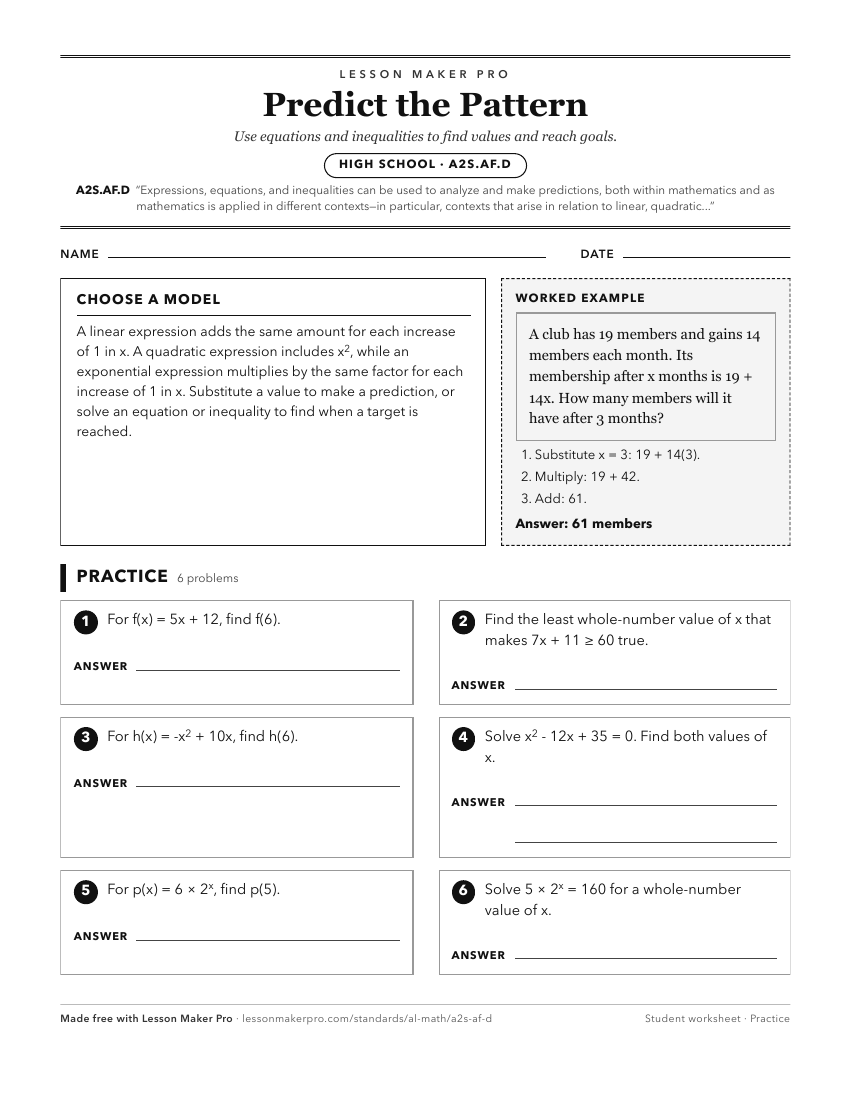
A ready-to-print activity worksheet aligned to A2S.AF.D, with an answer key for the teacher on its own page. No account needed.
PDF, US Letter, prints cleanly in black and white.
Download the worksheetKeep exploring
Related Standards
- A1P.AF.D
Expressions, equations, and inequalities can be used to analyze and make predictions, both within mathematics and as mathematics is applied in different context...
- 8A.AF.E
Expressions, equations, and inequalities can be used to analyze and make predictions, both within mathematics and as mathematics is applied in different context...
- GDA.AF.B
Expressions, equations, and inequalities can be used to analyze and make predictions, both within mathematics and as mathematics is applied in different context...
- 8A.AF.E.13
Create equations and inequalities in one variable and use them to solve problems in context, either exactly or approximately. Extend from contexts arising from ...
Turn this cluster into a lesson
Grade, subject, topic, and the complete cluster are prefilled. Create one free, no account needed.
Also for this cluster:Make a WorksheetMake a QuizMake a Sub Lesson