Alabama Math A1P.AF.H
Standard Cluster
Functions that are members of the same family have distinguishing attributes (structure) common to all functions within that family.
2019 Alabama Course of Study: Mathematics · Algebra I With Probability
Cluster contents
Standards in This Cluster
A1P.AF.H is a cluster heading. These are the individual standards under it.
- A1P.AF.H.23
Identify the effect on the graph of replacing f(x) by f(x) + k, k·f(x), f(f·x), for specific values of k (both positive and negative); find the value of k given...
- A1P.AF.H.24.a
Show that linear functions grow by equal differences over equal intervals, while exponential functions grow by equal factors over equal intervals.
- A1P.AF.H.24.b
Define linear functions to represent situations in which one quantity changes at a constant rate per unit interval relative to another.
- A1P.AF.H.24.c
Define exponential functions to represent situations in which a quantity grows or decays by a constant percent rate per unit interval relative to another.
- A1P.AF.H.26
Use graphs and tables to show that a quantity increasing exponentially eventually exceeds a quantity increasing linearly or quadratically.
- A1P.AF.H.27
Interpret the parameters of functions in terms of a context. Extend from linear functions, written in the form mx + b, to exponential functions, written in the ...
- A1P.AF.H.28
For a function that models a relationship between two quantities, interpret key features of graphs and tables in terms of the quantities, and sketch graphs show...
- A1P.AF.H.29
Calculate and interpret the average rate of change of a function (presented symbolically or as a table) over a specified interval. Estimate the rate of change f...
- A1P.AF.H.30.b
Graph piecewise-defined functions, including step functions and absolute value functions.
- A1P.AF.H.30.c
Graph exponential functions, showing intercepts and end behavior.
Teacher's field guide
What This Cluster Means
What Students Need to Do
- Students sort equations, graphs, and tables into function families. They point to a shared clue, such as constant first differences for linear functions or constant second differences for quadratics. They tell family traits apart from changes in slope or starting value.
What Mastery Looks Like
- A student groups y = 2x + 1 with y = -3x + 4 and explains that both graphs are lines. They distinguish y = x² from y = 2^x by noting where the variable appears.
Common Misconceptions
- Students may call x² exponential because it has an exponent. They may think two lines with different slopes belong to different families, or that a downward-opening quadratic is not quadratic.
How to Assess It
- On an exit ticket, have students sort y = 3x + 2, y = -x + 5, y = x² + 1, and y = 2^x by family and give one clue for each choice.
Lesson moves
Ways to Teach It
Hand out printed tables for y = 2x + 1, y = x², and y = 2^x; students mark differences or ratios and sort them.
Ask students to write why y = x² and y = 2^x belong to different families, even though both equations contain a 2.
Play a matching game: students pair equation cards for x², 2^x, and 2x with graph cards, then explain each match.
Compare a cab fare of $4 plus $2 per mile with $100 growing 10% yearly; students write each rule and name its family.
Free download
Printable A1P.AF.H Worksheet
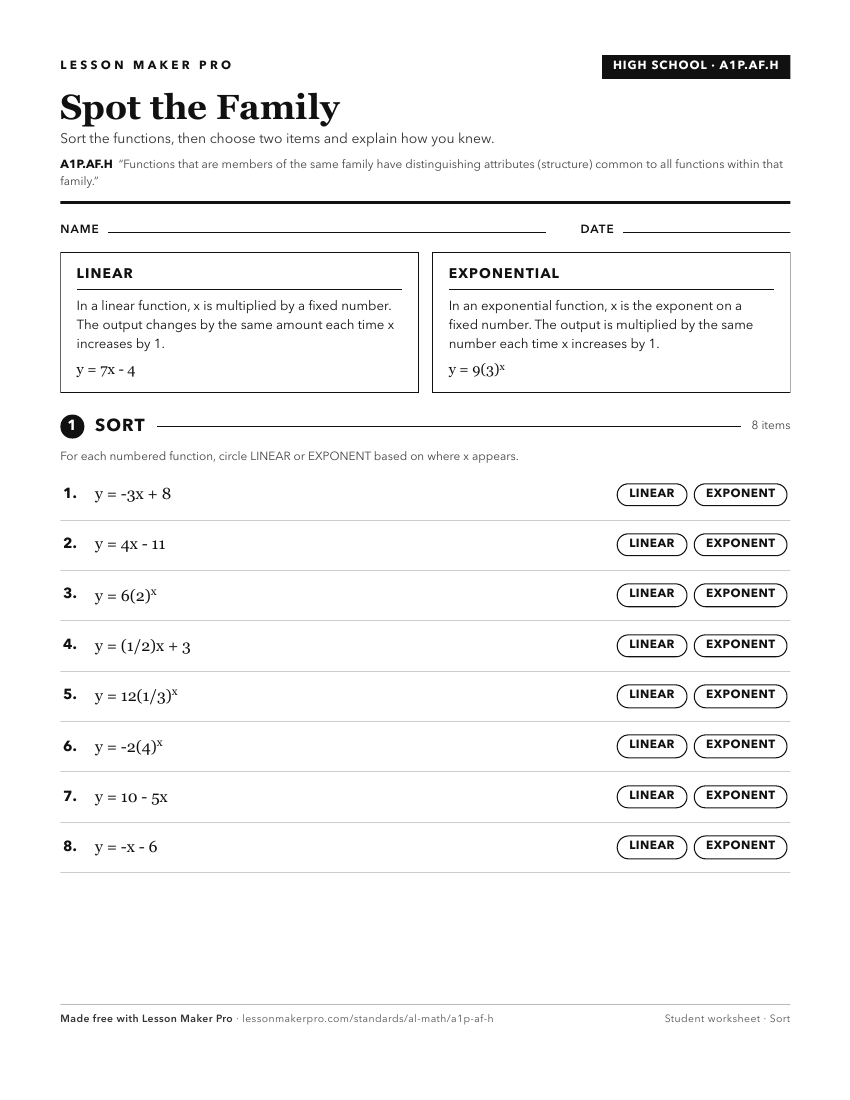
A ready-to-print activity worksheet aligned to A1P.AF.H, with an answer key for the teacher on its own page. No account needed.
PDF, US Letter, prints cleanly in black and white.
Download the worksheetKeep exploring
Related Standards
- A2S.AF.G
Functions that are members of the same family have distinguishing attributes (structure) common to all functions within that family.
- 8A.AF.I
Functions that are members of the same family have distinguishing attributes (structure) common to all functions within that family.
- PC.F.A.24
Compare and contrast families of functions and their representations algebraically, graphically, numerically, and verbally in terms of their key features. Famil...
- 8A.AF.H
Functions can be described by using a variety of representations: mapping diagrams, function notation (e.g., f(x) = x²), recursive definitions, tables, and grap...
Turn this cluster into a lesson
Grade, subject, topic, and the complete cluster are prefilled. Create one free, no account needed.
Also for this cluster:Make a WorksheetMake a QuizMake a Sub Lesson