Alabama Math 7A.PR.B.6
Standard Cluster
- 7A.PR.B
- Analyze the relationship between proportional and non-proportional situations.
Interpret y = mx + b as defining a linear equation whose graph is a line with m as the slope and b as the y-intercept. a. Use similar triangles to explain why the slope m is the same between any two distinct points on a non-vertical line in a coordinate plane. b. Given two distinct points in a coordinate plane, find the slope of the line containing the two points and explain why it will be the same for any two distinct points on the line. c. Graph linear relationships, interpreting the slope as the rate of change of the graph and the y-intercept as the initial value. d. Given that the slopes for two different sets of points are equal, demonstrate that the linear equations that include those two sets of points may have different y-intercepts.
2019 Alabama Course of Study: Mathematics
Cluster contents
Standards in This Cluster
7A.PR.B.6 is a cluster heading. These are the individual standards under it.
- 7A.PR.B.6.a
Use similar triangles to explain why the slope m is the same between any two distinct points on a non-vertical line in a coordinate plane.
- 7A.PR.B.6.b
Given two distinct points in a coordinate plane, find the slope of the line containing the two points and explain why it will be the same for any two distinct p...
- 7A.PR.B.6.c
Graph linear relationships, interpreting the slope as the rate of change of the graph and the y-intercept as the initial value.
- 7A.PR.B.6.d
Given that the slopes for two different sets of points are equal, demonstrate that the linear equations that include those two sets of points may have different...
Teacher's field guide
What This Cluster Means
What Students Need to Do
- Students find a line’s slope from two points and use rise-run triangles to explain why the slope stays the same. They graph lines and read the slope as a rate of change and the y-intercept as a starting value.
What Mastery Looks Like
- A student can graph y = 2x + 3 and explain that y starts at 3 and rises 2 for every 1 added to x. They can show, with similar triangles, why any two points on that line give the same slope. They can also draw a line with slope 2 that starts at a different value.
Common Misconceptions
- Students may divide the change in x by the change in y, or subtract coordinates in different orders. Some think a line’s slope changes when they choose different points. Others think lines with the same slope must have the same y-intercept.
How to Assess It
- Exit ticket: Plot (0, 2), (2, 6), and (4, 10), then draw rise-run triangles from the first point to each of the others. Explain why the slopes match, write the line’s equation, and label its rate of change and starting value.
Lesson moves
Ways to Teach It
Give pairs a coordinate grid and two colored pencils to draw rise-run triangles between three points on one line.
Ask students to write why triangles with runs of 2 and 4 can show the same slope.
Play a matching game with cards showing equations, graphs, point pairs, and slope-intercept descriptions.
Graph a taxi fare with a $3 pickup fee and $2 per mile, then label the starting cost and cost per mile.
Free download
Printable 7A.PR.B.6 Worksheet
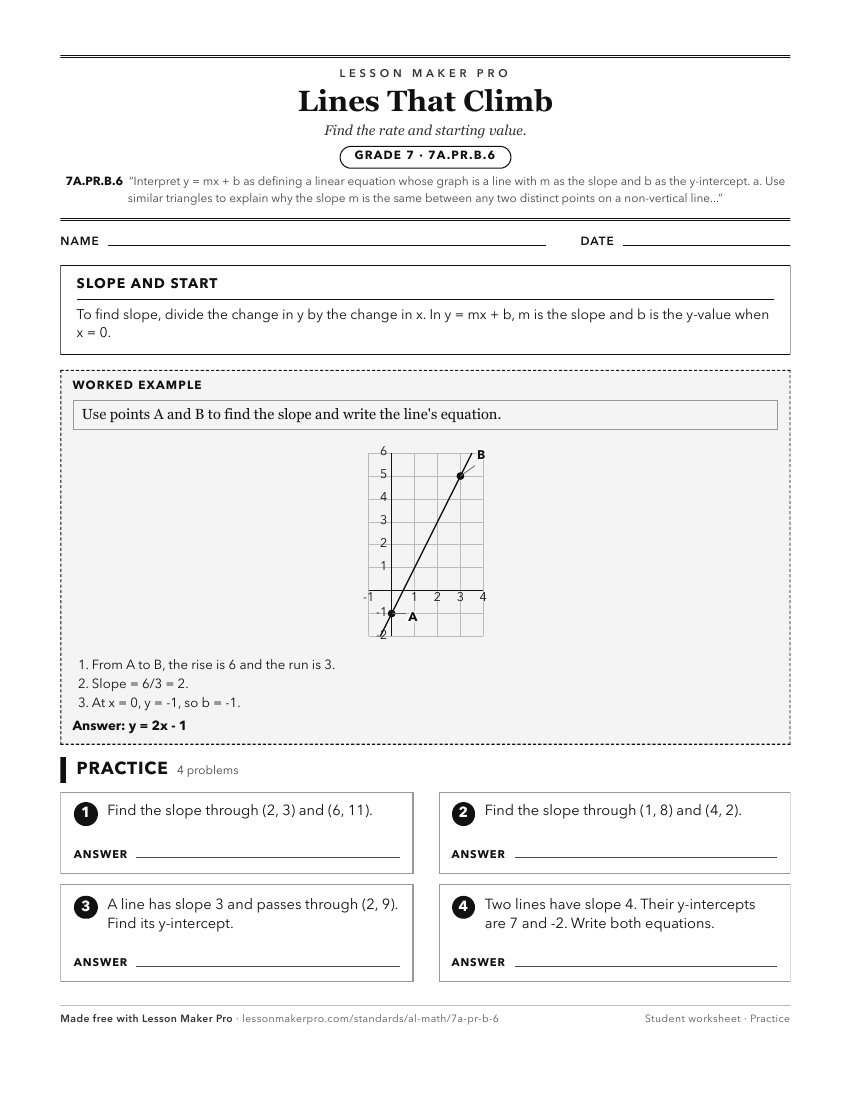
A ready-to-print activity worksheet aligned to 7A.PR.B.6, with an answer key for the teacher on its own page. No account needed.
PDF, US Letter, prints cleanly in black and white.
Download the worksheetKeep exploring
Related Standards
- 8.AF.B.9
Interpret y = mx + b as defining a linear equation whose graph is a line with m as the slope and b as the y-intercept.
- 8.AF.B.9.c
Graph linear relationships, interpreting the slope as the rate of change of the graph and the y-intercept as the initial value.
- A1P.AF.H.27
Interpret the parameters of functions in terms of a context. Extend from linear functions, written in the form mx + b, to exponential functions, written in the ...
Turn this cluster into a lesson
Grade, subject, topic, and the complete cluster are prefilled. Create one free, no account needed.
Also for this cluster:Make a WorksheetMake a QuizMake a Sub Lesson