Alabama Math 7.DSP.C.14
Standard Cluster
- 7.DSP.C
- Investigate probability models.
Define and develop a probability model, including models that may or may not be uniform, where uniform models assign equal probability to all outcomes and non-uniform models involve events that are not equally likely. a. Collect and use data to predict probabilities of events. b. Compare probabilities from a model to observed frequencies, explaining possible sources of discrepancy.
2019 Alabama Course of Study: Mathematics · Data Analysis, Statistics, and Probability
Cluster contents
Standards in This Cluster
7.DSP.C.14 is a cluster heading. These are the individual standards under it.
Teacher's field guide
What This Cluster Means
What Students Need to Do
- Students assign probabilities to outcomes with equal or unequal chances. They use trial data to estimate chances. They compare predictions with results and explain why they differ.
What Mastery Looks Like
- Given a bag with three red cubes and one blue cube, a student gives red a 3/4 chance and blue a 1/4 chance. They predict about 15 red draws in 20 draws with replacement and explain why 13 could occur.
Common Misconceptions
- Students may give red and blue a 1/2 chance each because there are two colors. They may treat a prediction of 15 reds as a guarantee. Some forget that not replacing a cube changes the chances.
How to Assess It
- A bag has three red cubes and one blue cube. After 20 draws with replacement, 13 were red. Ask: Is the color model uniform, how many red draws would you predict, and why might the tally differ?
Lesson moves
Ways to Teach It
Put three red cubes and one blue cube in a bag; draw with replacement 20 times, then use the tally to estimate each color's chance.
Have students write why 13 red draws can occur when a bag model predicts 15 in 20 trials.
Give pairs cards showing colored spinners and bags; have them match each card to probabilities and sort the models by equal or unequal chances.
Give students a weather log with ten days forecast at 70% rain and six rainy days; compare the tally with seven expected rainy days.
Free download
Printable 7.DSP.C.14 Worksheet
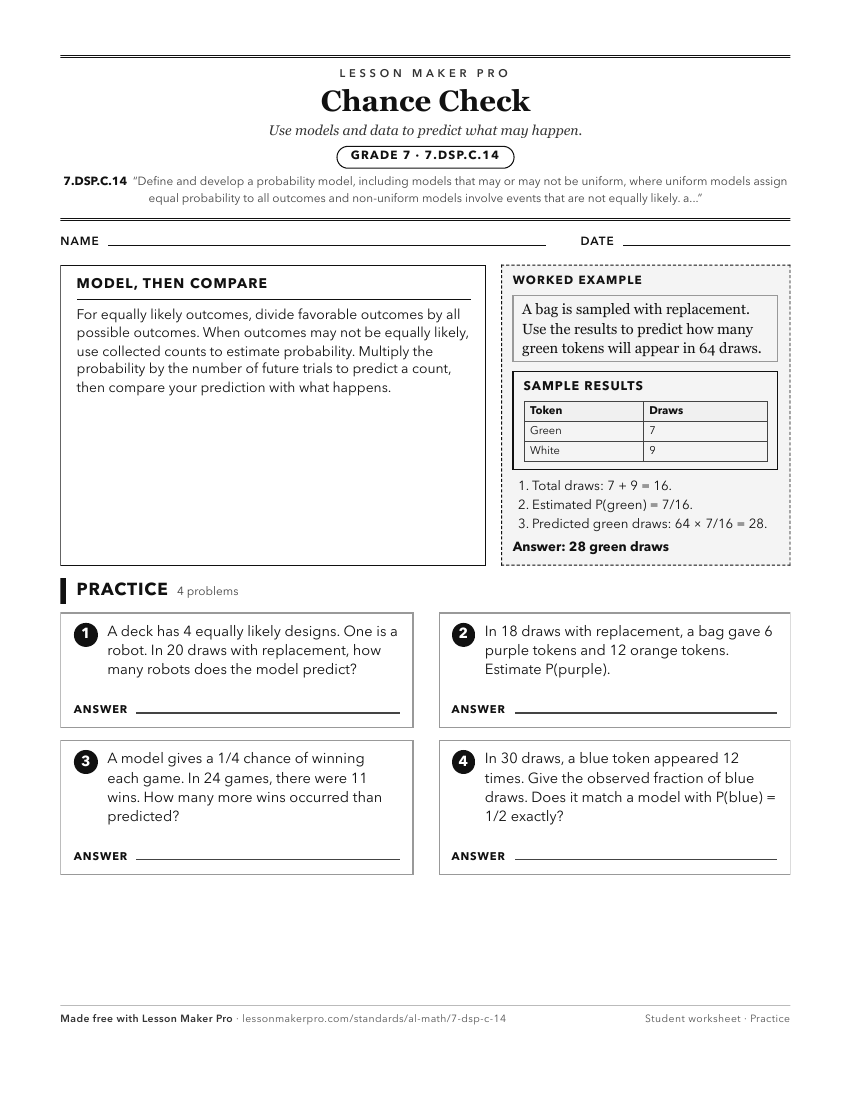
A ready-to-print activity worksheet aligned to 7.DSP.C.14, with an answer key for the teacher on its own page. No account needed.
PDF, US Letter, prints cleanly in black and white.
Download the worksheetKeep exploring
Related Standards
- 7A.DSP.C.30
Define and develop a probability model, including models that may or may not be uniform, where uniform models assign equal probability to all outcomes and non-u...
- 7A.DSP.C
Investigate probability models.
- 7.DSP.C
Investigate probability models.
- 7A.DSP.C.29
Use a number between 0 and 1 to represent the probability of a chance event occurring, explaining that larger numbers indicate greater likelihood of the event o...
Turn this cluster into a lesson
Grade, subject, topic, and the complete cluster are prefilled. Create one free, no account needed.
Also for this cluster:Make a WorksheetMake a QuizMake a Sub Lesson