Alabama Math 5.NBT.A.3.a
The Standard
- 5.NBT.A
- Understand the place value system.
- 5.NBT.A.3
- Using models and quantitative reasoning, explain that in a multi-digit number, including decimals, a digit in any place represents ten times what it represents in the place to its right and 1/10 of what it represents in the place to its left.
Explain patterns in the number of zeros of the product when multiplying a number by powers of 10, using whole-number exponents to denote powers of 10.
2019 Alabama Course of Study: Mathematics · Understand the place value system.
Teacher's field guide
What This Standard Means
What Students Need to Do
- Students multiply whole numbers by powers of 10, such as 10² and 10³. They use place value to explain how many trailing zeros the product has.
What Mastery Looks Like
- A student explains that 10³ means 10 × 10 × 10 and finds 40 × 10³ = 40,000. They count the zero already in 40 and know that multiplying by 10⁰ leaves the number unchanged.
Common Misconceptions
- Some students read 10³ as 10 × 3 or think 10⁰ equals 0. Others say 40 × 10³ has only three trailing zeros because they miss the zero already in 40.
How to Assess It
- Ask students to calculate 40 × 10³ and 40 × 10⁰. Have them explain the number of trailing zeros in each answer.
Lesson moves
Ways to Teach It
Give pairs digit tiles and a place value chart, then have them build 24 and shift its digits three places left to show 24 × 10³.
Ask students to write why 40 × 10³ has four trailing zeros instead of three.
Play a matching game with cards showing 6 × 10², 60 × 10², 600, and 6,000, and ask students to justify each match.
Give students an inventory slip for 30 cartons with 10³ paper clips each, then have them find the total and explain its four zeros.
Free download
Printable 5.NBT.A.3.a Worksheet
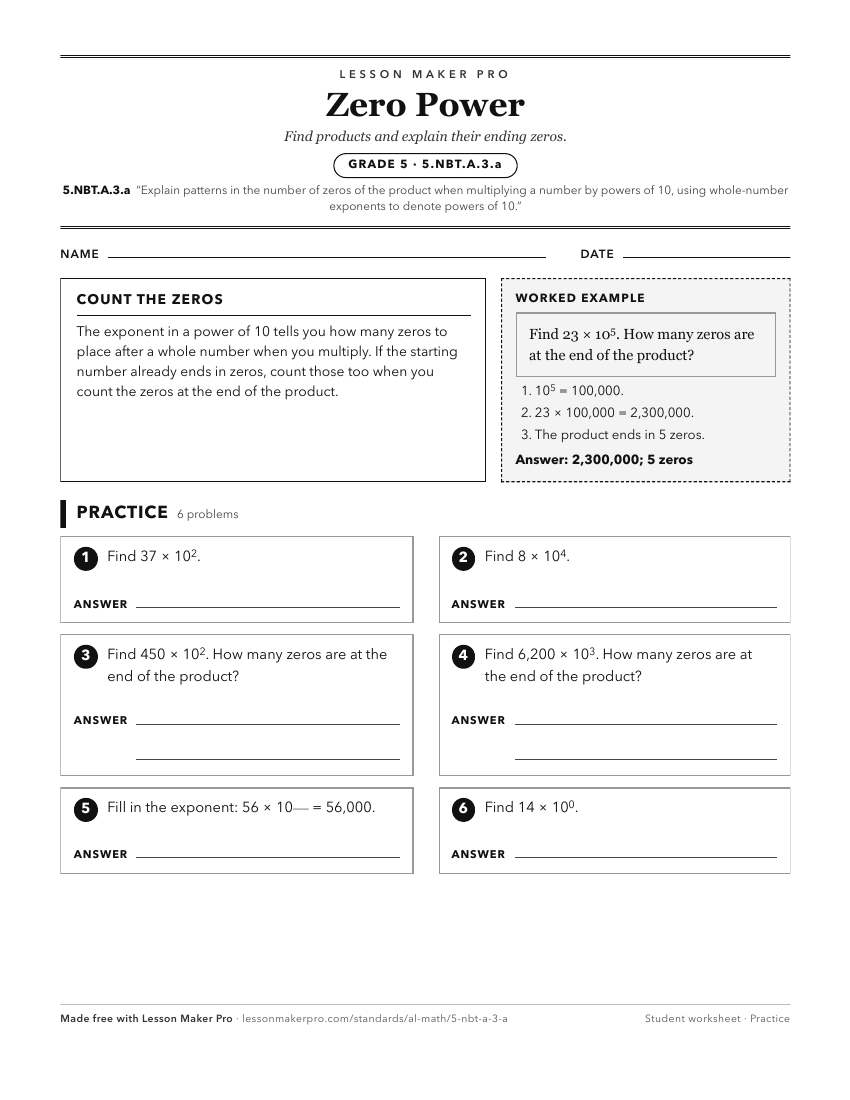
A ready-to-print activity worksheet aligned to 5.NBT.A.3.a, with an answer key for the teacher on its own page. No account needed.
PDF, US Letter, prints cleanly in black and white.
Download the worksheetKeep exploring
Related Standards
- 5.NBT.A.3.b
Explain patterns in the placement of the decimal point when a decimal is multiplied or divided by a power of 10, using whole-number exponents to denote powers o...
- 3.NBT.A.12
Use concrete materials and pictorial models based on place value and properties of operations to find the product of a one-digit whole number by a multiple of t...
- 1.NBT.B.11
Explain that the two digits of a two-digit number represent amounts of tens and ones.
- 5.NBT.A.3
Using models and quantitative reasoning, explain that in a multi-digit number, including decimals, a digit in any place represents ten times what it represents ...
Turn this exact standard into a lesson
Grade, subject, topic, and the complete standard are prefilled. Create one free, no account needed.
Also for this standard:Make a WorksheetMake a QuizMake a Sub Lesson