Alabama Math 5.NBT.A.3
Standard Cluster
- 5.NBT.A
- Understand the place value system.
Using models and quantitative reasoning, explain that in a multi-digit number, including decimals, a digit in any place represents ten times what it represents in the place to its right and 1/10 of what it represents in the place to its left. a. Explain patterns in the number of zeros of the product when multiplying a number by powers of 10, using whole-number exponents to denote powers of 10. b. Explain patterns in the placement of the decimal point when a decimal is multiplied or divided by a power of 10, using whole-number exponents to denote powers of 10.
2019 Alabama Course of Study: Mathematics · Understand the place value system.
Cluster contents
Standards in This Cluster
5.NBT.A.3 is a cluster heading. These are the individual standards under it.
- 5.NBT.A.3.a
Explain patterns in the number of zeros of the product when multiplying a number by powers of 10, using whole-number exponents to denote powers of 10.
- 5.NBT.A.3.b
Explain patterns in the placement of the decimal point when a decimal is multiplied or divided by a power of 10, using whole-number exponents to denote powers o...
Teacher's field guide
What This Cluster Means
What Students Need to Do
- Students use a place-value chart to show that a digit is worth ten times as much one place left and one tenth as much one place right. They explain zero patterns in whole-number products and digit shifts in decimal products and quotients when using powers of 10.
What Mastery Looks Like
- A student explains that the 6 in 0.06 is worth ten times the 6 in 0.006. They solve 4.26 × 10^2 = 426 and 4.26 ÷ 10^2 = 0.0426 by tracking each digit's place. They explain why 37 × 10^3 = 37,000.
Common Misconceptions
- Some students say the decimal point moves without recognizing that the digits change places. Others add zeros to the end of a decimal when multiplying by 10^2, or read 10^2 as 20.
How to Assess It
- Exit ticket: Solve 35 × 10^2 and 3.5 ÷ 10^2. Draw a place-value chart, then explain the zero pattern and the 5's new value.
Lesson moves
Ways to Teach It
Give pairs place-value mats and digit cards for 3.46; have them move each card two places left for × 10^2 and right for ÷ 10^2.
Ask, 'Why does 240 × 10^2 end with three zeros, not two?' Have students defend an answer with expanded form.
Play Place-Value Relay: call out 6.2 × 10^3 or 6.2 ÷ 10^2, and have teams write the result and show digit positions.
Use a meter stick: have students convert 2.4 meters to centimeters with × 10^2, then explain why 240 centimeters makes sense.
Free download
Printable 5.NBT.A.3 Worksheet
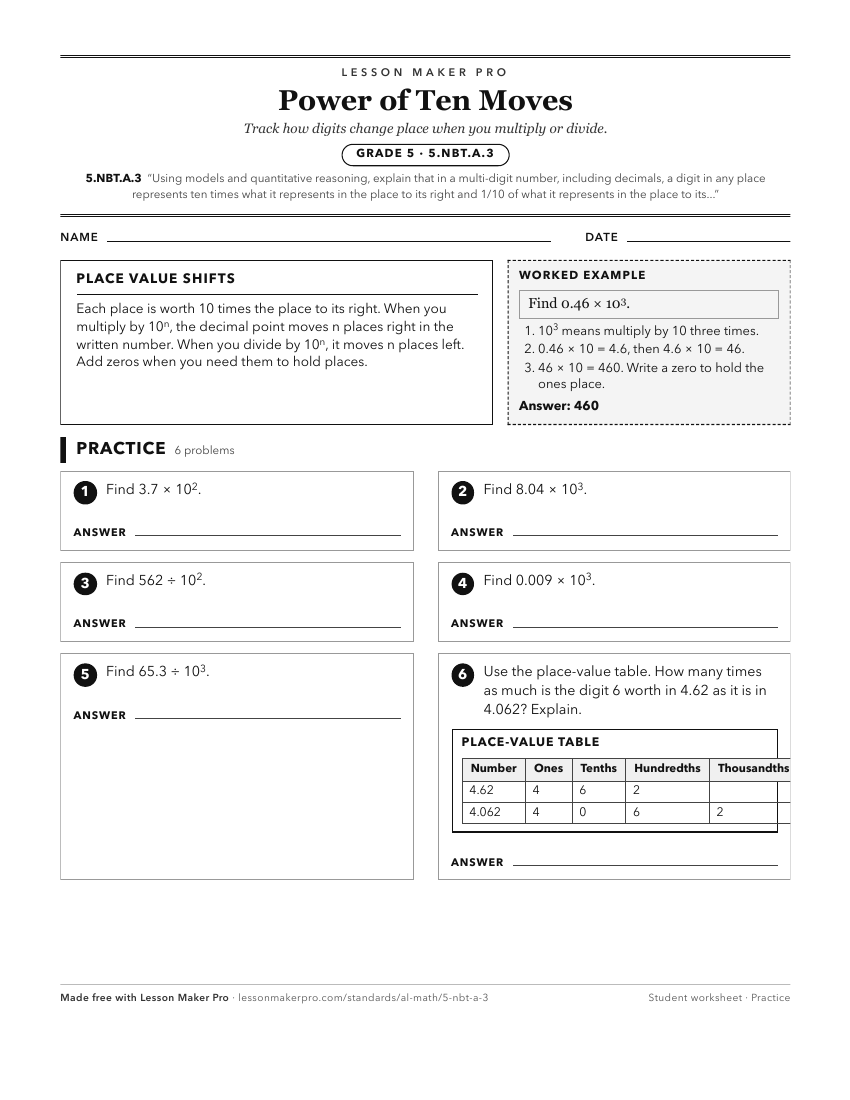
A ready-to-print activity worksheet aligned to 5.NBT.A.3, with an answer key for the teacher on its own page. No account needed.
PDF, US Letter, prints cleanly in black and white.
Download the worksheetKeep exploring
Related Standards
- 4.NBT.A.6
Using models and quantitative reasoning, explain that in a multi-digit whole number, a digit in any place represents ten times what it represents in the place t...
- 1.NBT.B.11
Explain that the two digits of a two-digit number represent amounts of tens and ones.
- 4.NF.C.18
Use models and decimal notation to represent fractions with denominators of 10 and 100.
- 2.NBT.A.6
Explain that the three digits of a three-digit number represent amounts of hundreds, tens, and ones.
Turn this cluster into a lesson
Grade, subject, topic, and the complete cluster are prefilled. Create one free, no account needed.
Also for this cluster:Make a WorksheetMake a QuizMake a Sub Lesson