Alabama Math 1.NBT.C.13
Standard Cluster
- 1.NBT.C
- Use place value understanding and properties of operations to add and subtract.
Add within 100, using concrete models or drawings and strategies based on place value. a. Add a two-digit number and a one-digit number. b. Add a two-digit number and a multiple of 10. c. Demonstrate that in adding two-digit numbers, tens are added to tens, ones are added to ones, and sometimes it is necessary to compose a ten. d. Relate the strategy for adding a two-digit number and a one-digit number to a written method and explain the reasoning used.
2019 Alabama Course of Study: Mathematics · Operations with Numbers: Base Ten
Cluster contents
Standards in This Cluster
1.NBT.C.13 is a cluster heading. These are the individual standards under it.
- 1.NBT.C.13.a
Add a two-digit number and a one-digit number.
- 1.NBT.C.13.b
Add a two-digit number and a multiple of 10.
- 1.NBT.C.13.c
Demonstrate that in adding two-digit numbers, tens are added to tens, ones are added to ones, and sometimes it is necessary to compose a ten.
- 1.NBT.C.13.d
Relate the strategy for adding a two-digit number and a one-digit number to a written method and explain the reasoning used.
Teacher's field guide
What This Cluster Means
What Students Need to Do
- Students add a two-digit number to a one-digit number, a multiple of ten, or another two-digit number. They use blocks or drawings to combine tens with tens and ones with ones. They make a new ten when the ones add to ten or more.
What Mastery Looks Like
- For 27 + 15, a student shows 3 tens and 12 ones, then trades 10 ones for 1 ten. They write 42 and explain where the extra ten came from. They can show how their drawing matches their written work.
Common Misconceptions
- Some students add each place separately and write 27 + 15 as 312. Others change the ones digit when adding 20, or forget to trade 10 ones for 1 ten.
How to Assess It
- Exit ticket: Solve 28 + 15 with a tens-and-ones drawing and a written method. Circle the ten made from ones and explain where it goes.
Lesson moves
Ways to Teach It
Give pairs base-ten blocks to build 36 + 8 and 36 + 20, then have them trade 10 ones for a ten when needed.
Ask, "Why is 27 + 15 equal to 42, not 312?" Have students explain with a labeled tens-and-ones sketch.
Play Addition Match with cards labeled 48 + 7, 55, and a drawing of five tens and five ones.
Show a class library tally of 28 books and 16 new books; students draw tens and ones to find the new total.
Free download
Printable 1.NBT.C.13 Worksheet
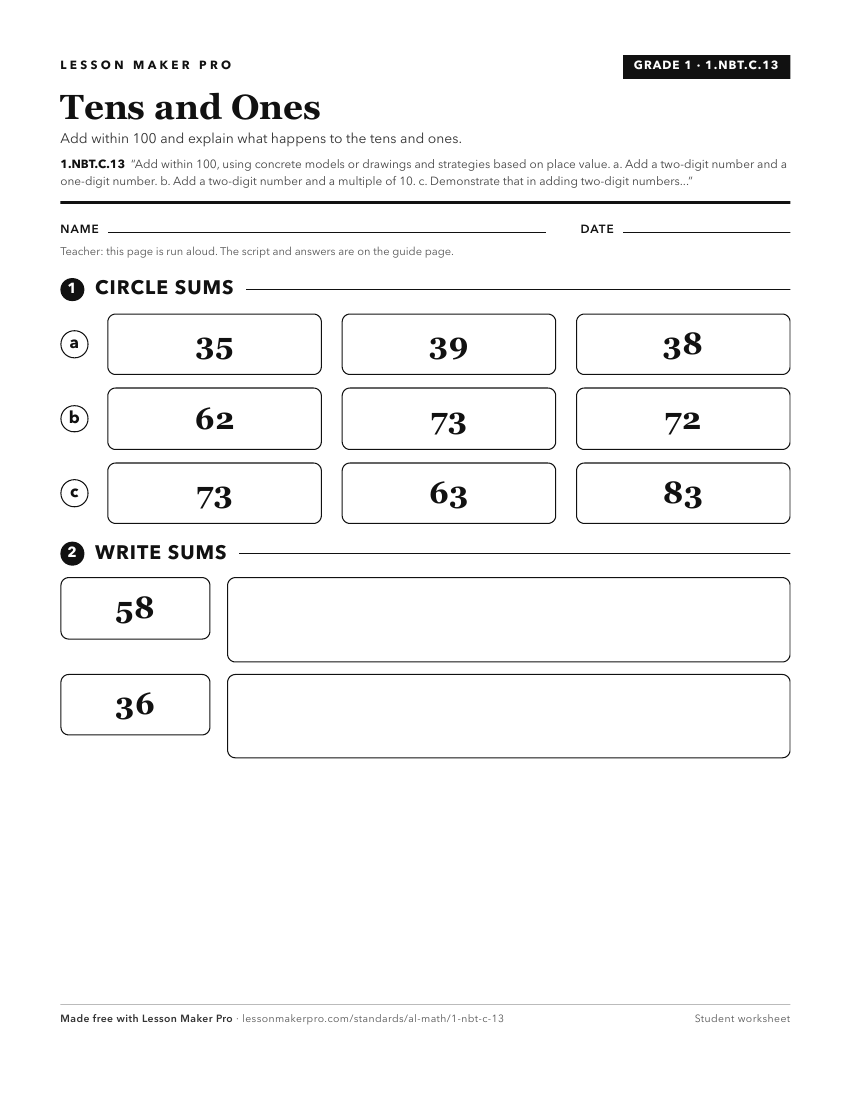
A ready-to-print activity worksheet aligned to 1.NBT.C.13, with an answer key for the teacher on its own page. No account needed.
PDF, US Letter, prints cleanly in black and white.
Download the worksheetKeep exploring
Related Standards
Turn this cluster into a lesson
Grade, subject, topic, and the complete cluster are prefilled. Create one free, no account needed.
Also for this cluster:Make a WorksheetMake a QuizMake a Sub Lesson