Alabama Math 1.NBT.C.13.d
The Standard
- 1.NBT.C
- Use place value understanding and properties of operations to add and subtract.
- 1.NBT.C.13
- Add within 100, using concrete models or drawings and strategies based on place value.
Relate the strategy for adding a two-digit number and a one-digit number to a written method and explain the reasoning used.
2019 Alabama Course of Study: Mathematics
Teacher's field guide
What This Standard Means
What Students Need to Do
- Students add a one-digit number to a two-digit number using tens and ones. They write steps that match their strategy and explain what happens when ten ones make a new ten.
What Mastery Looks Like
- For 27 + 5, a student can show two tens and twelve ones, then trade ten ones for a new ten. They write 27 + 3 + 2 = 32 and explain that adding 3 first makes 30.
Common Misconceptions
- Some students add 5 as five tens instead of five ones. Others find that 7 + 5 = 12 but write 212 because they do not trade ten ones for a ten.
How to Assess It
- Exit ticket: Solve 28 + 5. Draw tens and ones, write the steps you used, and explain where the new ten came from.
Lesson moves
Ways to Teach It
Build 27 with ten-sticks and cubes, add five cubes, trade ten cubes for a ten-stick, then write matching addition steps.
Show 27 + 5 = 27 + 3 + 2 and ask, “Why split 5 into 3 and 2?”
Draw a two-digit card and a one-digit card, sketch the tens and ones, then write the steps to find the sum.
Count 28 classroom pencils, add 5 new pencils, and record how the ones make a new ten.
Free download
Printable 1.NBT.C.13.d Worksheet
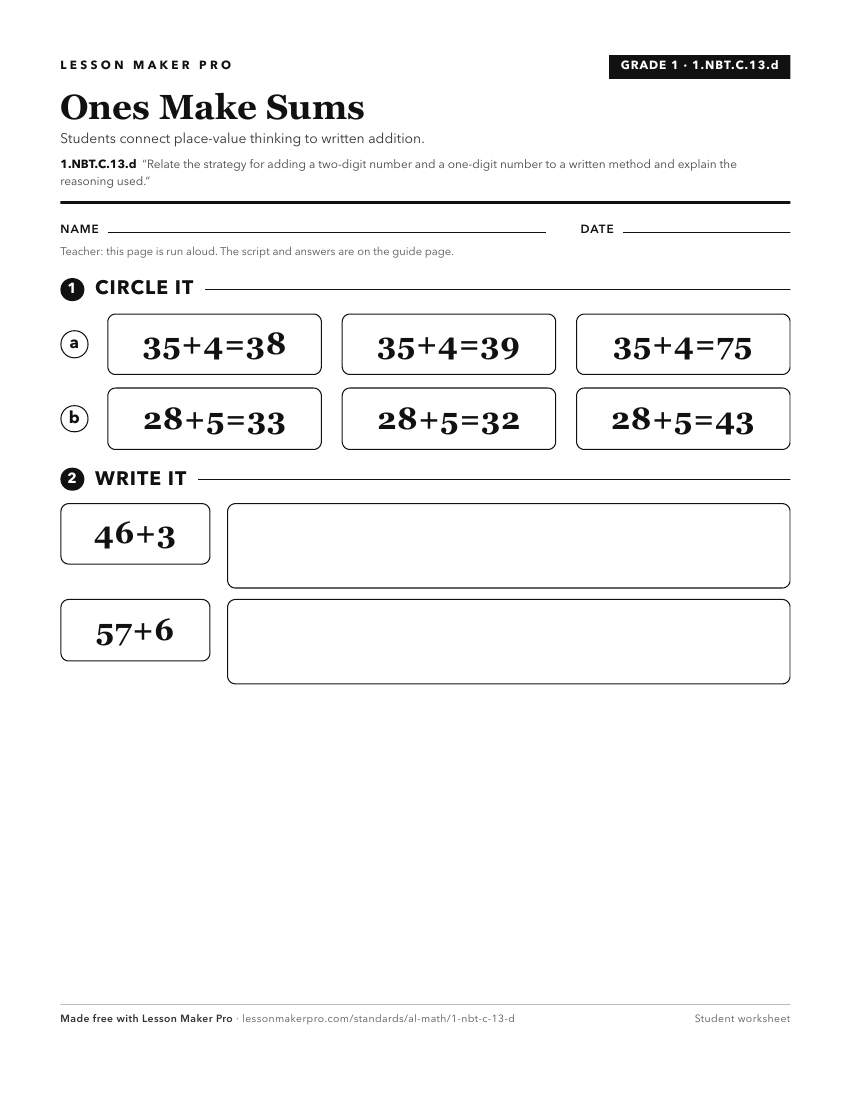
A ready-to-print activity worksheet aligned to 1.NBT.C.13.d, with an answer key for the teacher on its own page. No account needed.
PDF, US Letter, prints cleanly in black and white.
Download the worksheetKeep exploring
Related Standards
Turn this exact standard into a lesson
Grade, subject, topic, and the complete standard are prefilled. Create one free, no account needed.
Also for this standard:Make a WorksheetMake a QuizMake a Sub Lesson