Alabama ELA 8.CL.6
The Standard
Evaluate the development of central and supporting ideas in recorded or live presentations by examining the speaker’s rhetorical strategies and choices regarding point of view, purpose, comparisons, analogies, categories, allusions, and figurative, connotative, and technical word meanings.
2021 Alabama Course of Study: English Language Arts
Teacher's field guide
What This Standard Means
What Students Need to Do
- Students listen to a talk and track how its main idea gains support from start to finish. They judge how the speaker’s viewpoint, purpose, comparisons, groupings, references, and word choices shape that idea.
What Mastery Looks Like
- A student can point to where the main idea first appears, where a detail develops it, and where the speaker returns to it. They can cite a line and explain how an analogy or reference works. They can also explain how a figurative, loaded, or technical word affects listeners.
Common Misconceptions
- Students may name the topic instead of the main idea, or list details without explaining how they build it. They may treat a comparison as proof or take a figure of speech literally. They may miss a reference or assume a technical word has its everyday meaning.
How to Assess It
- Say: “Our 7:30 start leaves many students tired; an 8:30 start could help them focus; at 7:30, their brains are phones on one percent.” Ask: “What is my claim, which detail supports it, and what does the phone comparison add?”
Lesson moves
Ways to Teach It
Give students a printed transcript of a one-minute school-start speech; they place sticky notes on its claim, supports, comparisons, and loaded words.
Ask pairs: “Why call tired students ‘phones on one percent’? Who might disagree with that comparison, and why?”
Read a school-start argument using “Cinderella,” “night owls,” and “melatonin”; teams race to label the allusion, grouping, and technical term, then explain each.
Stage a school board bus-time hearing; partners give 30-second comments, then identify how calling riders “students” or “commuters” shapes an argument.
Free download
Printable 8.CL.6 Worksheet
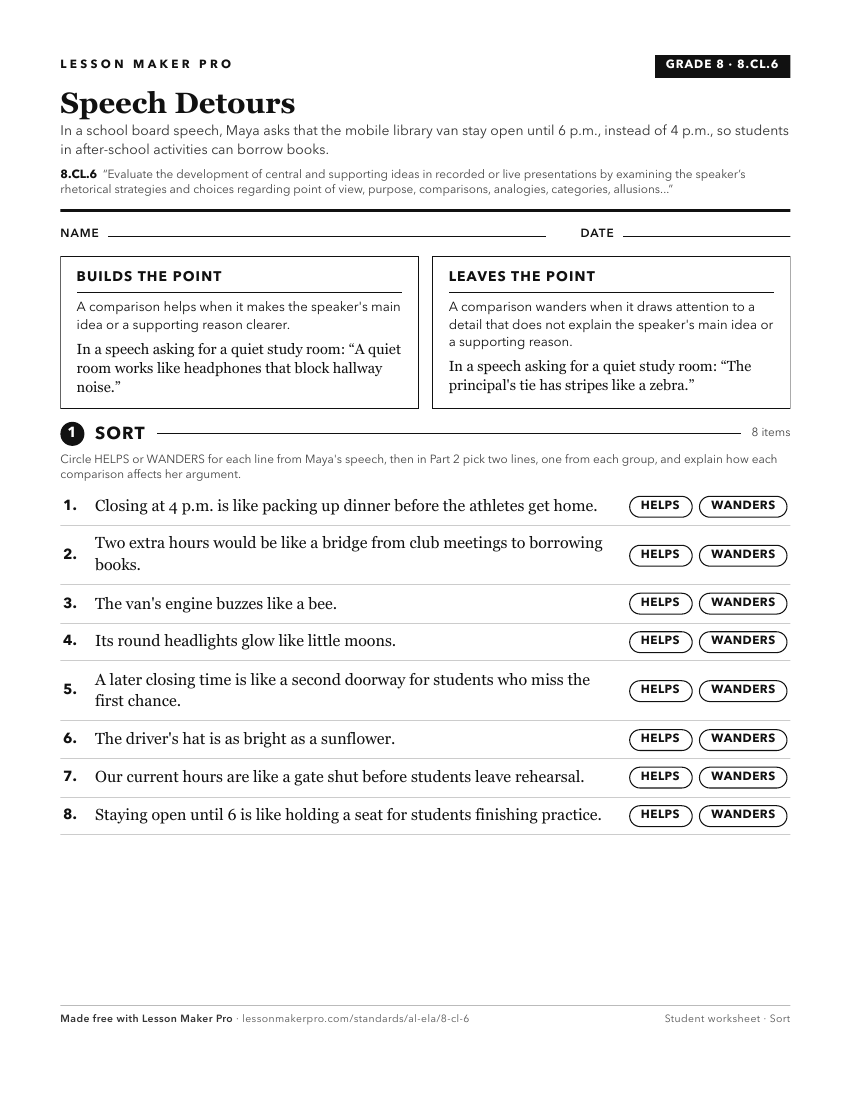
A ready-to-print activity worksheet aligned to 8.CL.6, with an answer key for the teacher on its own page. No account needed.
PDF, US Letter, prints cleanly in black and white.
Download the worksheetKeep exploring
Related Standards
- 6.CL.5
Evaluate the development of central and supporting ideas in recorded or live presentations by examining the speaker's rhetorical choices regarding point of view...
- 7.CL.5
Evaluate rhetorical strategies used to develop central and supporting ideas in recorded or live presentations, including point of view, purpose, comparison, cat...
- 8.LL.19
Evaluate a speaker's rhetorical and organizational choices in order to determine point of view, purpose, and effectiveness.
- 6.CL.1
Identify and explain an author's rhetorical choices, including point of view, purpose, anecdotes, and figurative, connotative, and technical word meanings, to d...
Turn this exact standard into a lesson
Grade, subject, topic, and the complete standard are prefilled. Create one free, no account needed.
Also for this standard:Make a WorksheetMake a QuizMake a Sub Lesson