Alabama ELA 5.LF.20
The Standard
Explain how the author's use of character types throughout a narrative helps drive its plot.
2021 Alabama Course of Study: English Language Arts · Literacy Foundations 4-5
Teacher's field guide
What This Standard Means
What Students Need to Do
- Students identify the lead character, a character who blocks a goal, and anyone who helps. They explain how each character's actions change what happens next.
What Mastery Looks Like
- In Cinderella, a student can explain how the stepmother keeps Cinderella from the ball and the fairy godmother helps her get there. They can connect those actions to the lost slipper and the search that follows.
Common Misconceptions
- Students may call every mean character a villain without checking whether that character blocks the lead's goal. They may list traits, such as kind or selfish, instead of explaining how a choice causes an event.
How to Assess It
- After reading Cinderella, ask: "How do the stepmother and fairy godmother each change what happens after Cinderella wants to go to the ball? Name one event each causes."
Lesson moves
Ways to Teach It
Give pairs Cinderella event cards and lead, blocker, and helper cards; have them draw arrows showing which character causes each event.
Ask, "If the fairy godmother never arrived, which event would disappear, and why?"
Play Plot Cause Match: students match Cinderella character cards to event cards, then explain each match before keeping the pair.
Have students write a six-line school talent show story with a performer, a competitor, and a friend, then underline each role's plot-changing action.
Free download
Printable 5.LF.20 Worksheet
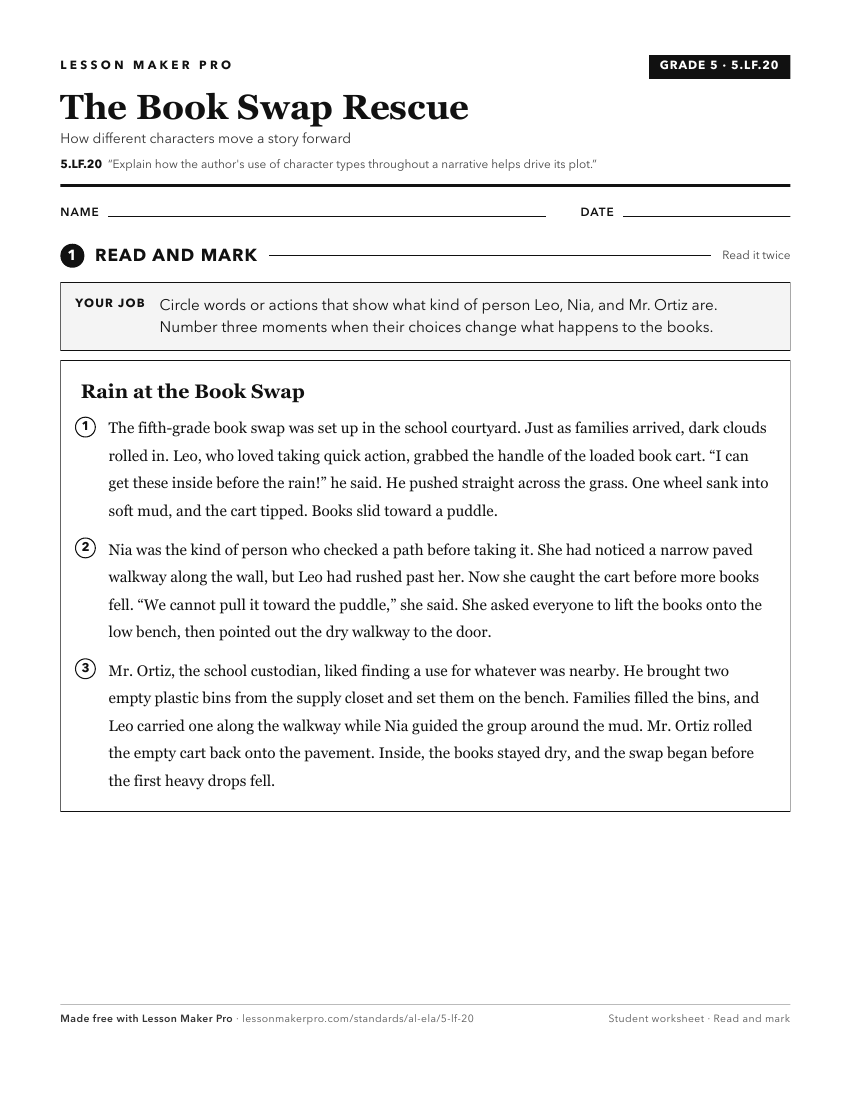
A ready-to-print activity worksheet aligned to 5.LF.20, with an answer key for the teacher on its own page. No account needed.
PDF, US Letter, prints cleanly in black and white.
Download the worksheetKeep exploring
Related Standards
- 3.LF.22.b
Explain how the characters' actions and dialogue contribute to the meaning of the story.
- 3.LF.22.a
Describe in detail the characters' behavior, emotions, and traits and explain how their actions influence events in the story.
- 6.CL.7.a
Write narratives incorporating key literary elements, including characters, plot, setting, point of view, resolution of a conflict, dialogue, and sensory detail...
- 2.LF.23.b
Describe the characters' traits, feelings, and behaviors in a story.
Turn this exact standard into a lesson
Grade, subject, topic, and the complete standard are prefilled. Create one free, no account needed.
Also for this standard:Make a WorksheetMake a QuizMake a Sub Lesson