Alabama ELA 2.LF.23.b
The Standard
- 2.LF.23
- Identify the main story elements in a literary text.
Describe the characters’ traits, feelings, and behaviors in a story.
2021 Alabama Course of Study: English Language Arts
Teacher's field guide
What This Standard Means
What Students Need to Do
- Students tell the difference between what a character is like, how the character feels, and what the character does. They use story details to explain their answers.
What Mastery Looks Like
- A student says Maya is kind because she invites a new classmate to play. They name her nervous feeling and point to the invitation as her action.
Common Misconceptions
- Students may call 'scared' a lasting trait or mistake 'runs away' for a feeling. They may assume a character feels the same way throughout the story, even when events change.
How to Assess It
- Read aloud: 'Maya felt nervous when she saw a new student sitting alone, but she invited him to play.' Ask students to name one trait, one feeling, and one action, then explain what shows the trait.
Lesson moves
Ways to Teach It
After reading The Three Little Pigs, have pairs place sticky notes reading 'careful,' 'afraid,' and 'builds with bricks' on a trait, feeling, action mat.
Ask partners, 'How might the third pig feel when the wolf arrives, and what in the story gives you that clue?'
Play a three-pile sort with cards reading 'kind,' 'worried,' 'shares her lunch,' 'runs away,' 'brave,' and 'excited.'
After recess, have students complete: 'I felt __ when __. I __. That action showed I was __.'
Free download
Printable 2.LF.23.b Worksheet
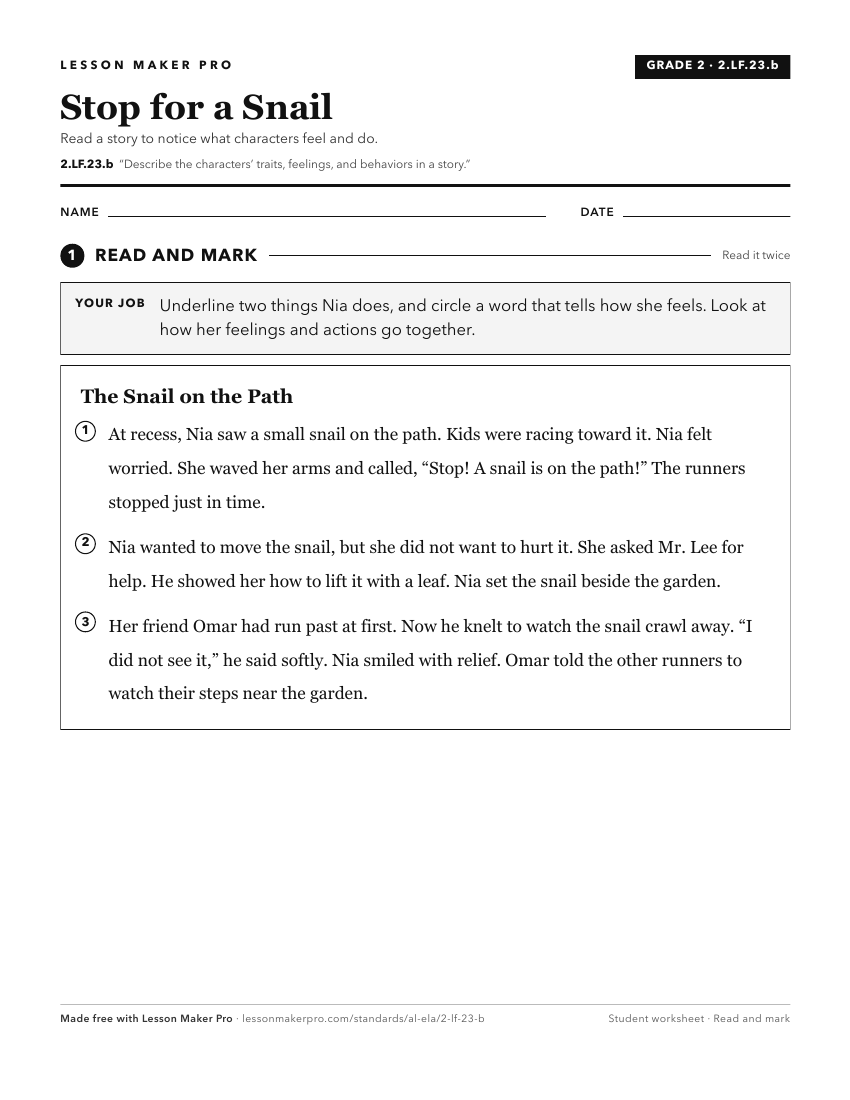
A ready-to-print activity worksheet aligned to 2.LF.23.b, with an answer key for the teacher on its own page. No account needed.
PDF, US Letter, prints cleanly in black and white.
Download the worksheetKeep exploring
Related Standards
- 3.LF.22.a
Describe in detail the characters' behavior, emotions, and traits and explain how their actions influence events in the story.
- 1.LF.23.a
Describe the characters and settings, using illustrations and textual evidence from a story.
- 3.LF.22.b
Explain how the characters' actions and dialogue contribute to the meaning of the story.
- 4.LF.15.a
Identify and explain attitudes and influences of multiple characters within a text.
Turn this exact standard into a lesson
Grade, subject, topic, and the complete standard are prefilled. Create one free, no account needed.
Also for this standard:Make a WorksheetMake a QuizMake a Sub Lesson