Alabama ELA 4.LF.15.a
The Standard
- 4.LF.15
- Analyze in depth a character, setting, or event in a story or drama, drawing on specific details in the text.
Identify and explain attitudes and influences of multiple characters within a text.
2021 Alabama Course of Study: English Language Arts
Teacher's field guide
What This Standard Means
What Students Need to Do
- Students describe how at least two characters feel or think about a person or event. They explain what shapes those views and how the characters affect each other's choices, using details from the text.
What Mastery Looks Like
- A student can explain why the lion first dismisses the mouse and why the mouse later helps him. They can use the release and rescue scenes to show how each character affects the other.
Common Misconceptions
- Students may call a character “nice” without saying what that character thinks about a specific person or event. They may describe what a character does but not explain why, or discuss only one character.
How to Assess It
- After reading “The Lion and the Mouse,” ask: “How do the lion and mouse each view the other at first? How does each one’s action affect the other? Use two story details.”
Lesson moves
Ways to Teach It
Give pairs lion and mouse cards plus three event strips: capture, release, rescue; students sort which events change each character’s view.
Ask: “Why does the lion let the mouse go, and what does the mouse’s rescue make him think later?” Require a line from each scene.
Play a match game with lion, mouse, attitude, and action cards; students build two sets and cite a story detail for each.
Show texts, “I hate the canceled game” and “Let’s practice indoors”; students label each attitude and explain how the reply might change the first.
Free download
Printable 4.LF.15.a Worksheet
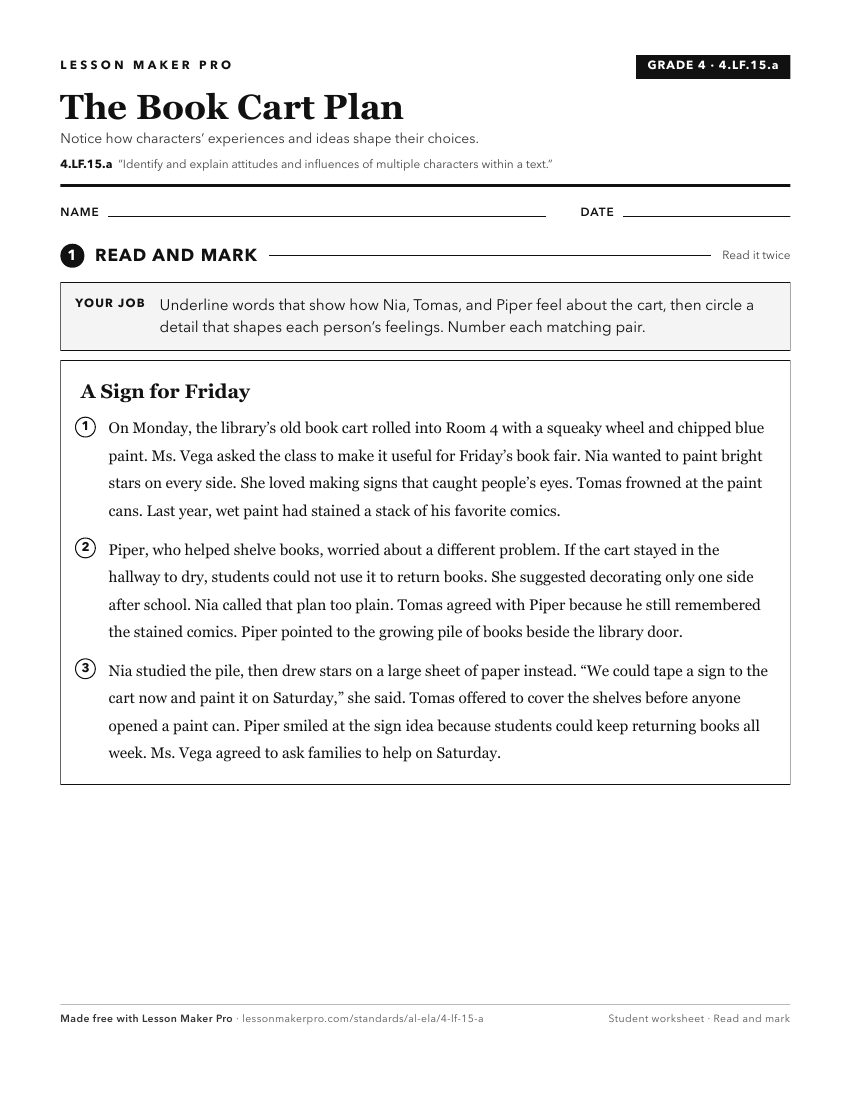
A ready-to-print activity worksheet aligned to 4.LF.15.a, with an answer key for the teacher on its own page. No account needed.
PDF, US Letter, prints cleanly in black and white.
Download the worksheetKeep exploring
Related Standards
- 4.LF.18.b
Compare the perspectives of different characters within a text.
- 3.LF.22.a
Describe in detail the characters' behavior, emotions, and traits and explain how their actions influence events in the story.
- K.LF.32.b
Compare and contrast the experiences of characters in a literary text.
- 2.LF.23.b
Describe the characters' traits, feelings, and behaviors in a story.
Turn this exact standard into a lesson
Grade, subject, topic, and the complete standard are prefilled. Create one free, no account needed.
Also for this standard:Make a WorksheetMake a QuizMake a Sub Lesson