Alabama ELA 5.LF.12
Standard Cluster
Interpret the meaning of words, phrases, and patterns as they are used in texts, including domain-specific and academic vocabulary and figurative language. a. Locate similes, metaphors, personification, hyperbole, imagery, alliteration, onomatopoeia, and idioms and interpret their meanings in context. b. Explain the meanings of common idioms, adages, and proverbs. c. Use the relationships between synonyms, antonyms, and homographs to increase understanding of word meanings. d. Explain how an author’s vocabulary and style influence the tone and mood of a text and support his/her purpose for writing. e. Use common, grade-appropriate Greek and Latin affixes and roots as clues to the meanings of words.
2021 Alabama Course of Study: English Language Arts · Literacy Foundations 4-5
Cluster contents
Standards in This Cluster
5.LF.12 is a cluster heading. These are the individual standards under it.
- 5.LF.12.a
Locate similes, metaphors, personification, hyperbole, imagery, alliteration, onomatopoeia, and idioms and interpret their meanings in context.
- 5.LF.12.b
Explain the meanings of common idioms, adages, and proverbs.
- 5.LF.12.d
Explain how an author's vocabulary and style influence the tone and mood of a text and support his/her purpose for writing.
Teacher's field guide
What This Cluster Means
What Students Need to Do
- Students use context, word parts, and word relationships to work out unfamiliar words. They explain figurative phrases, idioms, adages, and proverbs. They show how an author's word choices shape tone, mood, and purpose.
What Mastery Looks Like
- Students can spot a simile, metaphor, personification, hyperbole, imagery, alliteration, or onomatopoeia and explain its meaning in context. They explain idioms and proverbs, use roots and affixes, and check synonyms, antonyms, and homographs against context. They point to specific words that reveal tone or create a mood.
Common Misconceptions
- Students may read idioms literally or call every comparison a simile. They may treat both meanings of a homograph as interchangeable or let a prefix override sentence clues. They may confuse the author's tone with the feeling a passage creates.
How to Assess It
- For an exit ticket, give students: 'The wind whispered as Maya trudged home, carrying the weight of the world.' Ask them to identify the personification, explain the idiom, and name one word that creates the mood.
Lesson moves
Ways to Teach It
Give pairs tele, scope, re, and play cards; have them build telescope and replay, then check each meaning in a sentence.
Read 'The hallway swallowed our whispers' and ask how swallowed shapes the mood compared with carried.
Play homograph match with 'river bank/bank account,' 'baseball bat/cave bat,' and 'dog bark/tree bark' cards; students explain each meaning.
Use two weather forecast screenshots, one saying 'scattered showers' and one saying 'severe storm'; have students compare the expectations each creates.
Free download
Printable 5.LF.12 Worksheet
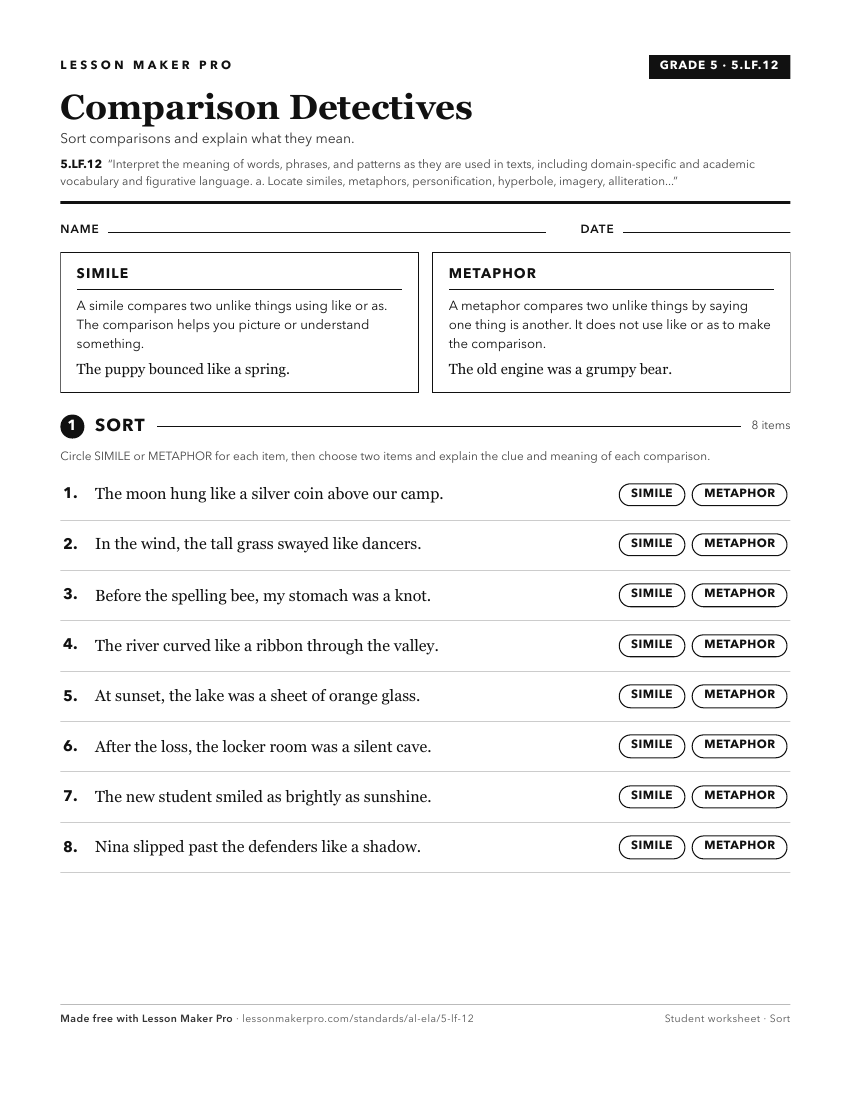
A ready-to-print activity worksheet aligned to 5.LF.12, with an answer key for the teacher on its own page. No account needed.
PDF, US Letter, prints cleanly in black and white.
Download the worksheetKeep exploring
Related Standards
Turn this cluster into a lesson
Grade, subject, topic, and the complete cluster are prefilled. Create one free, no account needed.
Also for this cluster:Make a WorksheetMake a QuizMake a Sub Lesson