Alabama ELA 3.LF.14
Standard Cluster
Describe word relationships and nuances in word meanings, including relating them to their opposites and distinguishing shades of meaning in similar or related words, including nouns, verbs, and adjectives. a. Determine meaning of words using synonyms in context. b. Determine meaning of words using antonyms as a clue. c. Describe the similarities and differences between related words. d. Use knowledge of homophones to determine appropriate use of words. e. Interpret figurative language. f. Identify relationships and nuances in word meanings to determine real-life connections between words and their use.
2021 Alabama Course of Study: English Language Arts · Literacy Foundations K-3
Cluster contents
Standards in This Cluster
3.LF.14 is a cluster heading. These are the individual standards under it.
- 3.LF.14.a
Determine meaning of words using synonyms in context.
- 3.LF.14.b
Determine meaning of words using antonyms as a clue.
- 3.LF.14.c
Describe the similarities and differences between related words.
- 3.LF.14.d
Use knowledge of homophones to determine appropriate use of words.
- 3.LF.14.e
Interpret figurative language.
- 3.LF.14.f
Identify relationships and nuances in word meanings to determine real-life connections between words and their use.
Teacher's field guide
What This Cluster Means
What Students Need to Do
- Students use nearby words and opposites to figure out meanings. They compare related nouns, verbs, and adjectives to explain small differences. They also choose the right homophone and explain figurative phrases.
What Mastery Looks Like
- A student can explain how a nearby word helps define an unfamiliar one. They can explain why sprinted suggests more speed than ran, choose hear instead of here, and describe when someone might say a backpack weighs a ton.
Common Misconceptions
- Students may treat angry and furious as if they mean exactly the same thing. They may choose a homophone by sound alone, such as writing here when they mean hear. They may take a phrase like 'my head is spinning' literally.
How to Assess It
- Exit ticket: 'Tara was furious, not calm, when she heard the news. She said, “My head is spinning.”' Ask what furious means, why heard fits instead of herd, and what Tara means by her last sentence.
Lesson moves
Ways to Teach It
Place run, jog, and sprint word cards on a speed line, then have students act out each verb to check their order.
Ask, 'When might someone say their backpack weighs a ton?' Have partners explain the phrase and write a sentence using it.
Play clue swap: read 'The room was dim, not bright'; teams explain dim and replace it with a close word.
Use a grocery list with pear and pair; students circle the fruit word, then write a sentence using the other.
Free download
Printable 3.LF.14 Worksheet
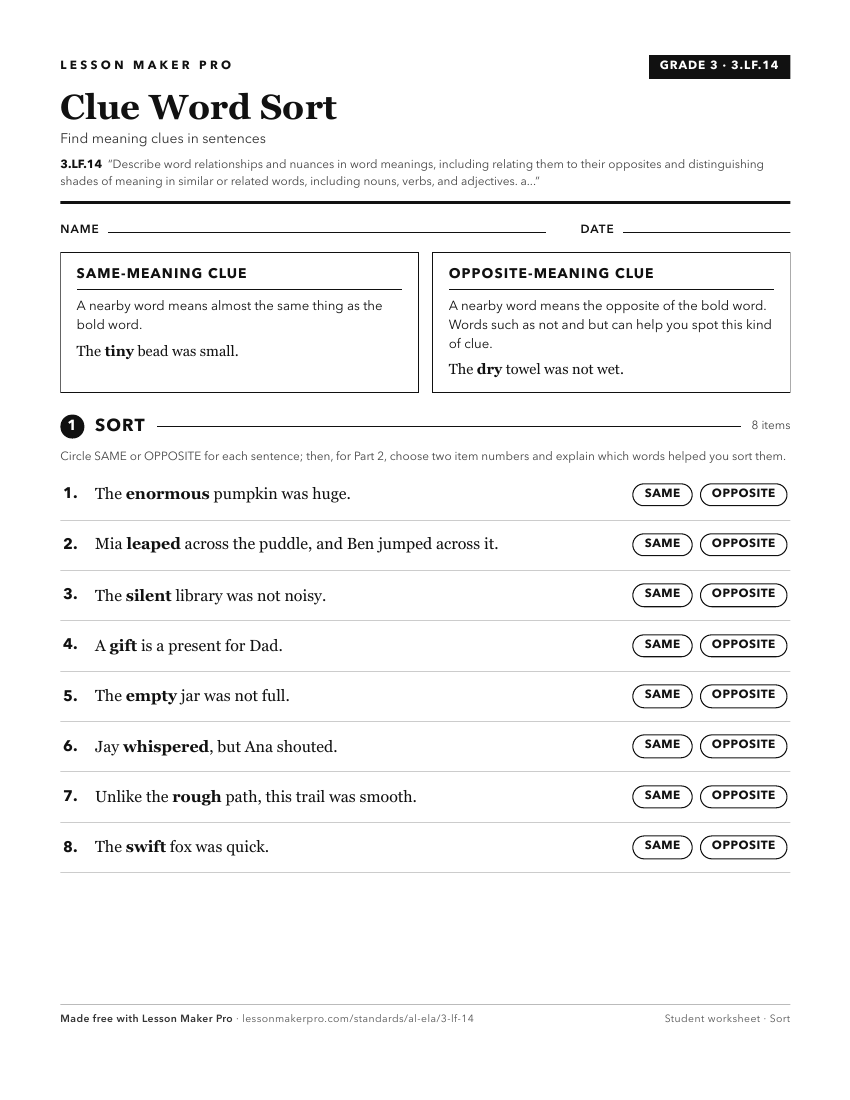
A ready-to-print activity worksheet aligned to 3.LF.14, with an answer key for the teacher on its own page. No account needed.
PDF, US Letter, prints cleanly in black and white.
Download the worksheetKeep exploring
Related Standards
- 2.LF.16
Describe word relationships and nuances in word meanings, including relating them to their opposites and distinguishing shades of meaning in similar or related ...
- 1.LF.12.c
Describe word relationships and nuances in word meanings, including relating them to their opposites and distinguishing shades of meaning in similar or related ...
- K.LF.19.a
Describe the relationship between words, including relating them to synonyms and antonyms.
Turn this cluster into a lesson
Grade, subject, topic, and the complete cluster are prefilled. Create one free, no account needed.
Also for this cluster:Make a WorksheetMake a QuizMake a Sub Lesson