Alabama ELA 2.LF.23.e
The Standard
- 2.LF.23
- Identify the main story elements in a literary text.
Identify the theme in myths, fables, and folktales.
2021 Alabama Course of Study: English Language Arts
Teacher's field guide
What This Standard Means
What Students Need to Do
- Students read or listen to a myth, fable, or folktale and name the message it teaches. They use a character's choices and the ending as clues.
What Mastery Looks Like
- A student can say, 'Even someone small can help,' rather than just 'helping.' They can point to an event in the story that supports that message.
Common Misconceptions
- Students may name a topic, such as friendship, instead of a message about friendship. They may retell what happened or choose a lesson that the ending does not support.
How to Assess It
- After reading The Empty Pot, ask students to write: 'What lesson does this tale teach? Give one event that supports your answer.'
Lesson moves
Ways to Teach It
Draw four event cards for The Lion and the Mouse; pairs order them and mark the choice that reveals the message.
After reading King Midas, ask, 'What does Midas learn about wanting more, and which moment shows it?'
Match Stone Soup, The Empty Pot, and The Lion and the Mouse to cards reading 'Sharing helps,' 'Tell the truth,' and 'Small friends help.'
Have students write about a time someone unexpected helped them, then compare that moment with The Lion and the Mouse.
Free download
Printable 2.LF.23.e Worksheet
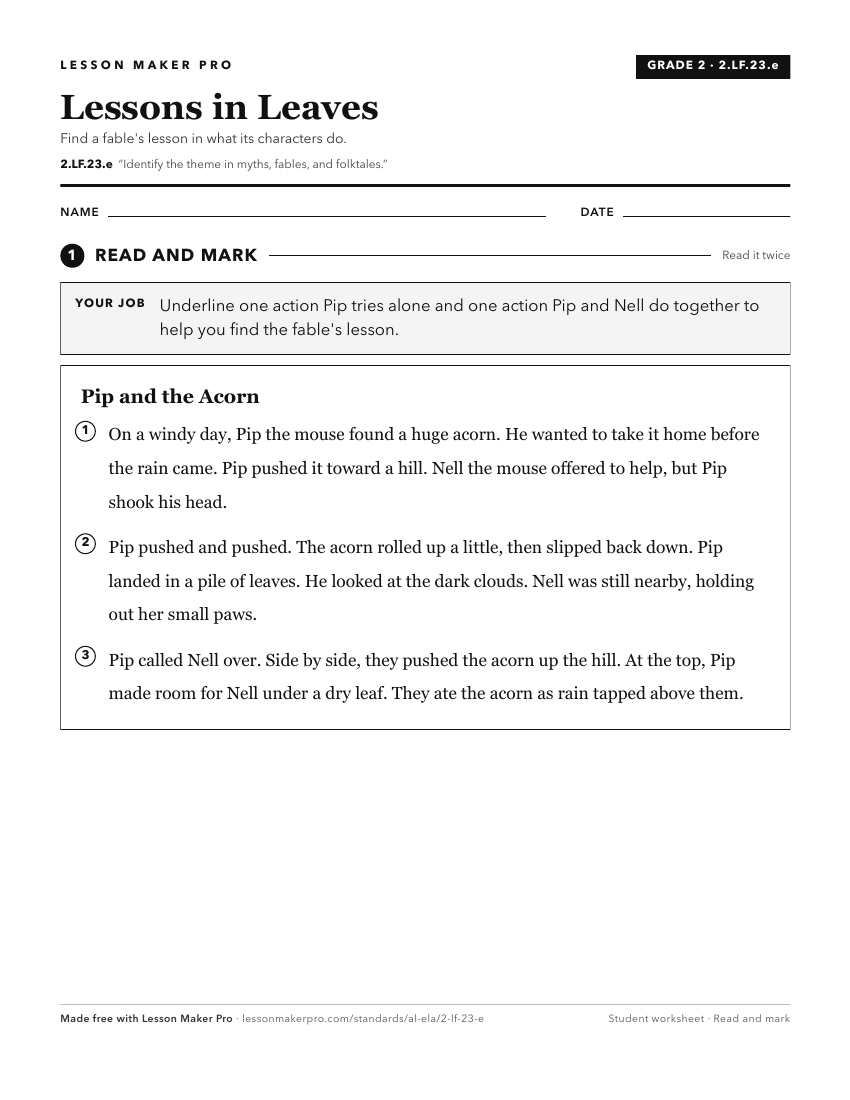
A ready-to-print activity worksheet aligned to 2.LF.23.e, with an answer key for the teacher on its own page. No account needed.
PDF, US Letter, prints cleanly in black and white.
Download the worksheetKeep exploring
Related Standards
- 4.LF.19.b
Analyze a common or shared theme and its development in stories, myths, and/or other traditional literature.
- 4.LF.19.a
Determine and state an implied theme, explicit theme, or life lesson from a myth, story, or other traditional literature.
- 4.LF.19
Compare and contrast the treatment of similar themes in stories, myths, and traditional literature from different cultures.
- 3.LF.22.c
Identify the central message, theme, or moral in a story, including myths, fables, and folktales, and explain the meaning conveyed in the passage.
Turn this exact standard into a lesson
Grade, subject, topic, and the complete standard are prefilled. Create one free, no account needed.
Also for this standard:Make a WorksheetMake a QuizMake a Sub Lesson