Alabama ELA 2.LF.23.d
The Standard
- 2.LF.23
- Identify the main story elements in a literary text.
Identify the central message or moral of a story.
2021 Alabama Course of Study: English Language Arts
Teacher's field guide
What This Standard Means
What Students Need to Do
- Students read or listen to a story and say what lesson the characters' choices teach. They point to an event that supports that lesson.
What Mastery Looks Like
- A student says that the boy's repeated lies made people stop trusting him. They use the villagers ignoring his real warning as evidence.
Common Misconceptions
- Students may retell the ending instead of naming a lesson. They may say the lesson is 'wolves are bad,' missing how the boy's choices caused the problem.
How to Assess It
- After reading The Boy Who Cried Wolf, ask: 'What lesson does the story teach? Name one event that shows it.'
Lesson moves
Ways to Teach It
Give pairs cards showing two false alarms and one real wolf; have them order the cards and explain the lesson.
Ask, 'Why did the villagers ignore the boy's real warning? What could he have done differently?'
Read 'the boy cried wolf' and 'lying breaks trust'; students hold up an 'event' or 'lesson' card for each.
Describe a child who repeatedly claims their lunch is missing when it is in their bag; ask how the story's lesson applies.
Free download
Printable 2.LF.23.d Worksheet
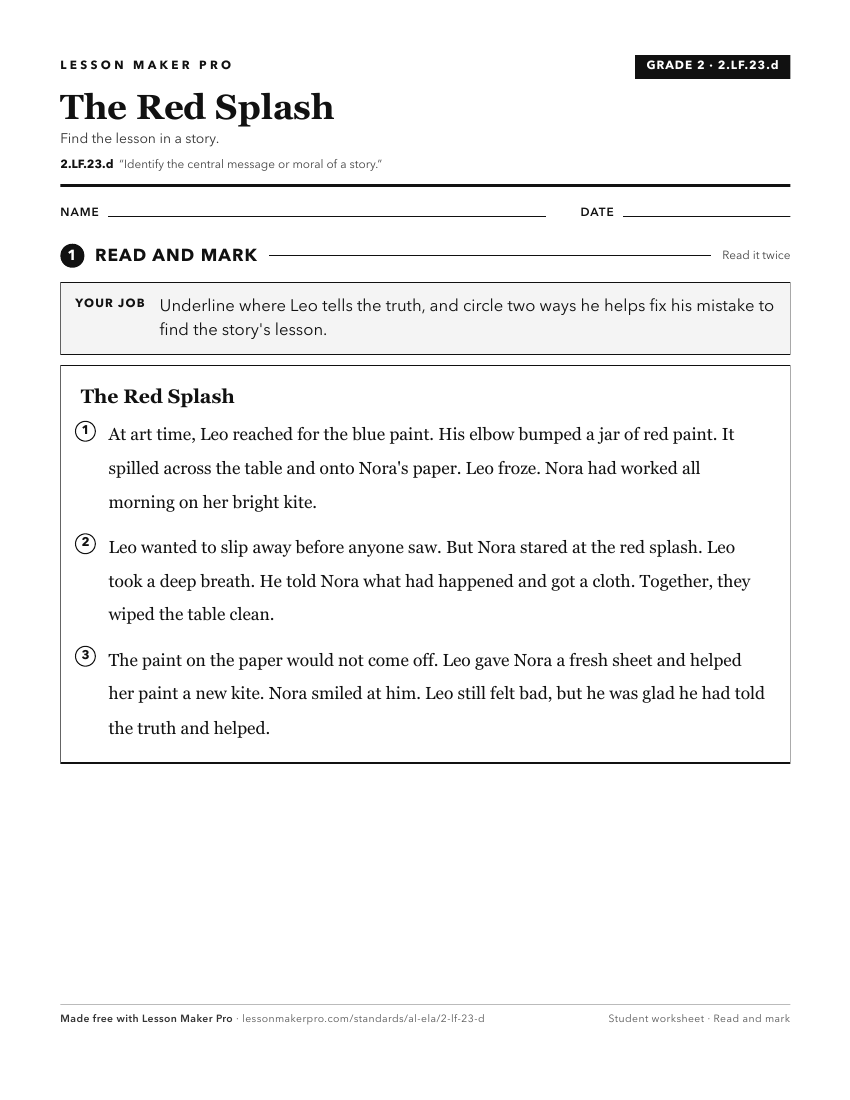
A ready-to-print activity worksheet aligned to 2.LF.23.d, with an answer key for the teacher on its own page. No account needed.
PDF, US Letter, prints cleanly in black and white.
Download the worksheetKeep exploring
Related Standards
- 3.LF.22.c
Identify the central message, theme, or moral in a story, including myths, fables, and folktales, and explain the meaning conveyed in the passage.
- 4.LF.21.a
Determine the central idea or theme of a text.
- 1.LF.26
With prompting and support, use textual evidence to explain the central message or moral of a literary text.
- 4.LF.19.a
Determine and state an implied theme, explicit theme, or life lesson from a myth, story, or other traditional literature.
Turn this exact standard into a lesson
Grade, subject, topic, and the complete standard are prefilled. Create one free, no account needed.
Also for this standard:Make a WorksheetMake a QuizMake a Sub Lesson