Alabama ELA 12.CL.5
The Standard
Evaluate structural and organizational details in texts to determine the author's purpose, including cases in which the meaning is ironic or satirical.
2021 Alabama Course of Study: English Language Arts
Teacher's field guide
What This Standard Means
What Students Need to Do
- Students track how a writer opens, builds, and ends a piece. They use that order, along with any mismatch between praise and facts, to explain what the writer really means.
What Mastery Looks Like
- A student can point to a glowing headline, a list of failures, and a sharp closing line, then explain why the praise is not sincere. They can explain how that sequence builds the writer's criticism.
Common Misconceptions
- Students may take exaggerated praise at face value and miss the criticism. They may spot sarcasm but ignore how a late reveal or repeated example shapes the writer's point.
How to Assess It
- Exit ticket: Read 'Our school has solved lunch lines: students wait 20 minutes, then get five minutes to eat; clearly, the line needs to be longer' and explain why the praise comes first and what the writer wants changed.
Lesson moves
Ways to Teach It
Give pairs strips reading 'Perfect lunch,' 'Wait 20 minutes,' and 'Eat in five'; students order them to build a sarcastic complaint.
Put 'Great news: lunch now takes 20 minutes' on the board, then ask why a writer might lead with 'Great news.'
Match cards labeled 'Perfect Lunch Lines' and 'Speedy Buses' to endings about long waits and late arrivals; explain each mismatch.
Compare a school lunch schedule with a mock review that opens with 'fine dining' and ends with a 20-minute wait; explain the order.
Free download
Printable 12.CL.5 Worksheet
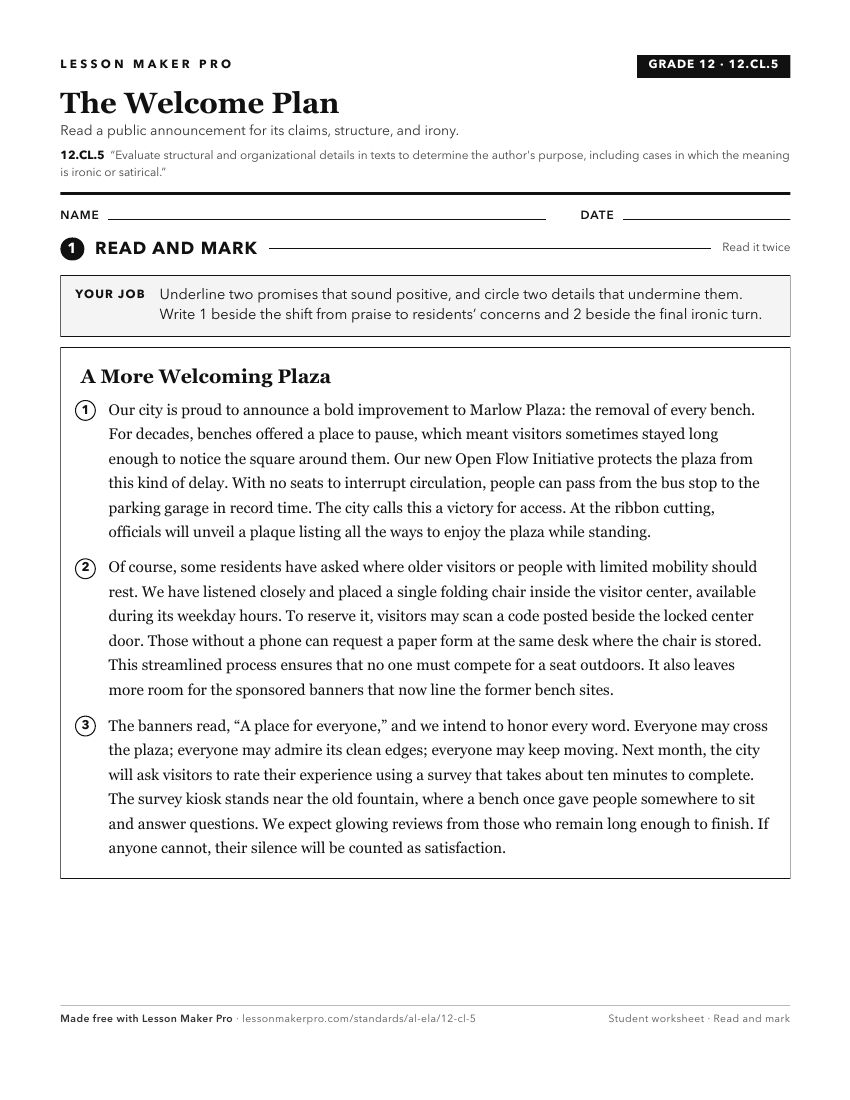
A ready-to-print activity worksheet aligned to 12.CL.5, with an answer key for the teacher on its own page. No account needed.
PDF, US Letter, prints cleanly in black and white.
Download the worksheetKeep exploring
Related Standards
- 11.CL.5
Evaluate structural and organizational details in literary, nonfiction/informational, digital, and multimodal texts to determine how genre supports the author's...
- 11.CL.6
Analyze a text's explicit and implicit meanings to make inferences about its theme and determine the author's purpose.
- 12.CL.6
Analyze a text's explicit and implicit meanings to make inferences about its theme and determine the author's purpose.
- 2.LF.31
Use information from a text to determine the author's purpose in different forms of informational and literary texts.
Turn this exact standard into a lesson
Grade, subject, topic, and the complete standard are prefilled. Create one free, no account needed.
Also for this standard:Make a WorksheetMake a QuizMake a Sub Lesson