Alabama ELA 2.LF.31
The Standard
Use information from a text to determine the author’s purpose in different forms of informational and literary texts.
2021 Alabama Course of Study: English Language Arts · Literacy Foundations K-3
Teacher's field guide
What This Standard Means
What Students Need to Do
- Students figure out why a writer made a text, such as to share facts, tell a story, give directions, or persuade. They use details from the text to explain their answer.
What Mastery Looks Like
- A student can tell why an author wrote a frog fact page and why another wrote a frog story. They can point to a detail in each text that supports their answer.
Common Misconceptions
- Students may say a frog story is meant to teach frog facts just because it mentions frogs. They may name the topic instead of the writer’s goal. They may also assume every story is written only to entertain.
How to Assess It
- Show these sentences: “Frogs breathe through their skin” and “Frog wore a tiny crown to the pond.” Ask, “Why did each writer write this?” Have students circle a clue in each sentence.
Lesson moves
Ways to Teach It
Give pairs four printed cards, a frog fact, a frog story, a recipe, and a party flyer, to sort by purpose and underline clues.
After reading a frog story and fact card, ask, “Why did each writer make this text, and which detail gives you a clue?”
Play Purpose Match: students draw a text card, name the writer’s goal, and keep the card only if they point to evidence.
Show today’s lunch menu and a book fair poster that says “Come buy books!” Have students explain each writer’s goal using one clue.
Free download
Printable 2.LF.31 Worksheet
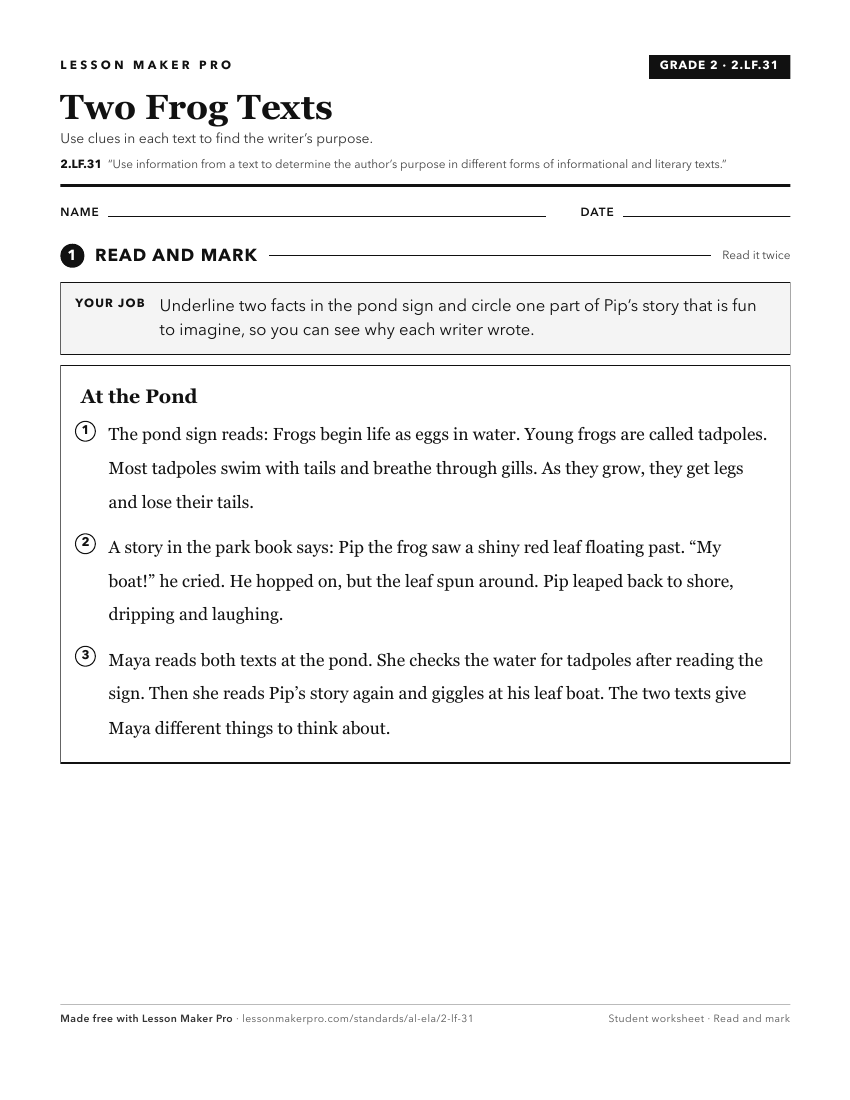
A ready-to-print activity worksheet aligned to 2.LF.31, with an answer key for the teacher on its own page. No account needed.
PDF, US Letter, prints cleanly in black and white.
Download the worksheetKeep exploring
Related Standards
- 11.CL.6
Analyze a text's explicit and implicit meanings to make inferences about its theme and determine the author's purpose.
- 12.CL.6
Analyze a text's explicit and implicit meanings to make inferences about its theme and determine the author's purpose.
- 7.CL.2
Evaluate how effectively an author uses structures of informational texts, including comparison and contrast, problem and solution, cause and effect, and substa...
- 2.LF.28
Establish a purpose before reading literary and informational texts to enhance comprehension.
Turn this exact standard into a lesson
Grade, subject, topic, and the complete standard are prefilled. Create one free, no account needed.
Also for this standard:Make a WorksheetMake a QuizMake a Sub Lesson