Alabama ELA 11.LL.21
The Standard
Analyze a speaker’s rhetorical, aesthetic, and organizational choices in order to determine point of view, purpose, and effectiveness.
2021 Alabama Course of Study: English Language Arts
Teacher's field guide
What This Standard Means
What Students Need to Do
- Students listen to a speech and analyze its rhetorical, aesthetic, and organizational choices. They use heard wording, imagery, repetition, and the order of ideas to explain the speaker’s point of view and purpose and judge effectiveness for the intended audience.
What Mastery Looks Like
- After hearing a speech, a student identifies a repeated phrase or vivid image and traces the sequence of ideas. They explain how these choices support the speaker’s position and purpose, then judge their likely effect on the audience using specific evidence from what they heard.
Common Misconceptions
- Students may name repetition or imagery without explaining its effect, or call a speech effective simply because they agree with it. A transcript helps verify wording after listening; silent reading alone does not demonstrate analysis of an audible speech.
How to Assess It
- Read aloud this school-board comment: “I nod off in first period; 40 of 50 students we surveyed report the same; please move the first bell to 8:30.” With the text covered, students explain the speaker’s position and purpose, then judge how the move from experience to survey evidence could affect board members.
Lesson moves
Ways to Teach It
Read a complete short school-board speech aloud while students listen without the transcript. They note its position, purpose, opening image, and order of ideas.
Read a graduation speech excerpt aloud twice. Students first listen, then use the transcript to check a repeated phrase or image and explain its likely effect on graduates.
After hearing a speech, students match heard phrases to possible audience effects and defend one judgment using specific wording and the speaker’s purpose.
Partners deliver a 30-second crosswalk request aloud. Listeners explain how wording and organization support the request and judge its effectiveness for council members; speakers try a revision.
Free download
Printable 11.LL.21 Worksheet
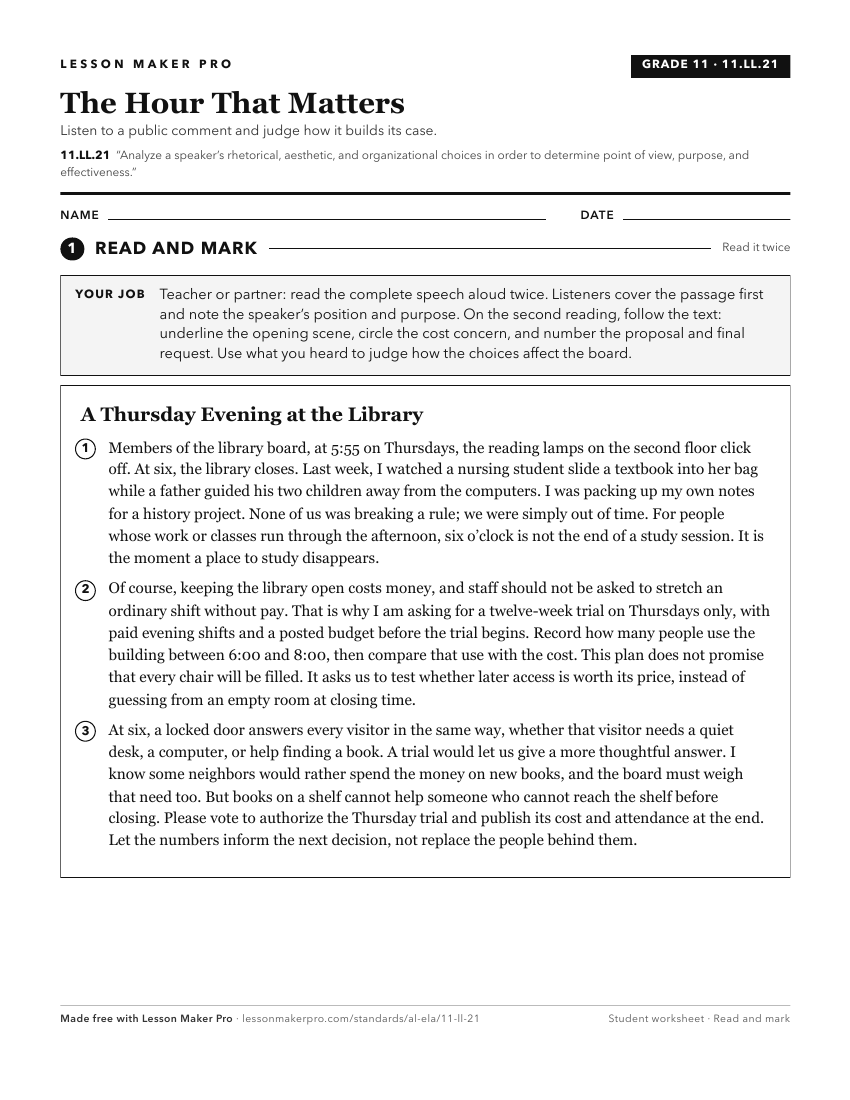
A ready-to-print activity worksheet aligned to 11.LL.21, with an answer key for the teacher on its own page. No account needed.
PDF, US Letter, prints cleanly in black and white.
Download the worksheetKeep exploring
Related Standards
- 12.LL.21
The 12th Grade version of this standard.
- 10.LL.18
Analyze a speaker's rhetorical, aesthetic, and organizational choices in order to determine point of view and purpose.
- 9.LL.18
Analyze a speaker's rhetorical, aesthetic, and organizational choices in order to determine point of view and purpose.
- 8.LL.19
Evaluate a speaker's rhetorical and organizational choices in order to determine point of view, purpose, and effectiveness.
Turn this exact standard into a lesson
Grade, subject, topic, and the complete standard are prefilled. Create one free, no account needed.
Also for this standard:Make a WorksheetMake a QuizMake a Sub Lesson