Wyoming Science HS-LS1-6
The Standard
Construct explanations and revise, as needed, based on evidence for: 1) how carbon, hydrogen, and oxygen may combine with other elements to form amino acids and/or other large carbon-based molecules, and 2) how other hydrocarbons may also combine to form large carbon-based molecules.
2023 Wyoming Science Content and Performance Standards · LS1 From Molecules to Organisms: Structure and Processes
Teacher's field guide
What This Standard Means
What Students Need to Do
- Students use molecule diagrams to explain how carbon, hydrogen, oxygen, and nitrogen can form amino acids. They show how small hydrocarbon molecules can join into long carbon chains. They revise an explanation when a diagram shows a missing atom or an incorrect bond.
What Mastery Looks Like
- A student can point to the nitrogen in an amino acid and explain why carbon, hydrogen, and oxygen alone cannot make it. They can use a diagram to show ethene units joined in a polyethylene chain and correct an explanation that does not match the diagram.
Common Misconceptions
- Students may think a plant gets the carbon in its molecules from soil rather than carbon dioxide in air. They may leave nitrogen out of an amino acid or think hydrocarbons contain oxygen. Some think joining small molecules creates new atoms.
How to Assess It
- Show structures for glycine (NH₂CH₂COOH), ethene (CH₂=CH₂), and a short polyethylene chain. Ask students to explain where a protein gets its nitrogen and how ethene units form a long chain, using the structures as evidence.
Lesson moves
Ways to Teach It
Give pairs colored atom cards to build glycine, then have them point to the carbon, hydrogen, oxygen, and nitrogen atoms.
Ask students to write why a plant cannot make an amino acid from carbon dioxide and water alone, then check for nitrogen.
Give groups cards showing glycine, a protein chain, ethene, and polyethylene; have them match each small molecule to a larger one.
Show a cracker ingredient label and a polyethylene food bag; ask students to identify carbon-based materials in the food and packaging.
Free download
Printable HS-LS1-6 Worksheet
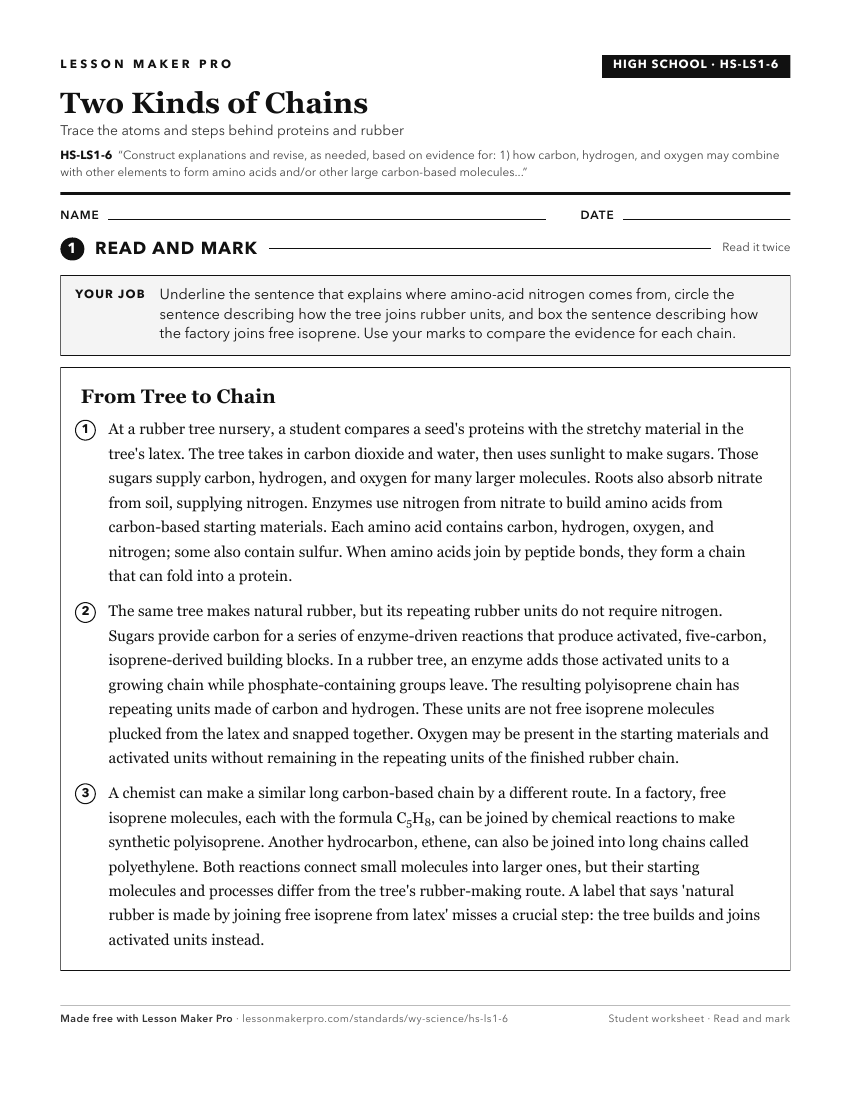
A ready-to-print activity worksheet aligned to HS-LS1-6, with an answer key for the teacher on its own page. No account needed.
PDF, US Letter, prints cleanly in black and white.
Download the worksheetKeep exploring
Related Standards
Turn this exact standard into a lesson
Grade, subject, topic, and the complete standard are prefilled. Create one free, no account needed.
Also for this standard:Make a WorksheetMake a QuizMake a Sub Lesson