Wyoming Math 7.G.4
Standard Cluster
Investigate the concept of circles. Demonstrate an understanding of the proportional relationships between diameter, radius, and circumference of a circle. Understand that π is defined by the constant of proportionality between the circumference and diameter. Given the formulas for circumference and area of circles, solve real-world and mathematical problems.
2023 Wyoming Mathematics Content and Performance Standards · Solve real-life and mathematical problems involving angle measure, area, surface area, and volume.
Cluster contents
Standards in This Cluster
7.G.4 is a cluster heading. These are the individual standards under it.
- 7.G.4a
Demonstrate an understanding of the proportional relationships between diameter, radius, and circumference of a circle.
- 7.G.4b
Understand that π is defined by the constant of proportionality between the circumference and diameter.
- 7.G.4c
Given the formulas for circumference and area of circles, solve real-world and mathematical problems.
Teacher's field guide
What This Cluster Means
What Students Need to Do
- Students measure a circle's radius, diameter, and distance around it. They compare circumference with diameter to make sense of pi. They use given formulas to find circumference and area.
What Mastery Looks Like
- Students find that circumference divided by diameter is about 3.14 for circles of different sizes. Given a radius or diameter, they find circumference and area and use square units for area.
Common Misconceptions
- Students may use diameter instead of radius in the area formula. They may mix up circumference and area, or label area in centimeters instead of square centimeters.
How to Assess It
- Exit ticket: A circular garden has a diameter of 10 m. Find its radius, circumference, and area using 3.14 for pi, then divide the circumference by the diameter.
Lesson moves
Ways to Teach It
Use string and a ruler to measure three jar lids, then record each lid's circumference divided by its diameter.
Draw circles with radii 2 cm and 4 cm, then explain why one has twice the circumference but four times the area.
Make cards for radii 2, 3, and 5 cm, then match each to its diameter, circumference, and area using 3.14.
Mark a jar lid, measure its diameter, predict how far it rolls in 10 turns, then check with a tape measure.
Free download
Printable 7.G.4 Worksheet
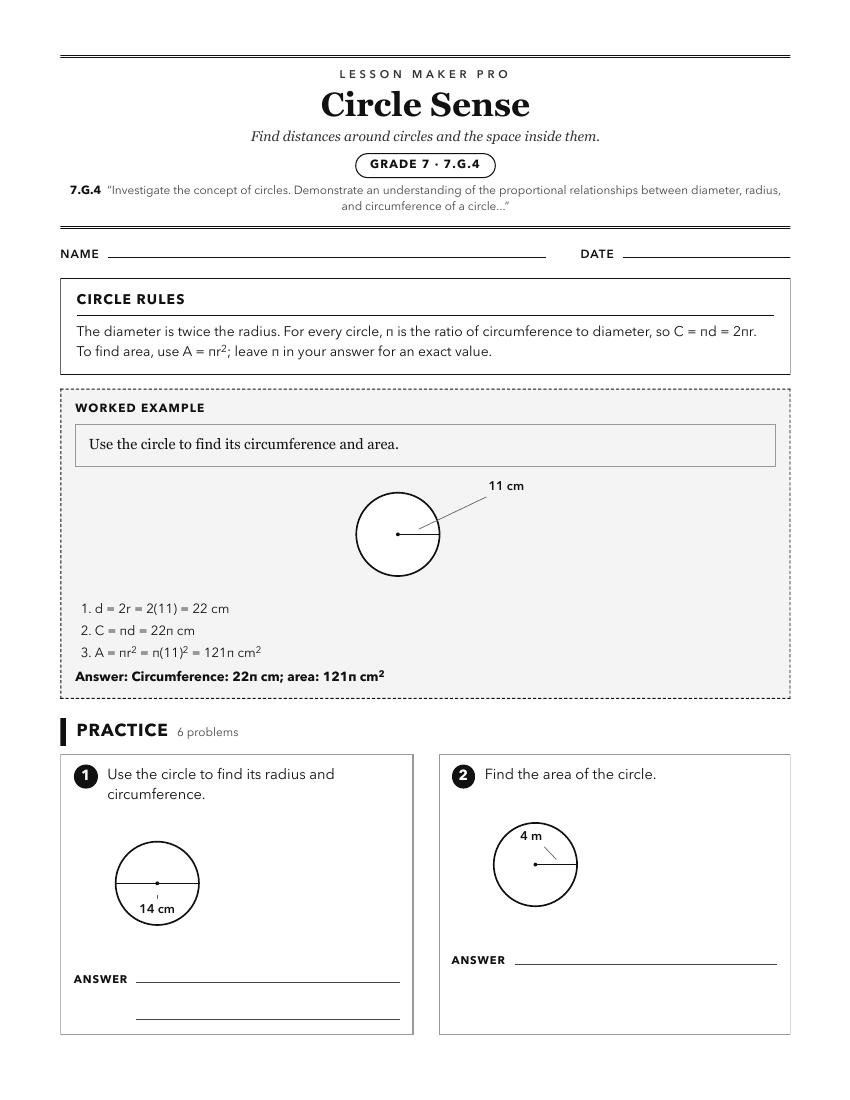
A ready-to-print activity worksheet aligned to 7.G.4, with an answer key for the teacher on its own page. No account needed.
PDF, US Letter, prints cleanly in black and white.
Download the worksheetKeep exploring
Related Standards
Turn this cluster into a lesson
Grade, subject, topic, and the complete cluster are prefilled. Create one free, no account needed.
Also for this cluster:Make a WorksheetMake a QuizMake a Sub Lesson