Virginia SOL 6.CE.1.c
The Standard
Investigate and explain the effect of multiplying or dividing a fraction, whole number, or mixed number by a number between zero and one.*
Virginia Standards of Learning for Mathematics · The student will estimate, demonstrate, solve, and justify solutions to problems using operations with fractions and mixed numbers, including those in context.
Teacher's field guide
What This Standard Means
What Students Need to Do
- Students predict and test how multiplying or dividing a positive number by a value between zero and one changes its size. They explain the change using equations, models, and comparison language.
What Mastery Looks Like
- Students correctly predict whether a product or quotient will be greater than or less than the starting positive number. They support the prediction with a model, numerical example, or clear explanation.
Common Misconceptions
- Students may believe multiplication always makes a number larger and division always makes it smaller. They may also reverse which number is the divisor or use a rule without explaining why the result changes.
How to Assess It
- Give this exit ticket: “Without calculating exactly, compare 6 × 3/4 and 6 ÷ 3/4 to 6. Draw a model and explain each comparison.”
Lesson moves
Ways to Teach It
Use fraction strips to model 4 × 1/2 and 4 ÷ 1/2, then compare each result with 4.
Ask students to explain why multiplying by 2/3 shrinks a positive quantity while dividing by 2/3 enlarges it.
Play a sorting game with expression cards, placing each under “less than,” “equal to,” or “greater than” the starting number.
Compare a recipe made at 3/4 size with the number of 3/4-cup servings that fit into 6 cups.
Free download
Printable 6.CE.1.c Worksheet
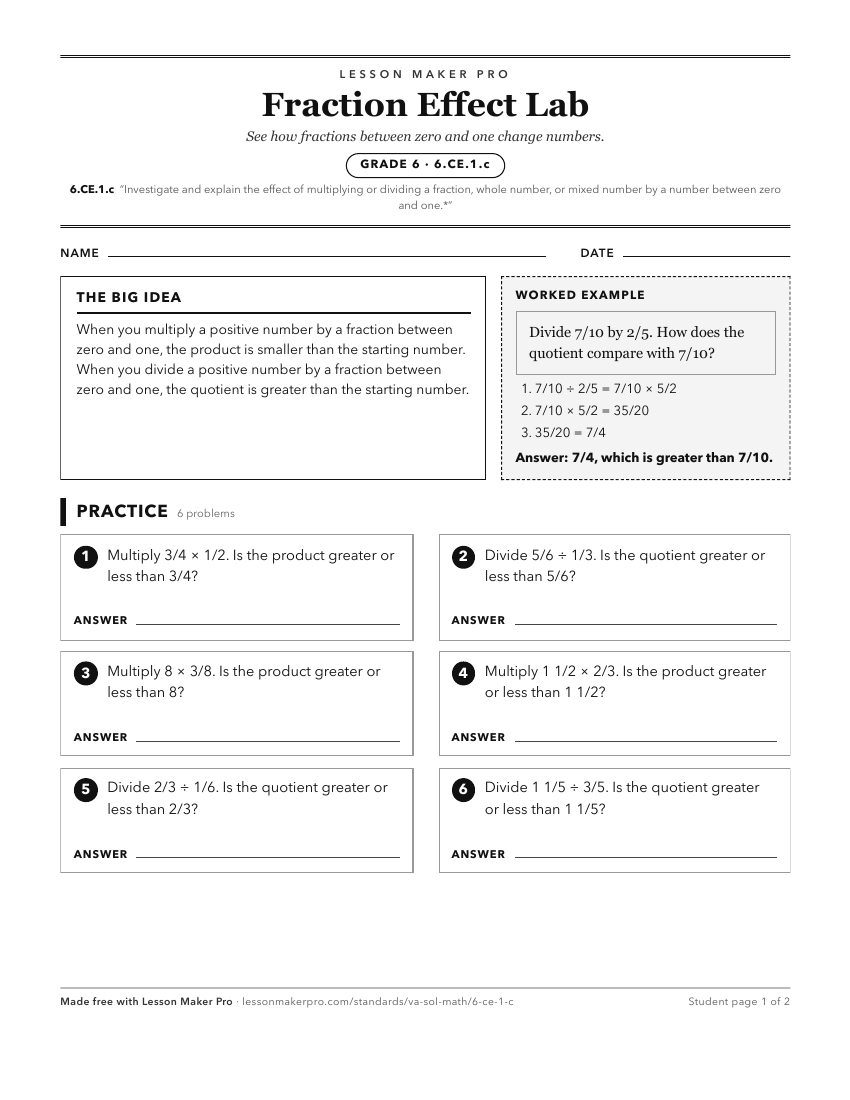
A ready-to-print activity worksheet aligned to 6.CE.1.c, with an answer key for the teacher on its own page. No account needed.
PDF, US Letter, prints cleanly in black and white.
Download the worksheetKeep exploring
Related Standards
- 7.PFA.4.b
Investigate and explain how the solution set of a linear inequality is affected by multiplying or dividing both sides of the inequality statement by a rational ...
- 5.CE.2.b
Estimate and determine the sum or difference of two fractions (proper or improper) and/or mixed numbers, having like and unlike denominators limited to 2, 3, 4,...
- 6.NS.1.c
Represent and determine equivalencies among fractions (proper or improper) and mixed numbers that have denominators that are 12 or less or factors of 100 and pe...
- 6.CE.1.a
Demonstrate/model multiplication and division of fractions (proper or improper) and mixed numbers using multiple representations.*
Turn this exact standard into a lesson
Grade, subject, topic, and the complete standard are prefilled. Create one free, no account needed.
Also for this standard:Make a WorksheetMake a QuizMake a Sub Lesson