Virginia SOL 4.PS.2.e
The Standard
Create a model or contextual problem to represent a given probability.
Virginia Standards of Learning for Mathematics · The student will model and determine the probability of an outcome of a simple event.
Teacher's field guide
What This Standard Means
What Students Need to Do
- Students receive a probability, such as 3/8, and create a matching model or situation. They identify favorable outcomes, total possible outcomes, and explain why the numbers match.
What Mastery Looks Like
- A student can build a spinner, number cube, or object bag whose favorable outcomes match a given probability. The student can also write a clear situation and explain how the model represents the probability.
Common Misconceptions
- Students may reverse the favorable outcomes and total outcomes. They may also draw unequal spinner sections, count only favorable objects, or create a situation where outcomes are not equally likely.
How to Assess It
- Exit ticket: Show a probability of 3/8 with either a labeled spinner or a bag of colored cubes. Explain what the 3 and 8 represent.
Lesson moves
Ways to Teach It
Give pairs counters, paper bags, and target probability cards, then have them build and label a matching bag model.
Ask students to write a prize wheel story for 2/5 and explain which sections represent winning.
Play a matching game where students pair probability cards with spinner diagrams, cube sets, and short situations.
Design a school carnival game with a stated chance of winning, then draw the game materials needed to create that chance.
Free download
Printable 4.PS.2.e Worksheet
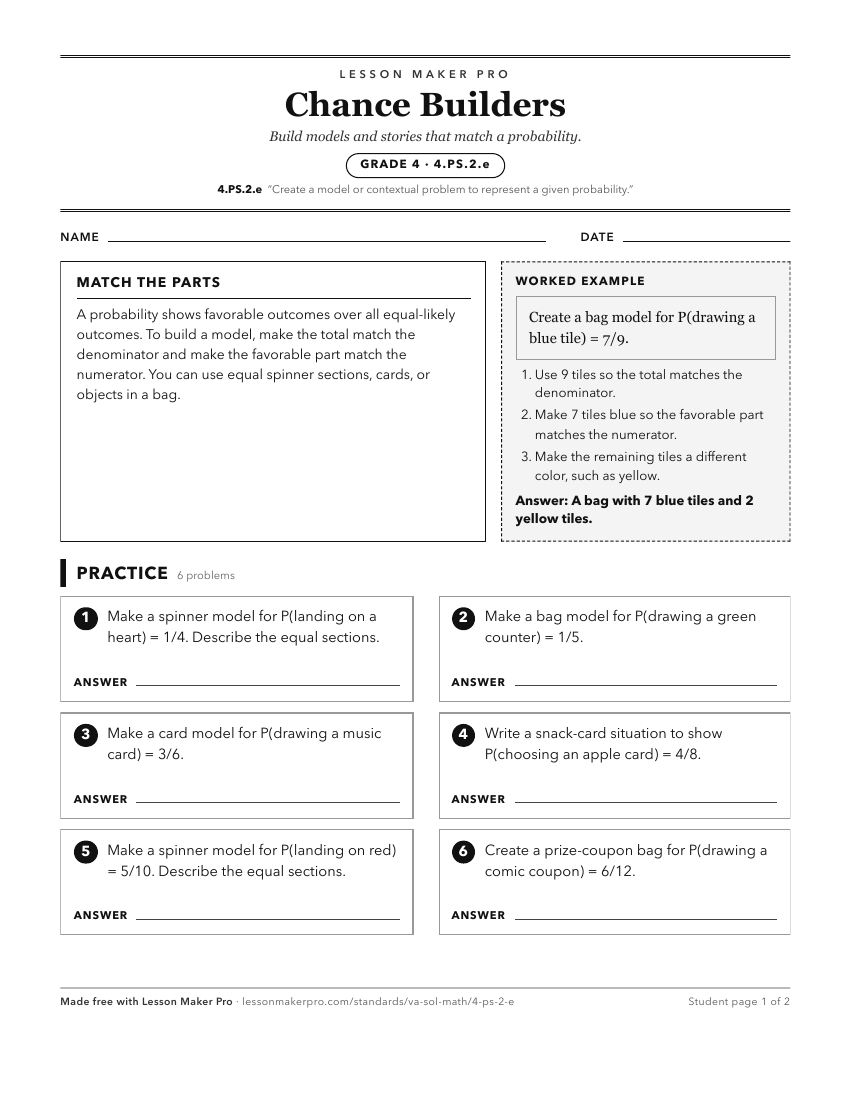
A ready-to-print activity worksheet aligned to 4.PS.2.e, with an answer key for the teacher on its own page. No account needed.
PDF, US Letter, prints cleanly in black and white.
Download the worksheetKeep exploring
Related Standards
- K.CE.1.f
Model and solve single-step contextual problems (join, separate, and part-part-whole) using 10 or fewer concrete objects.
- 5.PS.3
The student will determine the probability of an outcome by constructing a model of a sample space and using the Fundamental (Basic) Counting Principle.
- 6.PFA.1.f
Create a table of equivalent ratios to represent a proportional relationship between two quantities, when given a contextual situation.
- 4.PS.2
The student will model and determine the probability of an outcome of a simple event.
Turn this exact standard into a lesson
Grade, subject, topic, and the complete standard are prefilled. Create one free, no account needed.
Also for this standard:Make a WorksheetMake a QuizMake a Sub Lesson