Virginia SOL 2.MG.1.b.ii
The Standard
the weight of an object to the nearest pound, using a scale
Virginia Standards of Learning for Mathematics · The student will reason mathematically using standard units (U.S. Customary) with appropriate tools to estimate, measure, and compare objects by length, weight, and liquid volume to the nearest whole unit.
Teacher's field guide
What This Standard Means
What Students Need to Do
- Students estimate an object's weight in pounds, then use a scale to measure it to the nearest whole pound. They compare the estimate and measurement to decide whether the estimate was reasonable.
What Mastery Looks Like
- A student chooses pounds, makes a sensible estimate, and uses a scale correctly. The student records the nearest whole pound and compares the result with the estimate.
Common Misconceptions
- Students may confuse pounds with ounces or read the scale between whole-pound marks incorrectly. They may also give an estimate without checking whether it is close to the measured weight.
How to Assess It
- Give students a backpack and a scale. Ask them to estimate its weight, measure to the nearest pound, and write whether their estimate was reasonable.
Lesson moves
Ways to Teach It
Set out classroom objects and a scale, then have pairs estimate and measure each object's weight to the nearest pound.
Ask students to explain which is more reasonable for a full backpack, 2 pounds or 20 pounds, and defend their choice.
Play Weight Match by having students pair object cards with reasonable whole-pound estimates before checking selected objects on a scale.
Use grocery items to estimate and measure how many pounds a reusable shopping bag can hold comfortably.
Free download
Printable 2.MG.1.b.ii Worksheet
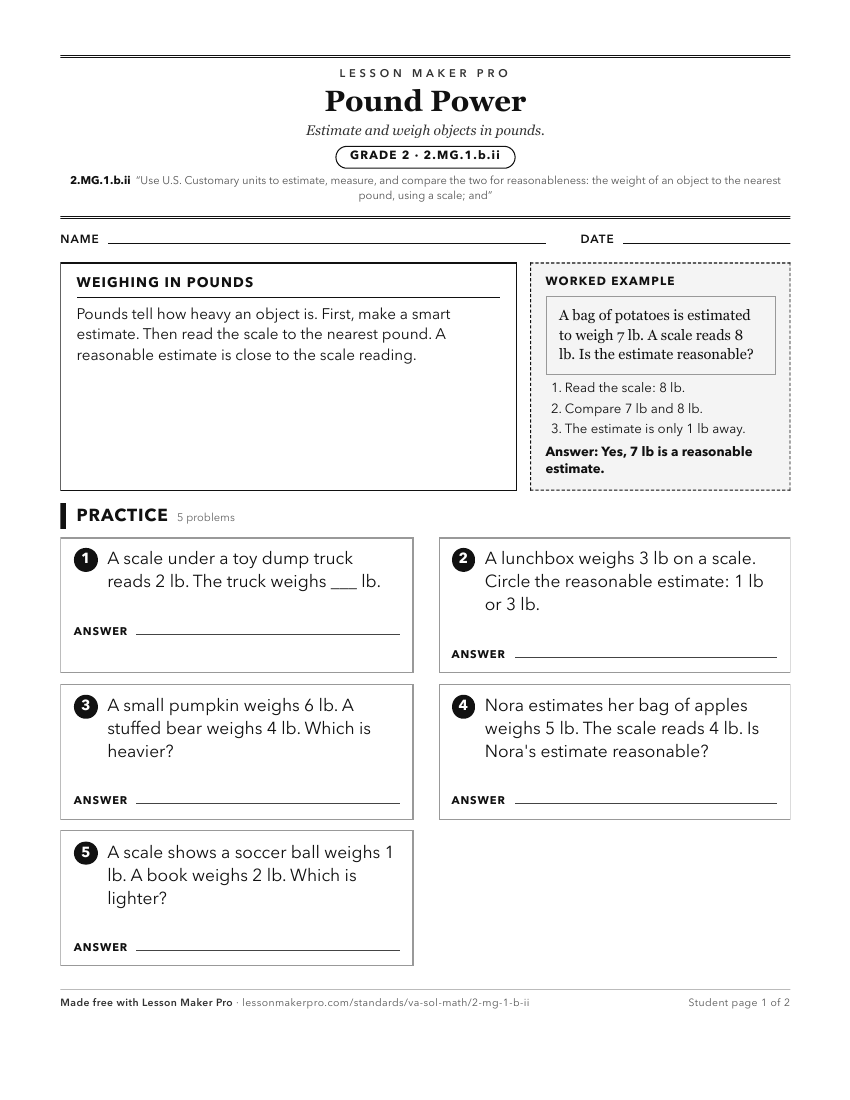
A ready-to-print activity worksheet aligned to 2.MG.1.b.ii, with an answer key for the teacher on its own page. No account needed.
PDF, US Letter, prints cleanly in black and white.
Download the worksheetKeep exploring
Related Standards
- 4.MG.1.b.ii
weight/mass of an object to the nearest U.S. Customary unit (ounce, pound) and nearest metric unit (gram, kilogram)
- 4.MG.1.d.ii
weight/mass (ounces and pounds)
- 1.MG.1.a.ii
weights of two objects (using a balance scale or a pan scale) and compare the measurements using the terms lighter, heavier, or the same as
- 3.MG.1.b.ii
weight/mass of an object to the nearest U.S. Customary unit (pound) and metric unit (kilogram)
Turn this exact standard into a lesson
Grade, subject, topic, and the complete standard are prefilled. Create one free, no account needed.
Also for this standard:Make a WorksheetMake a QuizMake a Sub Lesson