Virginia SOL VS.6.d
The Standard
- VS.6
- The student will apply history and social science skills to explain the establishment and growth of the new American nation with emphasis on the role of Virginians and events in Virginia during the 18th and 19th centuries by
explaining how geographical features and technological advances impacted the western movement in the first half of the 1800s
Virginia Standards of Learning for History and Social Science
Teacher's field guide
What This Standard Means
What Students Need to Do
- Students use maps to identify mountains, rivers, gaps, and routes that shaped travel west. They explain how roads, canals, steamboats, and railroads moved people and goods more quickly.
What Mastery Looks Like
- A student can explain that mountains slowed travel, while gaps and river valleys guided routes. They can connect each transportation advance to faster, cheaper, or safer movement west.
Common Misconceptions
- Students may treat mountains as travel routes rather than barriers that people crossed through gaps. They may label canals and railroads as natural features or include cars and airplanes. Some think rivers only blocked travel and miss their role in transportation and trade.
How to Assess It
- Exit ticket: A Virginia family plans to move west in 1840. Name one geographic feature and one transportation advance that would affect the trip, then explain how.
Lesson moves
Ways to Teach It
Give pairs a relief map, yarn, and route cards to plan a trip west across mountains, rivers, gaps, roads, and canals.
Ask students to write: Which mattered more for western movement, a geographic feature or a transportation advance, and why?
Play a route race where teams choose travel cards, then explain how each mountain, river, road, canal, or railroad changes the trip.
Compare an 1800s travel route with a current Virginia highway map, then list features modern engineers still work around or cross.
Free download
Printable VS.6.d Worksheet
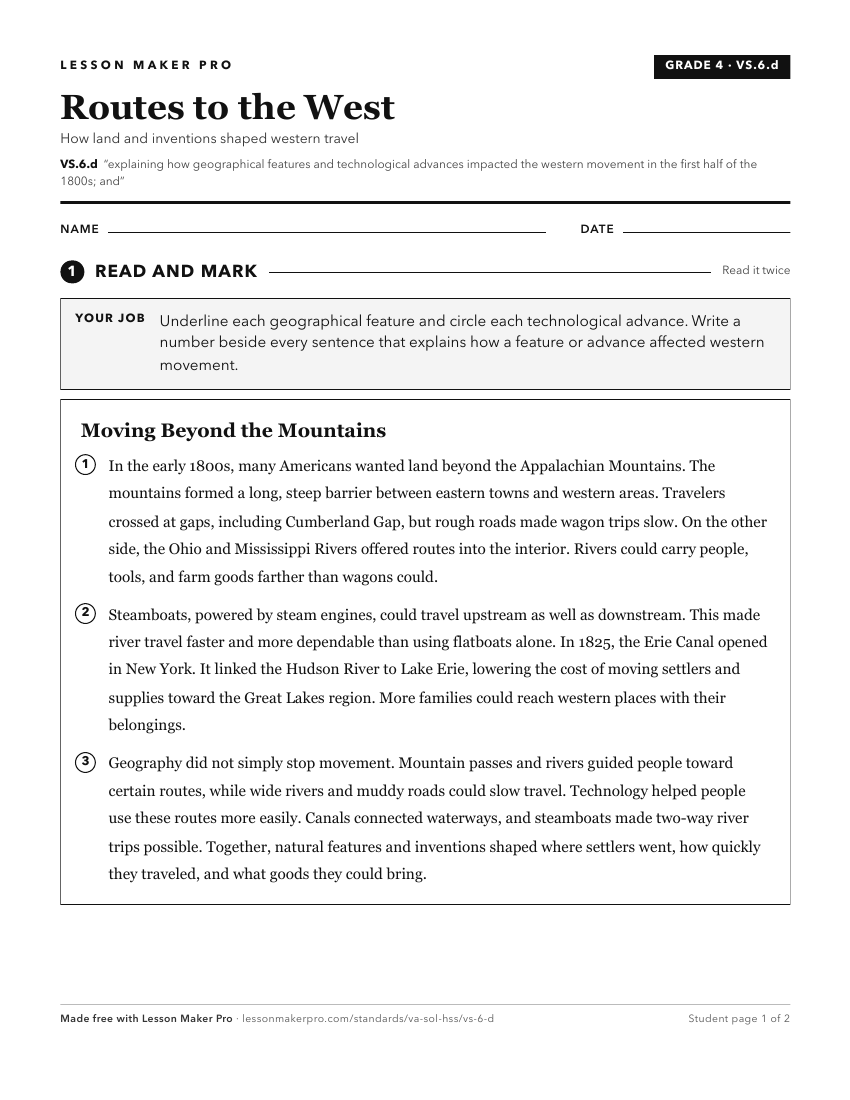
A ready-to-print activity worksheet aligned to VS.6.d, with an answer key for the teacher on its own page. No account needed.
PDF, US Letter, prints cleanly in black and white.
Download the worksheetKeep exploring
Related Standards
- USI.8.e
explaining technological advancements and innovations and their effects on life in America including, but not limited to the cotton gin, the reaper, the steam e...
- USII.1.a
explaining how technology allowed settlers to adapt to the physical features and climate of the West
- USI.8
The student will apply history and social science skills to explain westward expansion and reform in America from 1801 to 1861 by
- VS.9.a
explaining the importance of railroads, waterways, new industries, and the growth of cities to Virginia’s economic development in the late 1800s
Turn this exact standard into a lesson
Grade, subject, topic, and the complete standard are prefilled. Create one free, no account needed.
Also for this standard:Make a WorksheetMake a QuizMake a Sub Lesson